
Insider Peek 28: Earth Songs and the Rhythms That Connect Us
The Earth Songs collection feels like nature translated into rhythm. It is also inspired by the song Earth Song by Michael Jackson.
Not nature as a landscape with a horizon line. Not nature as a flower, animal or tree that can be named immediately. This series moves differently. It looks beneath and beyond the obvious forms of the natural world, into patterns, pulses, cells, coral, roots, constellations, movement and the invisible energies that connect one thing to another.
When I look at the Earth Songs collection, I feel that it is about interconnection.
It is also about transformation.
The paintings are abstract, but they do not feel detached from life. They feel alive with it. Dots gather like cells. Lines travel like roots, rivers or neural pathways. Organic shapes drift between microscopic and cosmic space. Some areas feel botanical, some marine, some almost galactic. The series reminds me that nature is not only what we see on the surface. Nature is also pattern, repetition, emergence, movement and relationship.
That is why I think of these paintings as songs.
A song is not one note. It is rhythm, variation, pause, return, surprise and harmony. Earth has its own songs too: tides, seasons, growth rings, coral branches, seed pods, rain, migration, heartbeat, breath, decay and renewal. We may not always hear them as music, but they are there.
In this series, I wanted colour and form to carry that sense of living rhythm.
Why Abstract Nature Matters to Me
Abstract painting gives me a different kind of freedom.
With representational work, the subject often gives me a clear starting point: a cat, a koi, a flower, a fruit, a familiar food. I still interpret the subject emotionally, but the visible form anchors the painting. With abstraction, the anchor is more internal. It begins with movement, colour, memory, sensation or a pattern that wants to unfold.
That can feel more mysterious.
It can also feel closer to how nature actually works beneath the surface.
A flower is beautiful, but before the flower there is root, cell division, moisture, minerals, light and timing. A coral reef is beautiful, but it is also countless tiny organisms building structure together. A body is visible, but it is also circulation, breath, nerves, cells and unseen communication. A city is visible, but it is also people, histories, cultures, routes and shared rhythms.
The Earth Songs paintings live in that hidden space.
They are not diagrams. They are emotional interpretations of patterns I sense everywhere: growth, connection, collision, blossoming, dissolving, gathering, scattering and beginning again.
Melting Pot and the Energy of Convergence
Some paintings in this series speak not only of nature, but of society as a living organism.
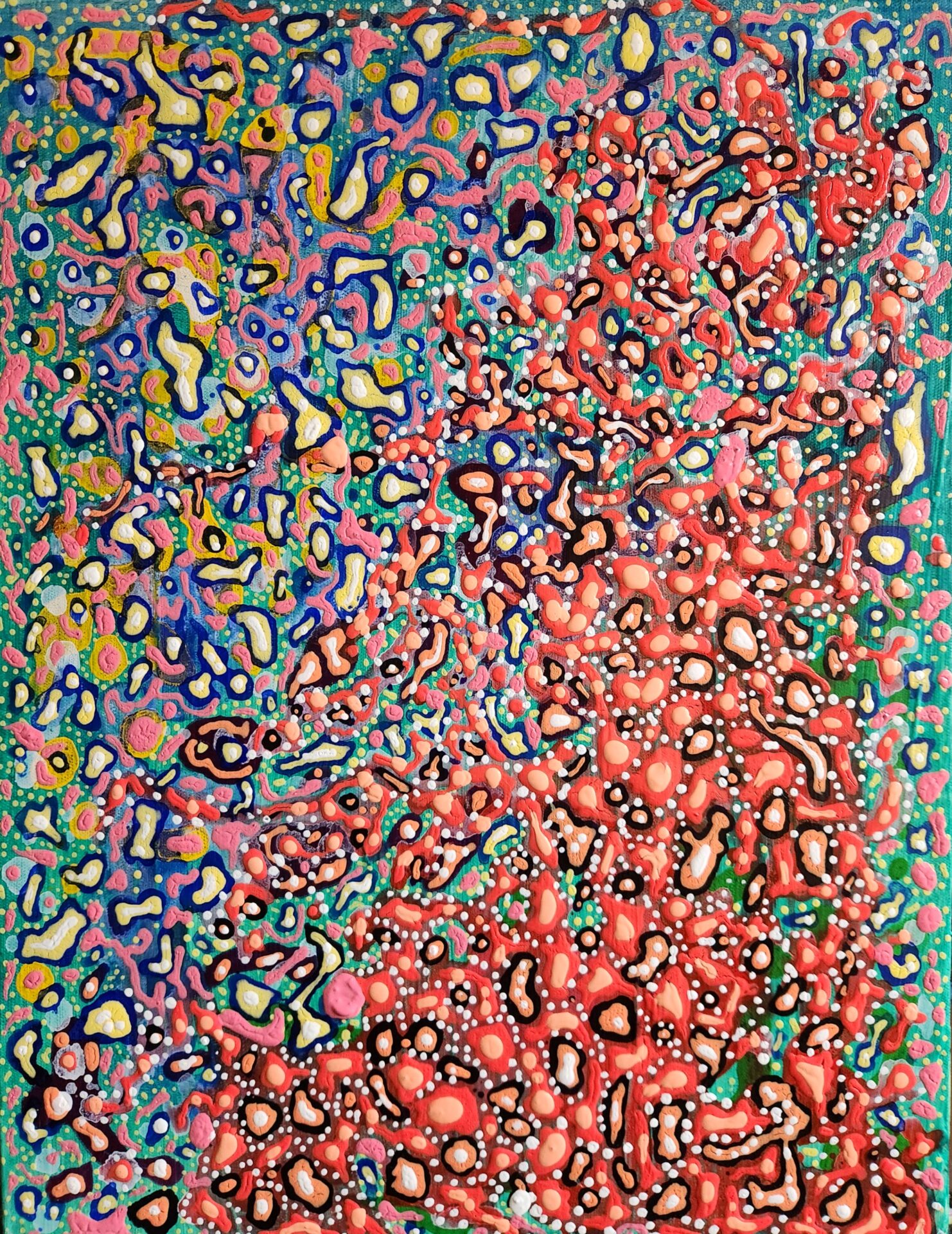
Melting Pot feels especially meaningful because it reflects Singapore as a place of convergence. Overlapping shapes, saturated colours and energetic marks suggest cultures meeting, identities layering, and many different lives moving within one shared space.
A melting pot is not smooth in a simple way. It has edges, contrasts, histories, flavours and tensions. It is alive because different elements do not disappear completely into sameness. They interact. They influence one another. They create something that could not exist if every part remained separate.
This connects deeply with the larger spirit of Earth Songs.
Nature also works through convergence. Soil is a meeting place. A reef is a gathering. A forest is a network. A city is another kind of ecosystem. Nothing truly exists alone.
When I painted Melting Pot, I wanted that sense of collective energy to feel bright and generous. The painting does not need to explain Singapore literally. It carries the feeling of a place built through layers: heritage, movement, adaptation, resilience and shared belonging.
It is abstract, but to me, it is full of life.
Atomic Nature and the Invisible Networks of Life
The Atomic Nature works are about looking at life through another scale.
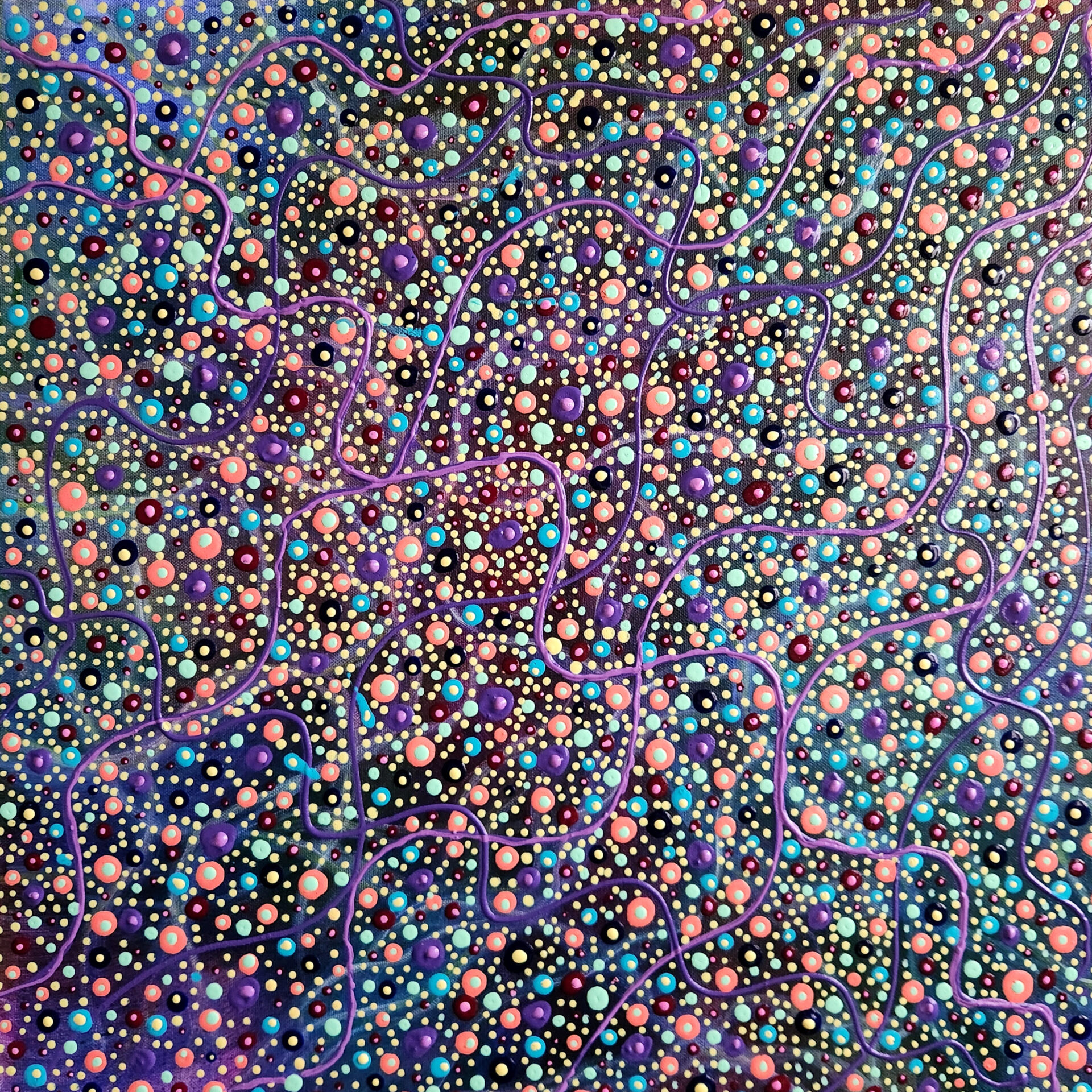
Atomic Nature 1 feels like a map of unseen relationships. Colourful dots and winding lines move across a dark ground, suggesting cells, constellations, roots or pathways. I like that it can be read in more than one way.
That openness matters.
Sometimes the microscopic and the cosmic look strangely related. A cell cluster can resemble a star field. A root network can resemble lightning. Coral can resemble branching blood vessels. The same visual language appears again and again across different scales of life.
That is one of the ideas I love most in this series.
Nature repeats itself, but never mechanically. Patterns return with variation. A spiral, a branch, a cluster, a pulse. We see echoes of the same intelligence everywhere, from the smallest organism to the largest landscape.
In Atomic Nature 1, I wanted the dots and lines to feel active, as if communication is happening across the canvas. The painting is not still in the quiet sense. It is still like a paused moment inside a living process.
Something is forming.
Something is connecting.
Something is becoming visible.
Atomic Nature 2 and the Field of Open Connection
Some abstract paintings feel like entering a field rather than looking at an object.
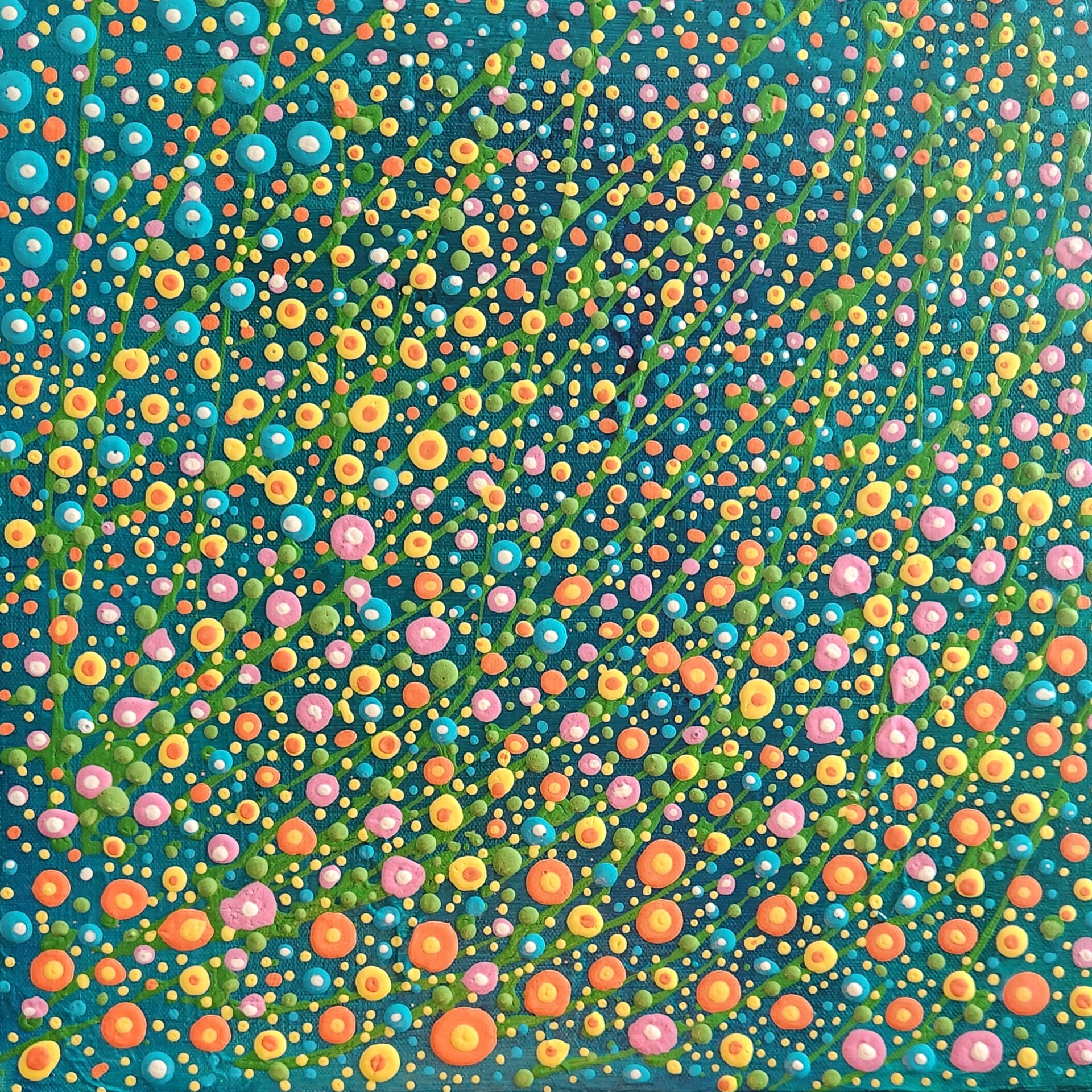
Atomic Nature 2 has that sense of field. The blue ground allows the dots and branching pathways to feel suspended, almost like coral formations, constellations or organisms moving through water.
I enjoy paintings that refuse to settle into only one meaning.
A viewer may see sea life. Another may see growth. Another may see cells. Another may see a sky full of strange stars. This ambiguity is not confusion to me. It is invitation. It lets the painting remain alive each time someone returns to it.
The dots in this work are important because they create rhythm. One dot alone is simple. Many dots together become movement, density, pattern and relationship. The eye begins to travel from one cluster to another, sensing connections even where lines do not explicitly draw them.
This is how life often feels.
We are connected in ways we cannot always see.
Atomic Nature 3 and the Motion of Becoming
Growth is not always neat.
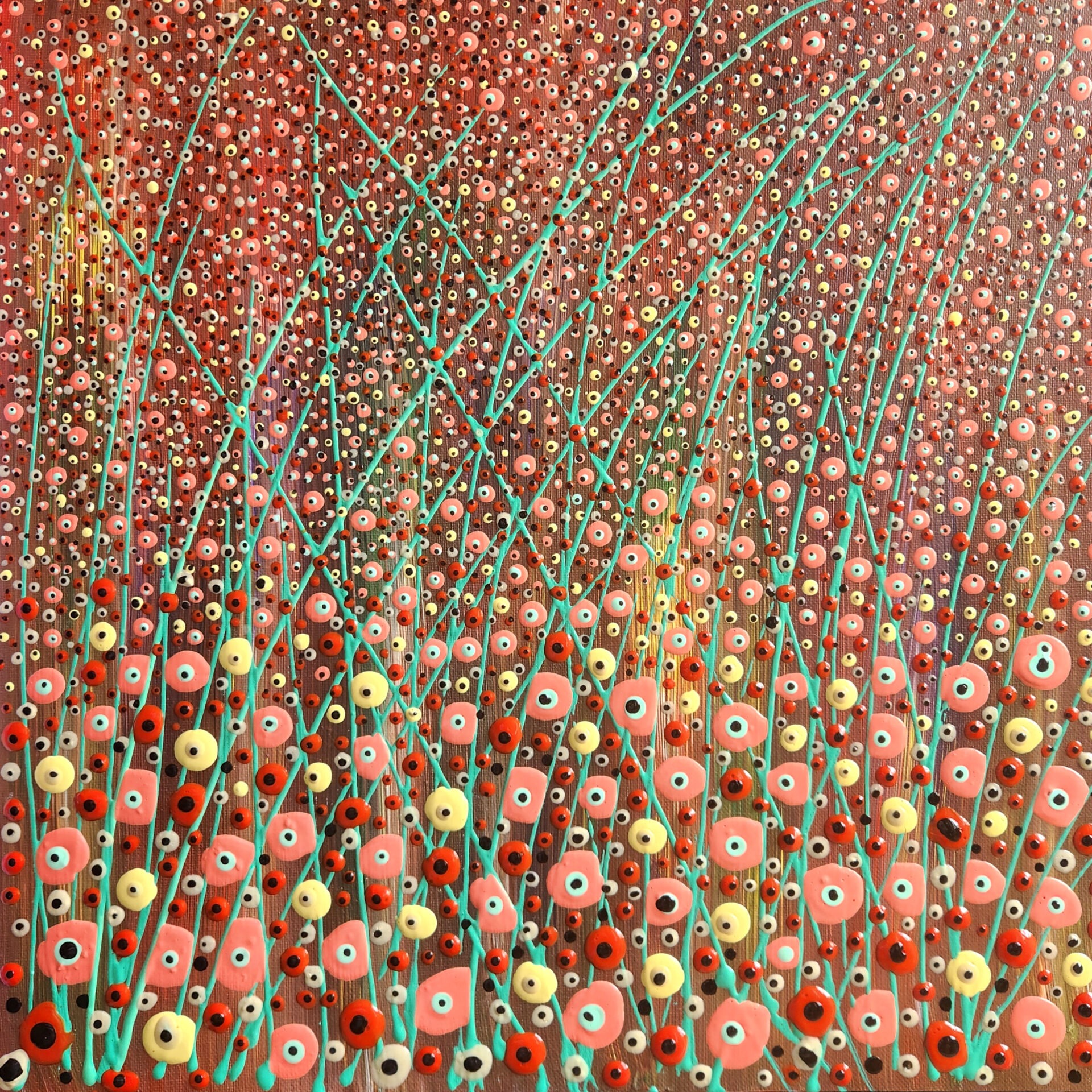
Atomic Nature 3 carries a more botanical energy for me. The forms seem to rise, branch and bloom. There are dots, stems, organic shapes and a sense of upward motion, as if the painting is caught in the middle of becoming.
I like that word: becoming.
Nature is rarely finished. A bud is becoming a flower. A seed is becoming a plant. A reef is building itself. A wound is healing. A person is changing. Even decay becomes part of the next cycle of growth.
This painting reminds me that transformation is not always tidy. It can be layered, messy, bright, uneven and full of surprising turns. Some parts of the canvas feel dense. Others open into space. That is how growth often happens in life too.
We do not become in straight lines.
We branch.
Atomic Nature 4 and the Poetry of Evolving Life
Some forms feel as if they are floating between worlds.
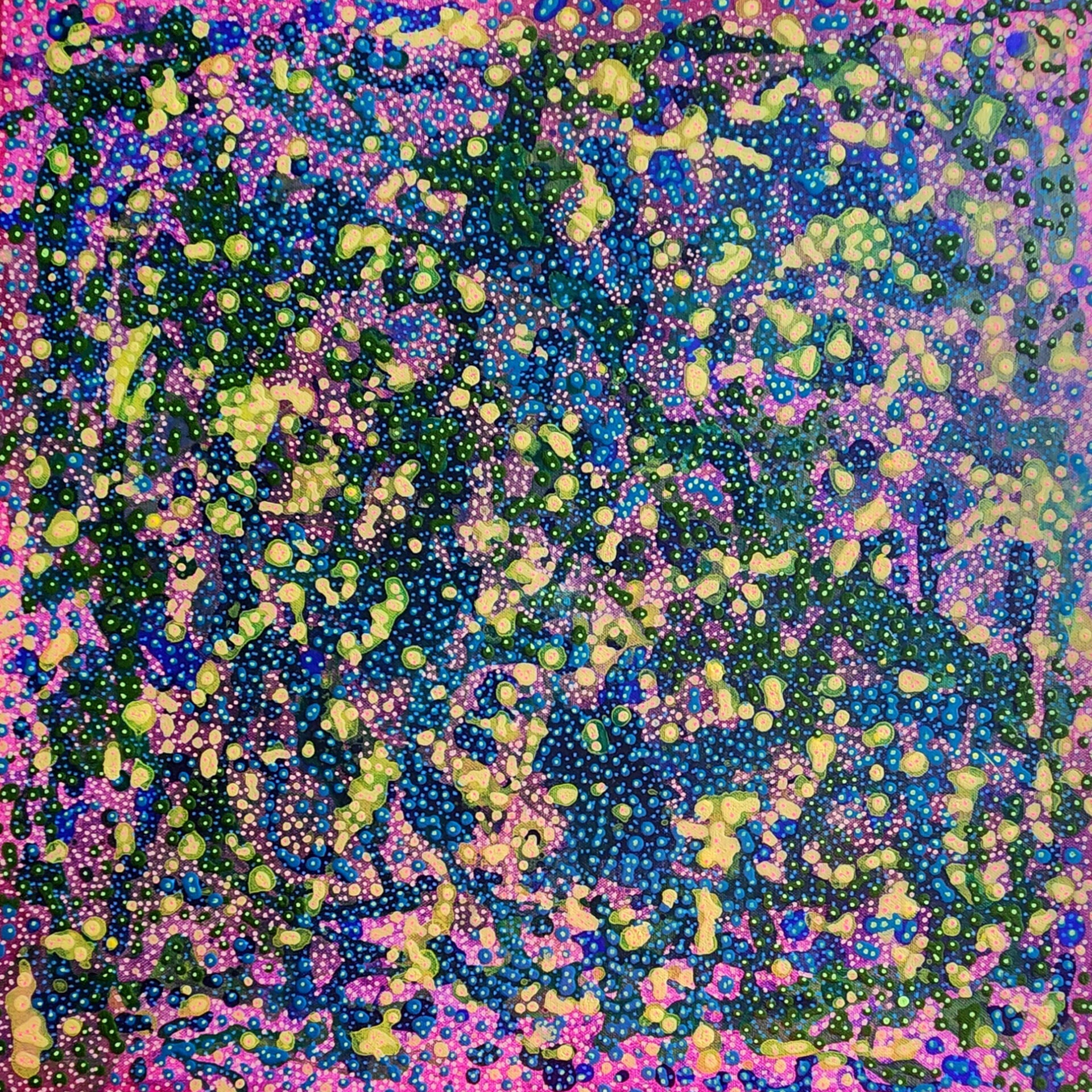
Atomic Nature 4 has amoebic shapes and bright layers that seem to drift between microscopic and cosmic space. It could be seen as cells moving under a lens, or planets in a strange orbit, or fragments of organic life carried by water.
That in-between quality is very important to me.
I do not always want abstraction to answer the viewer too quickly. I want it to keep opening. When a form can suggest several things at once, the imagination has room to participate. The painting becomes less like a statement and more like a conversation.
The colours in this piece feel playful but also alive with motion. Blue, green, yellow and pink tones create a sense of energy moving through the surface. The dots add detail, almost like tiny signals or particles.
It makes me think of life at the edge of visibility.
The things happening before we have words for them.
Atomic Nature 5 and the Boldness of Organic Growth
There is a confidence in growth when it finally pushes outward.
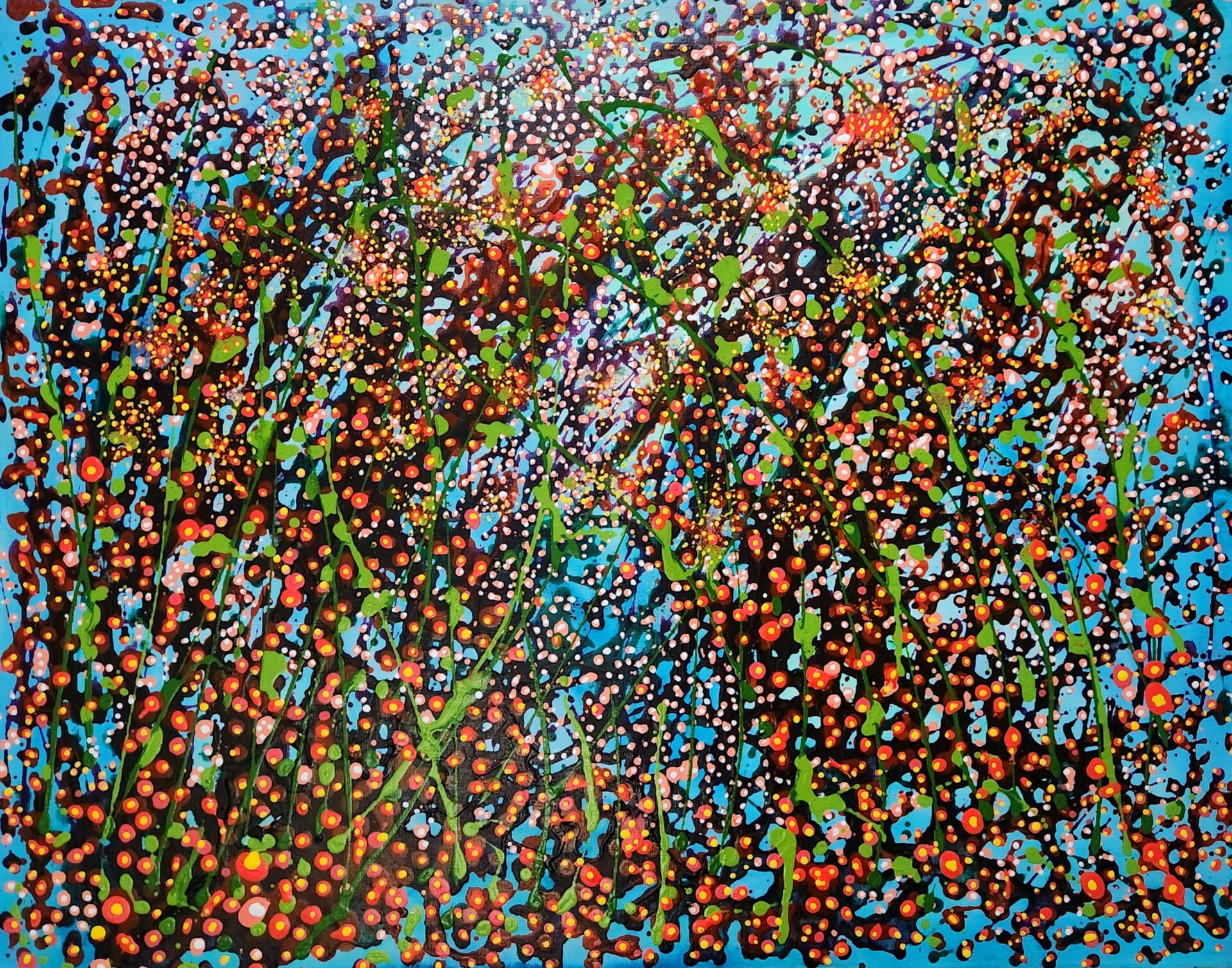
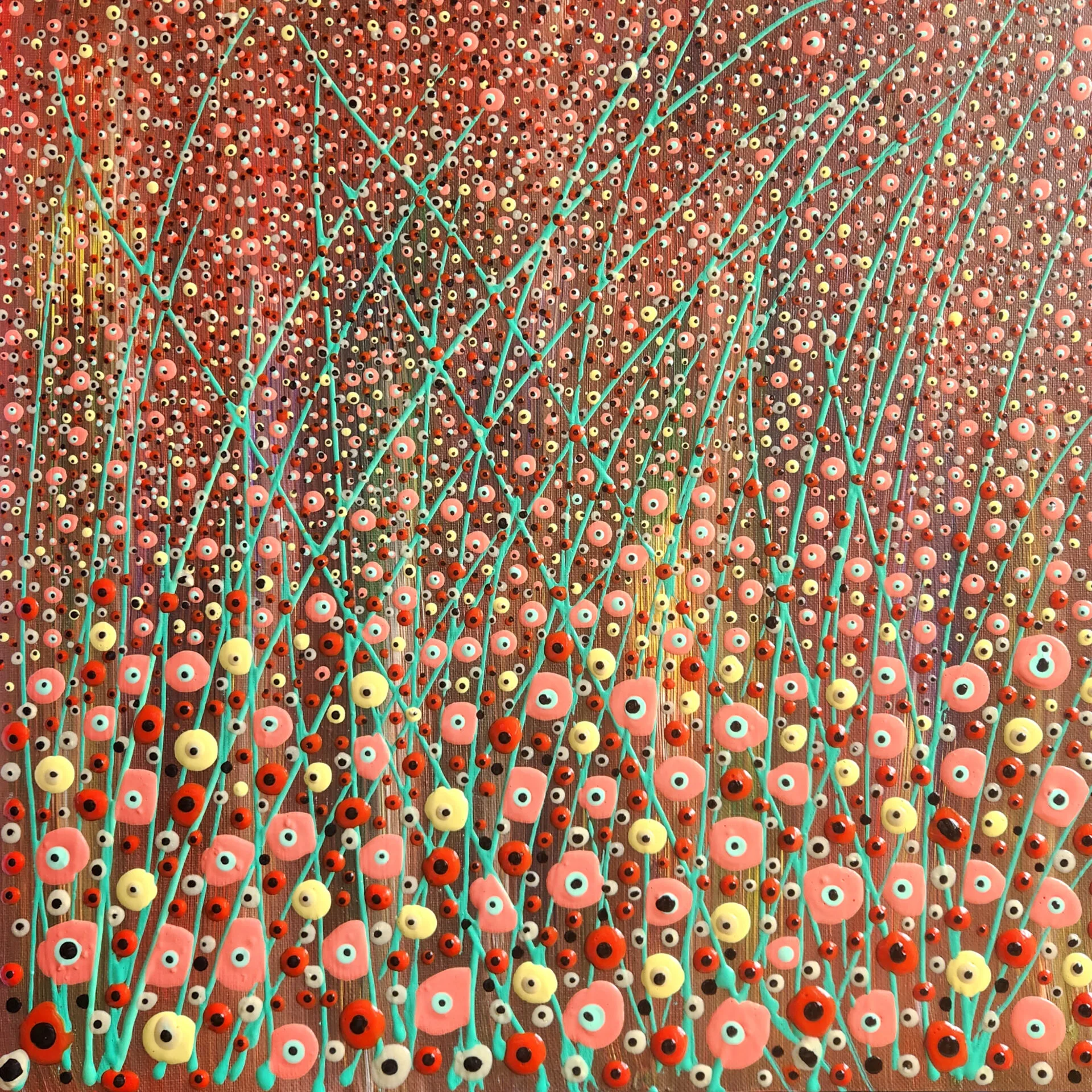
Atomic Nature 5 feels abundant and bold. Green lines, colourful dots and blooming forms suggest petals, stems, dew, cellular structures and plant life all at once.
This is one of the reasons I enjoy the Atomic Nature works as a group. They do not separate the flower from the cell, or the organism from the energy that moves through it. They suggest that beauty is not only on the outside of the bloom. It is inside the process that makes blooming possible.
There is courage in organic growth.
A form reaches. A colour expands. A line finds its direction. The whole painting feels as though it is growing its own logic as it goes.
This mirrors how I often experience the creative process. I begin with marks, colour, movement and instinct. Then the painting starts to tell me where it wants to go. I follow, adjust, layer, respond. Eventually, something appears that could not have been planned completely from the beginning.
That, too, is an earth song.
Coral Symphony and the Living Architecture of Reefs
The Coral Symphony paintings bring another layer to the collection.
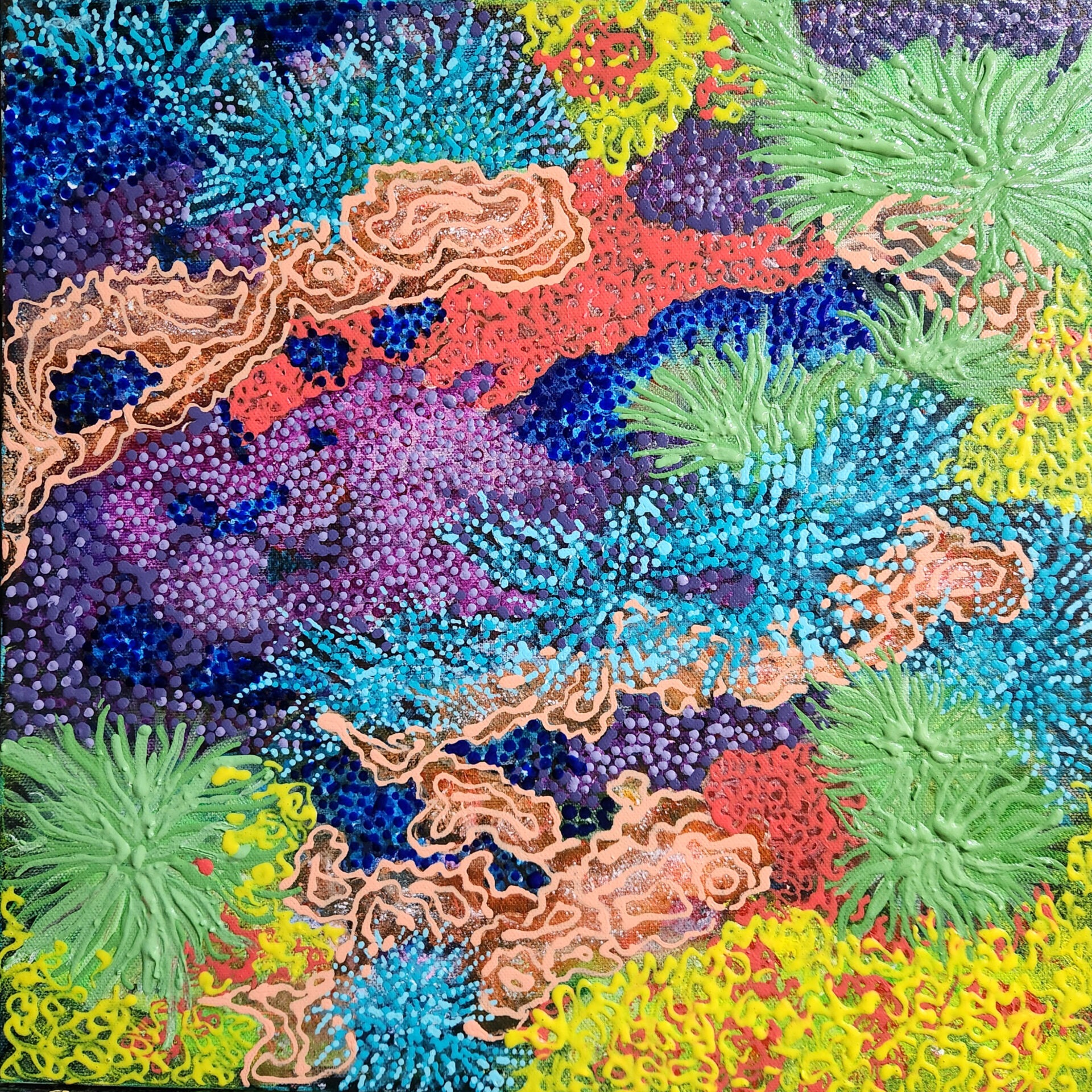
Coral Symphony 1 feels immersive, like entering an environment rather than viewing a single object. The textures and colours suggest coral formations, botanical growth and living complexity.
Coral reefs fascinate me because they are both delicate and powerful. They look like underwater gardens, but they are also living architecture. Tiny organisms build vast structures together over time. They shelter other life. They create worlds.
That idea moves me.
A reef is not made by one grand gesture. It is made through repeated small acts of building. Again and again, little by little, life creates structure. This is such a beautiful metaphor for art, healing, relationships and personal growth.
The Coral Symphony works let me explore that visual richness: branching, clustering, layering, glowing, hiding, revealing.
They are full, but they still need rhythm.
A symphony cannot be noise. It has to move.
Coral Symphony 2 and the Hidden Intricacies of Living Systems
Some paintings ask the viewer to come closer.
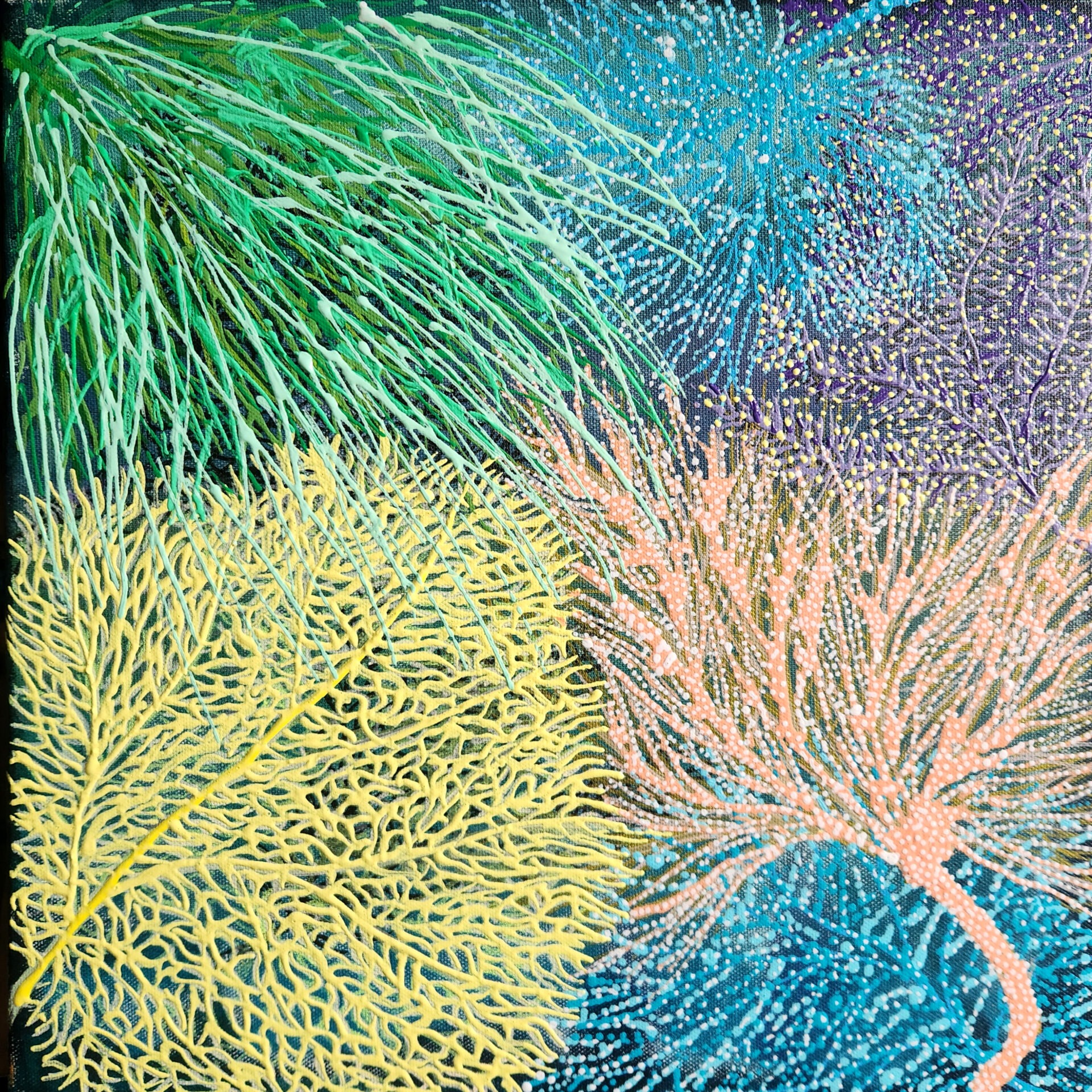
Coral Symphony 2 has a sense of layered intricacy. The forms feel coral-like, but also botanical, almost like a garden seen through water or a living system viewed from inside itself.
This ambiguity is where abstraction becomes exciting.
The painting does not say, this is one thing. It suggests relationships between things: coral and flower, growth and pattern, water and garden, complexity and harmony. It asks the eye to move slowly because there is no single centre that explains everything.
That feels true to nature.
Living systems are not always arranged around one obvious centre. They spread, adapt, respond and interdepend. A reef, a forest, a body, a community, a creative life: each one has many points of activity happening at once.
The beauty is in the relationships.
Coral Symphony 3 and Underwater Energy
Some works in the series feel especially marine.
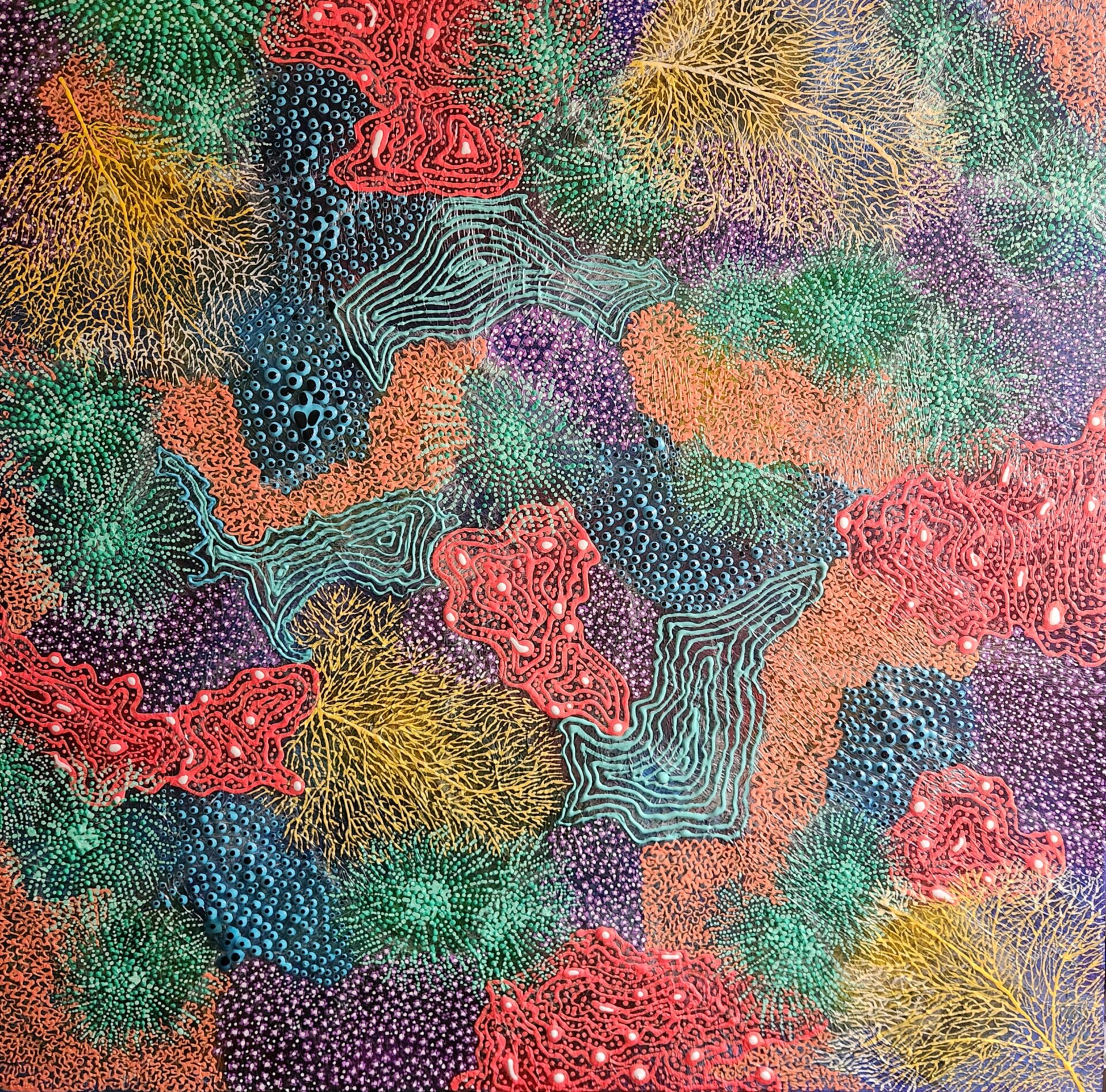
Coral Symphony 3 carries that underwater energy strongly. The layered colours and coral-like forms create a sense of movement beneath the surface. It feels like life multiplying, branching and singing in colour.
I think this painting connects to my love for underwater worlds too. The ocean holds mystery in a way that is both calming and overwhelming. Coral reefs are especially wondrous because they are so full of life, yet so vulnerable. They remind us that beauty can be intricate, collective and fragile all at once.
To paint coral abstractly is not to copy a reef exactly.
It is to honour the feeling of one: density, colour, shelter, rhythm, and the sense that every small form belongs to a larger whole.
What Earth Songs Signifies
To me, Earth Songs signifies the hidden music of connection.
It is about the ways life gathers itself into pattern. Dots become clusters. Lines become pathways. Shapes become organisms. Colour becomes movement. Movement becomes rhythm. Rhythm becomes a kind of visual song.
The collection also speaks about transformation.
Forms dissolve and reform. A cellular shape becomes botanical. A coral pattern becomes cosmic. A painting that begins as instinct becomes a landscape of inner and outer life. Nothing stays fixed. Everything is in conversation with everything else.
That feels deeply connected to how I understand nature.
Nature is not static scenery. It is process. It is growth, decay, renewal, adaptation and relationship. It is the visible world and the invisible systems beneath it. It is beauty and complexity. It is harmony that includes chaos.
In this series, I wanted to make paintings that feel alive with that process.
Chaos and Harmony
One of the tensions I love in these works is the balance between chaos and harmony.
Too much order, and the painting loses life. Too much chaos, and the eye cannot rest. The challenge is to let energy move freely while still creating a rhythm the viewer can enter.
That is also a life question.
How do we hold change without becoming overwhelmed? How do we allow growth without needing to control every shape it takes? How do we recognise that messiness can be part of becoming, not proof that something has gone wrong?
The Earth Songs paintings do not offer neat answers.
They offer movement.
They remind me that harmony is not the absence of complexity. Harmony is relationship within complexity.
The Inner Landscape
Although the collection is nature-inspired, I also see inner landscapes in these paintings.
The dots can feel like thoughts, memories, cells, stars, seeds, impulses, possibilities. The lines can feel like paths, connections, decisions, roots or threads between people. The layered colours can feel like emotional weather.
Abstract art allows this kind of double vision.
We may begin by looking at something that seems external, then realise we are also looking inward. A painting of cellular rhythm may become a reflection on personal growth. A coral-like surface may become a meditation on community. A cosmic pattern may become a feeling of belonging to something larger.
That is why abstraction can be so personal.
It leaves room for the viewer’s own life to enter.
A Song Made of Colour
If this collection has a sound in my imagination, it is not one melody.
It is many small rhythms layered together: dots like beats, lines like melody, colours like voices, textures like echoes. Some paintings feel bright and lively. Some feel deep and mysterious. Some feel botanical. Some feel marine. Some feel almost celestial.
Together, they form a chorus.
That is the beauty of Earth Songs for me. It does not reduce nature to one image. It listens for the patterns beneath many forms of life and lets them become colour.
In the end, this series is my way of saying that we are part of the same living rhythm.
The cell and the star.
The coral and the flower.
The city and the forest.
The body and the earth.
The inner landscape and the world outside us.
Everything is separate in one way, and connected in another.
That mystery is where the song begins.
Leave a Reply