
A painting rarely begins when the brush touches the canvas. By then, something has already been gathering.
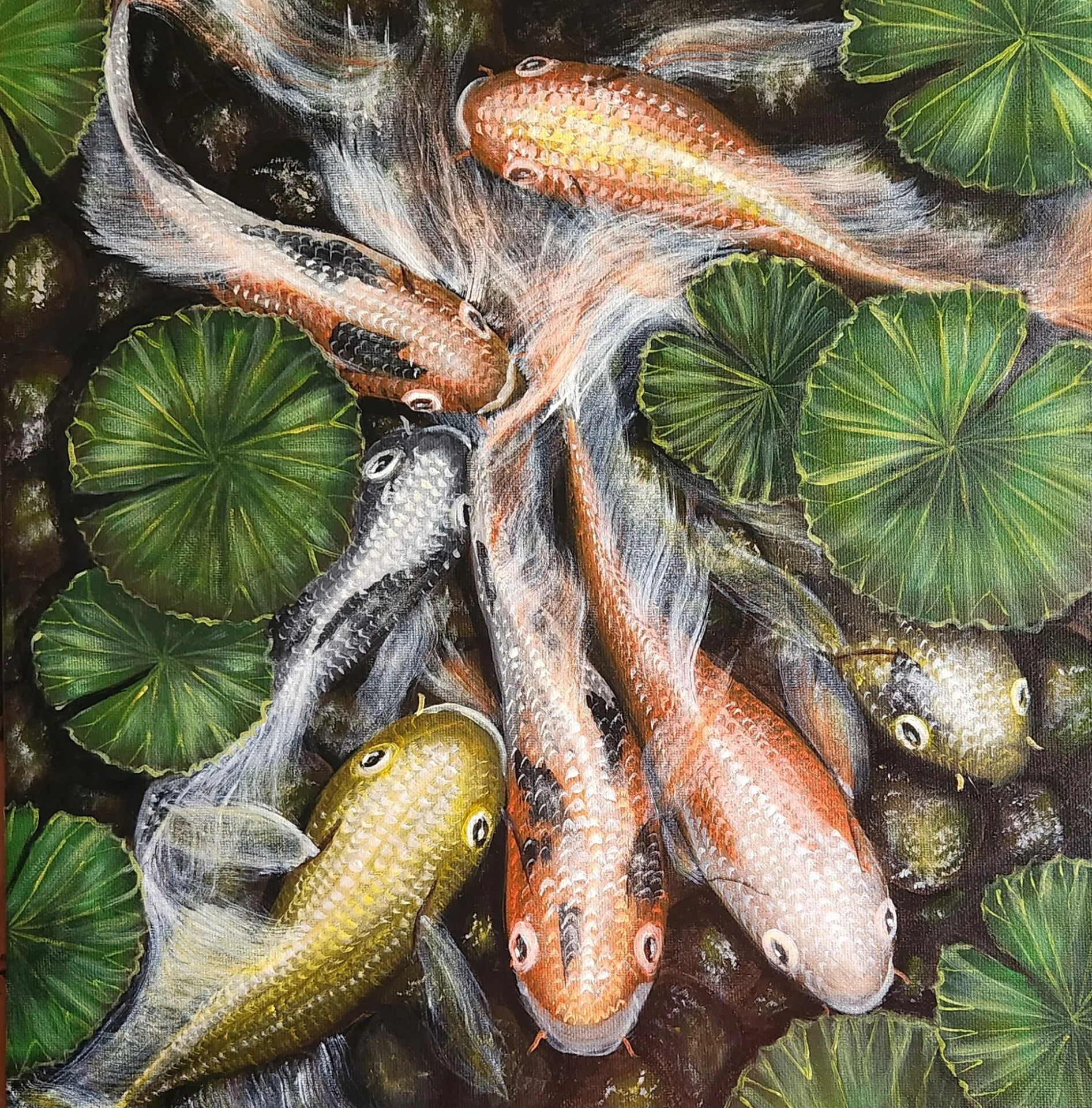
It may begin with the curve of a leaf noticed during a walk, the flash of a koi turning beneath dark water, or a colour that remains in my mind after the rest of a scene has disappeared. Sometimes it begins with an emotion for which I do not yet have words. There is no clear picture, only a pull: a sense of warmth, distance, shelter, longing, movement, or stillness that asks to be explored.
This is the most private stage of making art. There is nothing finished to show and often nothing impressive to describe. I am simply paying attention. The painting exists as atmosphere before it exists as image.
People sometimes imagine inspiration as a bright arrival, complete and undeniable. My experience is quieter. An idea usually comes as a fragment. It does not tell me what the painting should be. It asks a question: what would happen if I stayed with this?
How does a painting begin?
A painting begins by identifying the feeling or visual idea worth exploring, then gathering references, simplifying the composition, choosing a limited colour palette, preparing the surface, and placing a broad first mark. The early goal is not detail. It is to establish the painting’s mood, movement, value structure, and visual focus while leaving room for discovery.
In my studio, the process usually follows these stages:
- Notice the subject, memory, colour, or feeling that continues to call me back.
- Ask what the painting is truly about beyond its visible subject.
- Gather several references for structure, gesture, light, and atmosphere.
- Test the composition through small thumbnail sketches.
- Choose a restrained palette and decide the emotional temperature.
- Prepare the canvas with a ground that supports the intended atmosphere.
- Block in the largest shapes and values before adding detail.
- Step back, respond to the painting, and allow the original plan to change.
Before the sketch
I keep visual references, photographs, small colour notes, and sketches, but I try not to rush immediately into arranging them. First I notice what is alive in the idea.
If I am drawn to koi, for example, is it the brilliance of their markings, the grace of their bodies, or the way they appear and disappear beneath a reflective surface? Those possibilities lead to very different paintings. One might become a celebration of colour. Another might be about movement. A third might use the fish almost as a memory, partly obscured by water and light.
The subject is therefore only one part of the beginning. A painting of a bird can be about alertness, freedom, fragility, pattern, or home. A floral work can feel abundant and extroverted, or spare and inward. A landscape can describe a place, but it can also hold the emotional weather of a particular time.
Before making compositional decisions, I ask myself a few simple questions:
- What made me stop and notice?
- What feeling should remain when the details are gone?
- Where is the energy in this subject?
- What can be left unsaid?
These questions are not a formula. They help me move beneath the obvious description of a subject and closer to the reason I want to paint it.
The felt sense of an image
There is a useful phrase, “felt sense,” for the bodily impression of something that has not yet become clear language. In the studio, I often trust this kind of knowing. I may not be able to explain why one thumbnail sketch feels open and another feels cramped, but I can feel the difference in my breath and attention.
This does not mean technique is unimportant. Composition, value, colour, edges, materials, and drawing all matter. Felt sense is not a replacement for craft; it is a way of listening while craft is being used.
When I place a shape on a small sketch, I watch what happens to the whole. Does the eye have somewhere to rest? Is the movement too predictable? Does the subject feel contained, or does it seem to continue beyond the frame? I turn the sketch, crop it, simplify it, and sometimes cover parts with scraps of paper. The aim is not to produce a miniature finished artwork. It is to find the underlying rhythm.
Some beginnings arrive with a clear central subject. Others begin as a relationship between spaces: a dark mass beside a pale opening, a diagonal movement interrupted by a still form, or a cluster of detail surrounded by quiet. At this stage, three rough shapes can tell me more than thirty carefully drawn petals.
Collecting without copying
References are valuable, especially when painting animals, plants, and places whose structure deserves accuracy. Yet a reference is a source of information, not a set of instructions.
I may collect several photographs to understand how a fish turns, how a wing folds, or how light passes through a leaf. I might use one image for posture, another for colour, and my own memory for atmosphere. I want the painting to become a new visual experience rather than a copy of a single photograph.
This is one reason I do not begin with detail. Detail can make us loyal to the reference before we have discovered the painting. If I render every scale or feather too soon, I become reluctant to move the form, change the lighting, or remove an element that weakens the composition.
Instead, I look for essential character. A koi’s body is not only an outline; it is a flexible gesture moving through water. A bird is not only a catalogue of markings; it has weight, attention, and direction. A flower is not simply symmetrical decoration; it turns, overlaps, fades, and responds to light.
The more clearly I understand that character, the more freedom I have to interpret it.
Choosing the emotional temperature
Colour often enters before the final drawing. I make small mixtures or place swatches beside one another to test the emotional temperature of the idea.
A muted teal can make coral feel luminous. A warm ivory may hold a scene more gently than pure white. Deep blue-green can create depth without the finality of black. A touch of ochre may bring warmth to a palette that otherwise feels distant.
At this stage, I am less interested in finding the “correct” local colour than in finding relationships. Colours change one another. The same red can feel bright beside grey, earthy beside orange, or delicate beside a dark green. The painting’s mood grows from these conversations.
I usually limit the early palette. Too many choices can disperse the original impulse. A restrained group of colours creates a world with its own internal weather. Additional notes can come later, once that world feels stable.
I also consider how much contrast the image needs. Strong value contrast draws attention quickly and can create drama. Closer values invite a slower gaze. Neither is inherently better. The question is what serves the felt sense that brought me to the canvas.
Preparing the ground
The surface is the first physical condition of the painting. A bright white canvas can feel exposed and full of possibility, but it can also make every first mark appear louder than it is. Sometimes I begin with a thin warm or cool ground so that the entire surface already belongs to the same atmosphere.
That ground may remain visible through later layers. Small passages between brushstrokes can unify the work and give it a subtle inner light. Even when almost completely covered, the first colour influences the mixtures placed over it.
Preparing the surface is practical, but it is also a transition. I arrange the palette, choose brushes, move references to the side, and clear enough space to work. These ordinary actions allow attention to settle. The studio becomes less a room containing many unfinished tasks and more the place where this particular painting can begin.
There is often resistance here. An imagined painting contains no awkward passages. A real painting immediately does. Starting means exchanging a beautiful possibility for a specific, imperfect object.
I have learned that this is not a flaw in the process. It is the process.
The first mark is a proposal
The first mark can carry too much ceremony. If I treat it as a permanent decision, my hand becomes cautious. It is more useful to think of it as a proposal.
I place a line, mass, or broad wash and then allow the painting to answer. The mark establishes a relationship: large or small, high or low, active or still, warm or cool. The next mark responds to that relationship. Gradually, the surface becomes a conversation.
Early marks are usually broad. I block the largest value shapes, locate the main movement, and test the balance of occupied and open space. I step back often. Close to the canvas, one brushstroke can feel significant. From a distance, it may disappear or disrupt a larger rhythm.
This is also the time when the initial sketch must be allowed to change. A composition that worked at the size of my palm may feel different on a larger surface. The scale of the brush, the texture of the ground, and the physical movement of my arm introduce new information.
Following the sketch too obediently would ignore what the actual painting is offering.
Making room for uncertainty
The beginning of a painting is full of uncertainty, and not all uncertainty needs to be solved immediately. In fact, resolving everything too soon can make a work feel closed.
I try to identify which decisions are structural and which can remain open. The main placement, value pattern, and movement may need clarity. The exact edge of a fin, the number of leaves, or the final surface texture can wait.
Leaving some areas unresolved gives me room to discover connections later. A shape in the background may echo the curve of the subject. A colour mixed for one passage may become the missing note elsewhere. Paint has its own material suggestions: a run, scrape, broken edge, or translucent layer can reveal a possibility that no sketch predicted.
Uncertainty can be uncomfortable because it looks like not knowing what I am doing. Yet experience has taught me that skilled making is not the absence of not knowing. It is the ability to remain responsive while the answer develops.
There are days when that responsiveness is available and days when it is not. On difficult days, I return to small actions: mix one useful colour, adjust one large shape, or make several quick studies without asking any of them to succeed. Momentum often returns through contact with the materials.
When the painting becomes itself
At some point, a shift occurs. The painting stops feeling like an arrangement I am imposing and starts to have its own logic. Certain changes become clearly wrong for this particular work, even if they might be beautiful elsewhere. The image develops boundaries.
This moment does not mean the painting is easy from then on. It means I have something more specific to listen to. The question changes from “What could this be?” to “What does this need?”
Sometimes it needs greater clarity. Sometimes it needs disruption because the first solution is too polished or familiar. It may need a quieter background, a less descriptive edge, a warmer note, or the courage to remove a passage that took hours to paint.
The origin remains present beneath these decisions. I return to the initial felt sense and ask whether it still lives in the work. Technique can improve a surface while slowly erasing the reason for the painting. A highly resolved image is not necessarily a truthful one.
The beginning therefore remains useful throughout the entire process. It is a compass rather than a blueprint.
What viewers never need to know
Most of this history will be invisible when the painting leaves the studio. A viewer does not need to know which fish was moved three times, which layer was scraped away, or which colour changed the direction of the work.
Yet those invisible decisions create the final experience. They determine whether the eye moves or rests, whether space feels shallow or deep, and whether the subject seems merely described or genuinely present.
I love that a finished painting can hold this private history without explaining it. The work meets each viewer in a new context, carrying the marks of its making but no demand that they be decoded.
For me, an insider peek is not about revealing a secret formula. There is no formula. It is about sharing the attention behind the object: the noticing, testing, doubt, care, and repeated return that allow an image to take form.
A painting begins before I know what it will look like. It begins when something in the world, or in my inner life, becomes vivid enough to deserve company. I stay with it. I make a small mark. Then another.
Slowly, possibility becomes presence.
Frequently asked questions about beginning a painting
What should an artist do before starting a painting?
Before starting, clarify what made the subject meaningful, collect useful references, make a few small composition studies, and decide on the dominant value pattern and colour mood. These preparations create direction without removing spontaneity.
Should a painting begin with a sketch or directly with paint?
Either approach can work. A sketch is useful when placement, proportion, or a complex composition needs planning. Beginning directly with broad paint can preserve energy and encourage discovery. I often use small sketches first, then keep the drawing on the canvas loose enough to change.
What is the best first layer for a painting?
The best first layer depends on the medium and intended result. I often use a thin warm or cool ground because it reduces the glare of a white canvas and helps unify later colours. The first painted layer then establishes the largest light and dark shapes rather than finished details.
How do you overcome fear of the blank canvas?
Treat the first mark as a proposal, not a permanent decision. Use a broad brush, make several small studies, or cover the white surface with a simple ground. Fear usually becomes more manageable once the materials are moving and there is something concrete to respond to.
How do you know whether an idea is strong enough for a painting?
An idea does not need to be fully formed, but it should hold your attention. If a subject, colour relationship, memory, or feeling continues to return and opens new questions, it is usually worth exploring. A small study can reveal whether the idea has enough visual energy for a larger work.


Leave a Reply