

Insider Peek 26: Petals, Still and Wild, and the Beauty of Growing Both Ways
The Petals, Still and Wild collection feels like a conversation between two kinds of beauty.
One is arranged, tended, placed carefully in a vase. The other grows in open fields, loose and wind-touched, answering only to season, light and soil. One feels intimate, close to home, held within walls. The other feels expansive, untamed, alive with movement and sky.
When I look at the Petals, Still and Wild collection, I see flowers as more than flowers.
I see the parts of us that want order and the parts of us that long for freedom. I see the beauty of care, but also the beauty of wildness. I see the quiet grace of a bouquet on a table and the open breath of a meadow that refuses to be contained.
That is what this series signifies to me: duality, growth, tenderness and resilience.
It is about the cultivated and the wild living side by side.
Why Flowers Keep Returning
Flowers are familiar subjects in art, but they never feel exhausted to me.
A flower is delicate, but not weak. It can be brief, but meaningful. It can be arranged by human hands or scattered by nature. It can mark celebration, grief, love, apology, remembrance, devotion, renewal, season and ordinary domestic beauty.
This is why I keep returning to flowers.
They carry emotion without needing to explain themselves. A vase of daisies can feel sincere. Poppies can feel bright and animated. Pansies can feel expressive, almost like little faces turned toward us. Tulips can feel graceful and restrained. Wildflowers can feel joyful, rebellious and alive in the wind.
In a flower painting, I am not only painting petals.
I am painting a state of being.
The difference between a flower in a vase and a flower in a meadow is not only location. It changes the whole emotional atmosphere. A vase creates focus. It asks us to look closely. A wild field creates immersion. It asks us to feel surrounded.
Both have their own wisdom.
The Stillness of the Vase
A bouquet in a vase carries human intention.
Someone has chosen the flowers, gathered them, arranged them, placed them somewhere they can be seen. There is care in that. There is a desire to bring nature indoors, to make beauty part of daily life, to hold something fleeting for a little while.
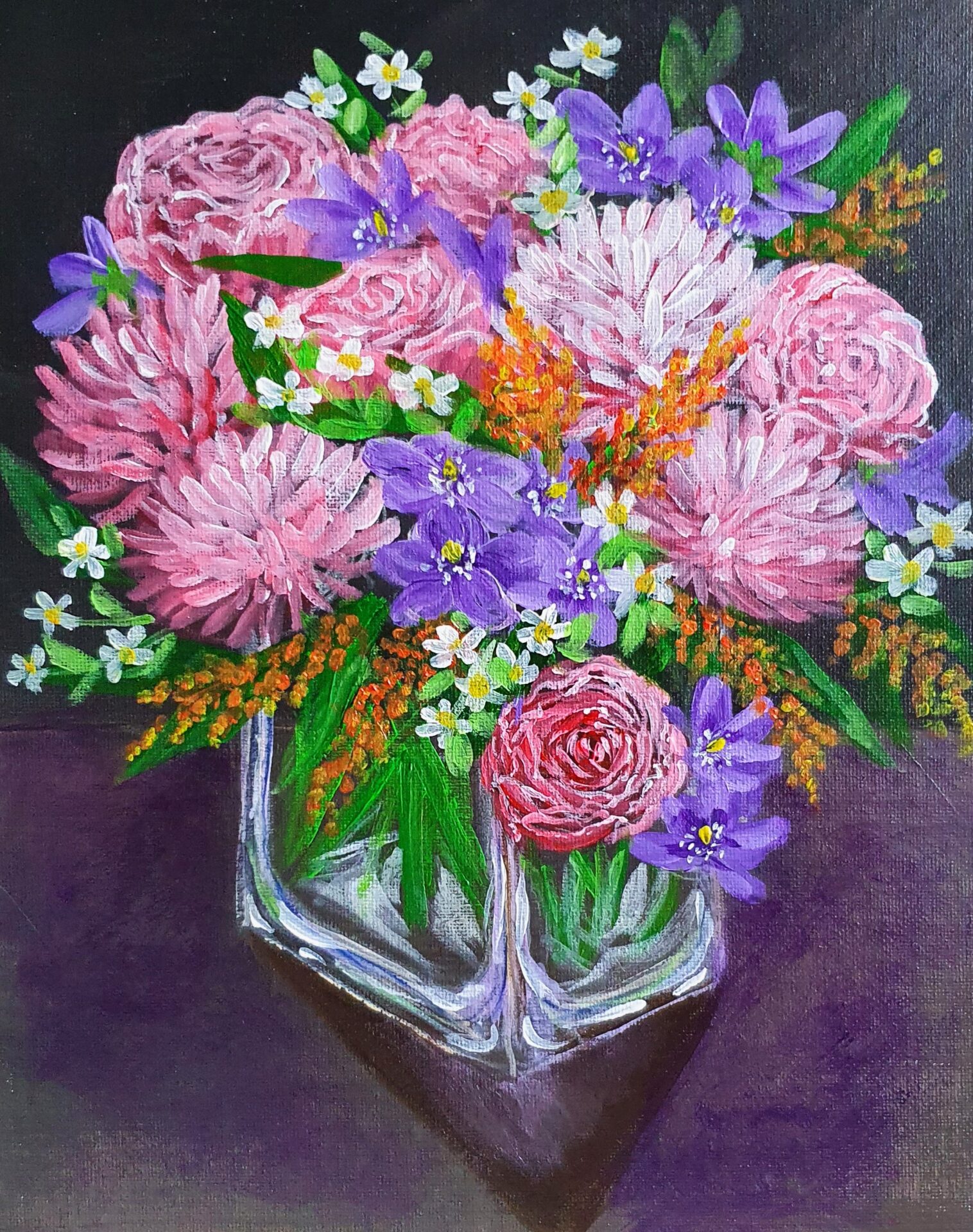
Bouquet of Flowers represents this side of the collection beautifully. The flowers are generous but held together. Each bloom has its own colour and form, yet the vase gives the arrangement coherence. There is variety, but also structure.
I think this is why bouquets feel comforting.
They remind us that beauty can be cared for. It can be brought close. It can sit quietly on a table and change the mood of a room. A bouquet does not need to be dramatic to have presence. It can simply be there, softening the edges of a day.
In painting a vase, I am also painting containment. Not restriction in a negative way, but the kind of container that allows something delicate to be seen. The vase holds water. It steadies the stems. It gives the flowers a temporary home.
Sometimes we need that too.
A place to gather ourselves. A shape to rest in. A little order around our tenderness.
Wildflowers and the Freedom to Bloom
Wildflowers speak in another voice.
They do not ask for arrangement. They grow where the conditions allow, often in places that are not polished or planned. They appear in fields, slopes, roadside edges, mountain meadows, patches of green that become suddenly alive with colour.
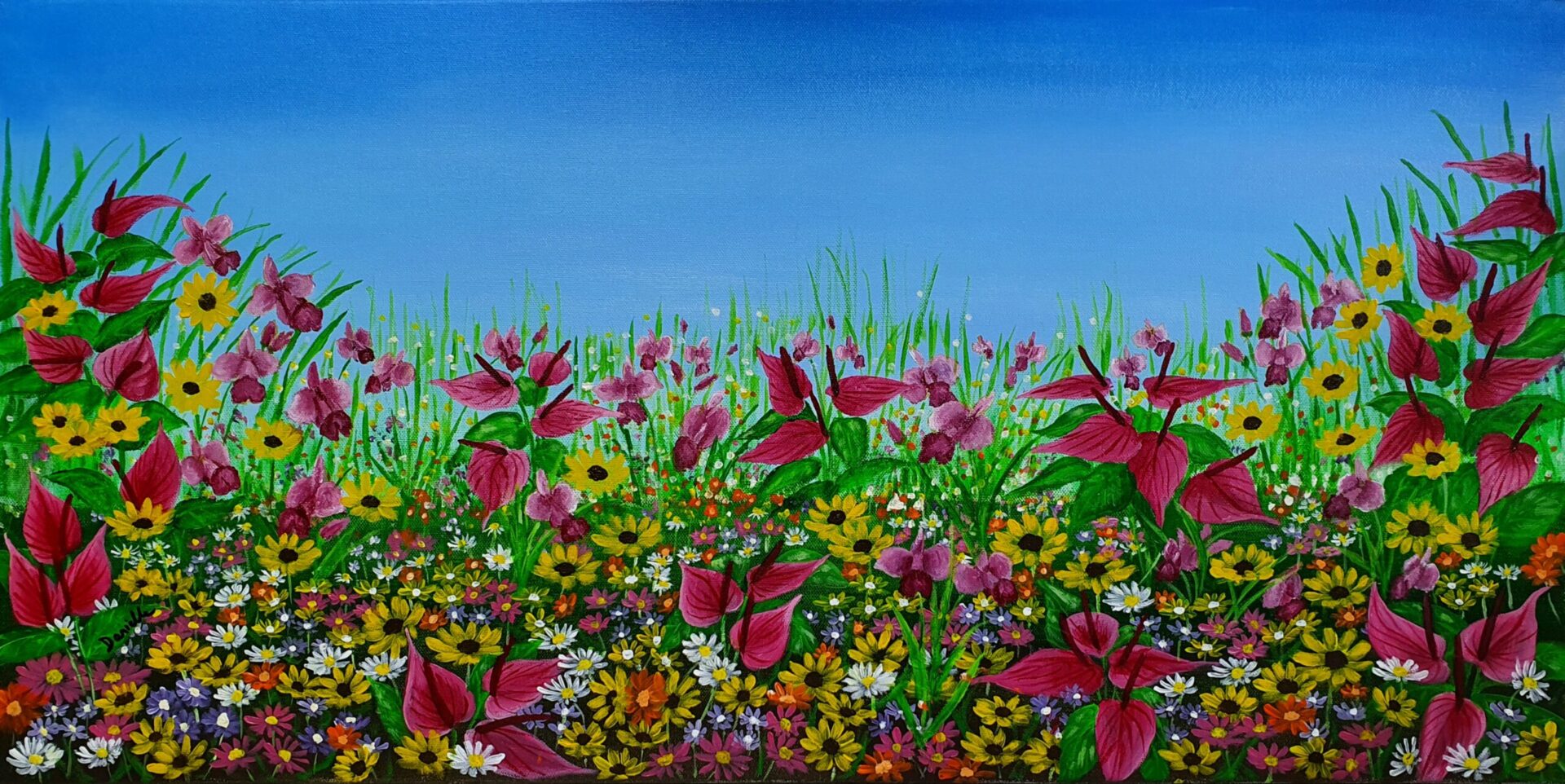
Wild Flowers 5 has that open feeling. The flowers move across the pasture with energy. Reds, yellows and whites create rhythm against the green, while the sky gives the painting a sense of air.
This is the wild side of the collection: not chaotic in an ugly way, but alive in a way that cannot be over-controlled.
Wildflowers remind me that growth does not always need permission. A bloom may be small, but it still insists on appearing. It may not be arranged by anyone, but it still contributes to the whole field. It may last only a season, but while it is here, it transforms the place around it.
There is resilience in that.
To bloom in the wild is to accept uncertainty: weather, wind, uneven ground, competition, exposure. And yet the flowers rise. Not because everything is perfect, but because life keeps moving toward light.
That is a kind of courage.
Meadow Serenity and the Spaciousness of Nature
Some wildflower paintings carry joy. Others carry a deeper kind of calm.
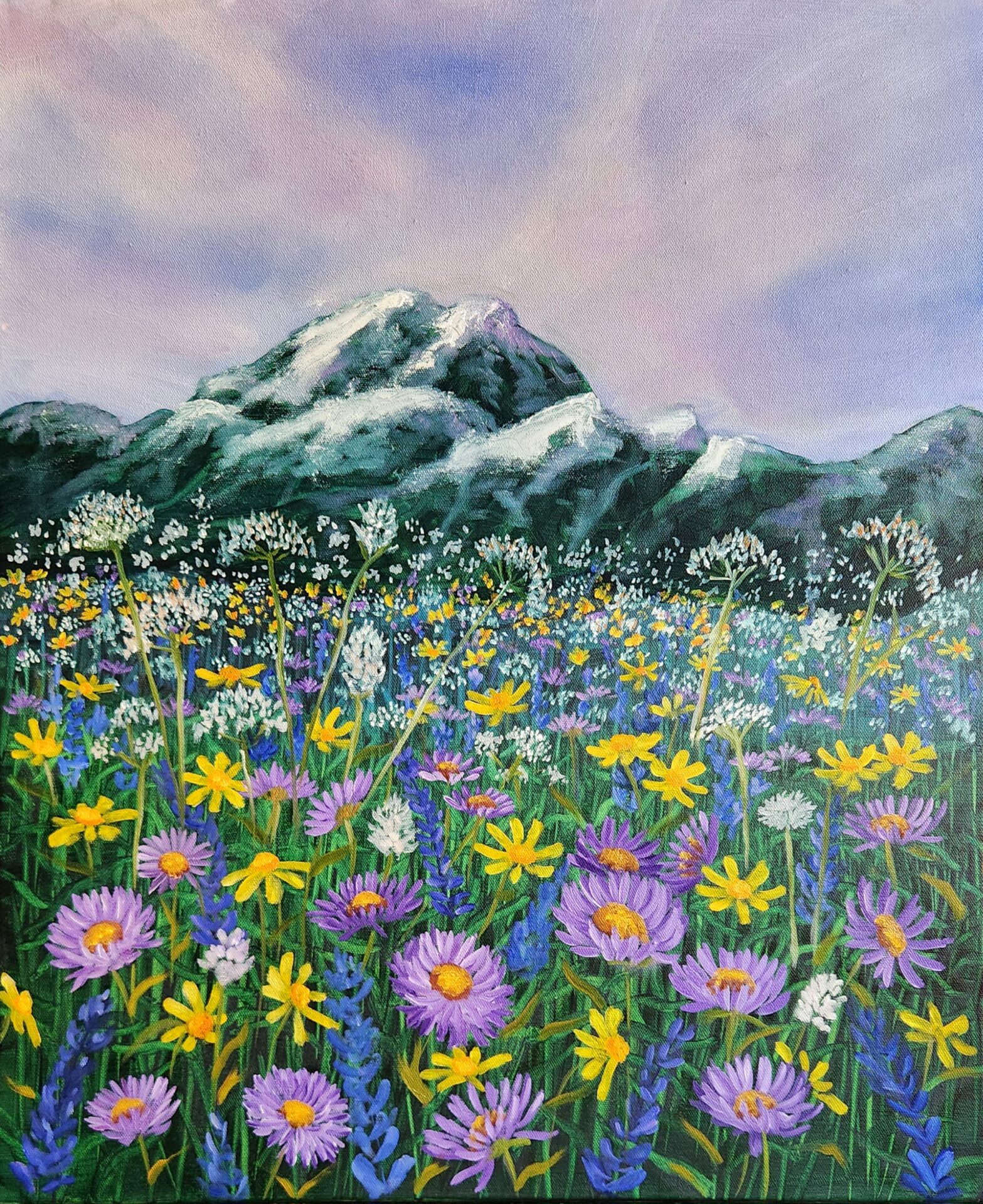
Meadow Serenity feels like a breath. The wildflowers in the foreground bring colour and immediacy, while the mountains introduce steadiness and distance. The scene feels alive, but also spacious.
I love this contrast.
Flowers are temporary. Mountains feel ancient. Flowers bend in the wind. Mountains hold still. Flowers bring colour close to the eye. Mountains pull the gaze outward and upward.
Together, they create balance.
This painting makes me think about the relationship between our brief, vivid moments and the larger landscapes that hold us. Our joys may be small and seasonal, but they still matter. A meadow bloom does not last forever, but while it blooms, it belongs fully to the mountain air.
That is one of nature’s teachings: impermanence does not make beauty less real.
Sometimes it makes beauty more precious.
Daisies and the Honesty of Simplicity
Not every flower needs drama.
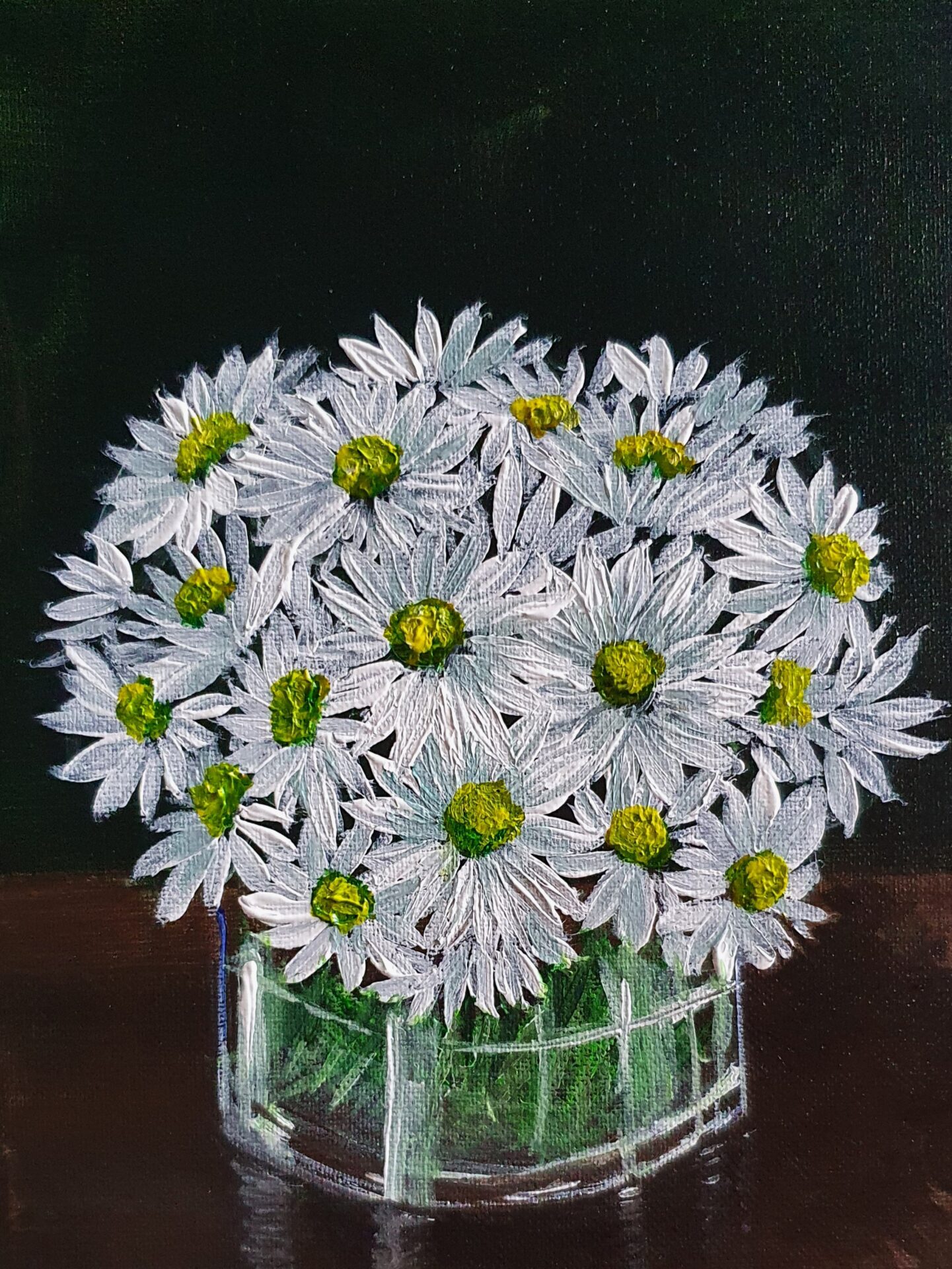
Daisies is one of the quieter works in the collection. The white petals stand against a darker background, giving the bouquet presence without making it loud. The glass vase keeps the arrangement grounded and familiar.
Daisies feel sincere to me.
They do not have the heavy romance of roses or the theatrical flourish of some flowers. Their beauty is open-faced, modest and clear. Painting daisies is an exercise in not overcomplicating. The petals, centres, stems and vase all ask for attention, but the emotional tone remains simple.
There is something beautiful about that kind of simplicity.
In life, we often underestimate what is plain and steady. We chase the rare, the dramatic, the impressive. But daisies remind me that sincerity has its own radiance. A simple flower can still hold light. A small bouquet can still change a room.
Stillness does not have to be empty.
It can be honest.
Poppies and Animated Tenderness
Poppies bring more movement.
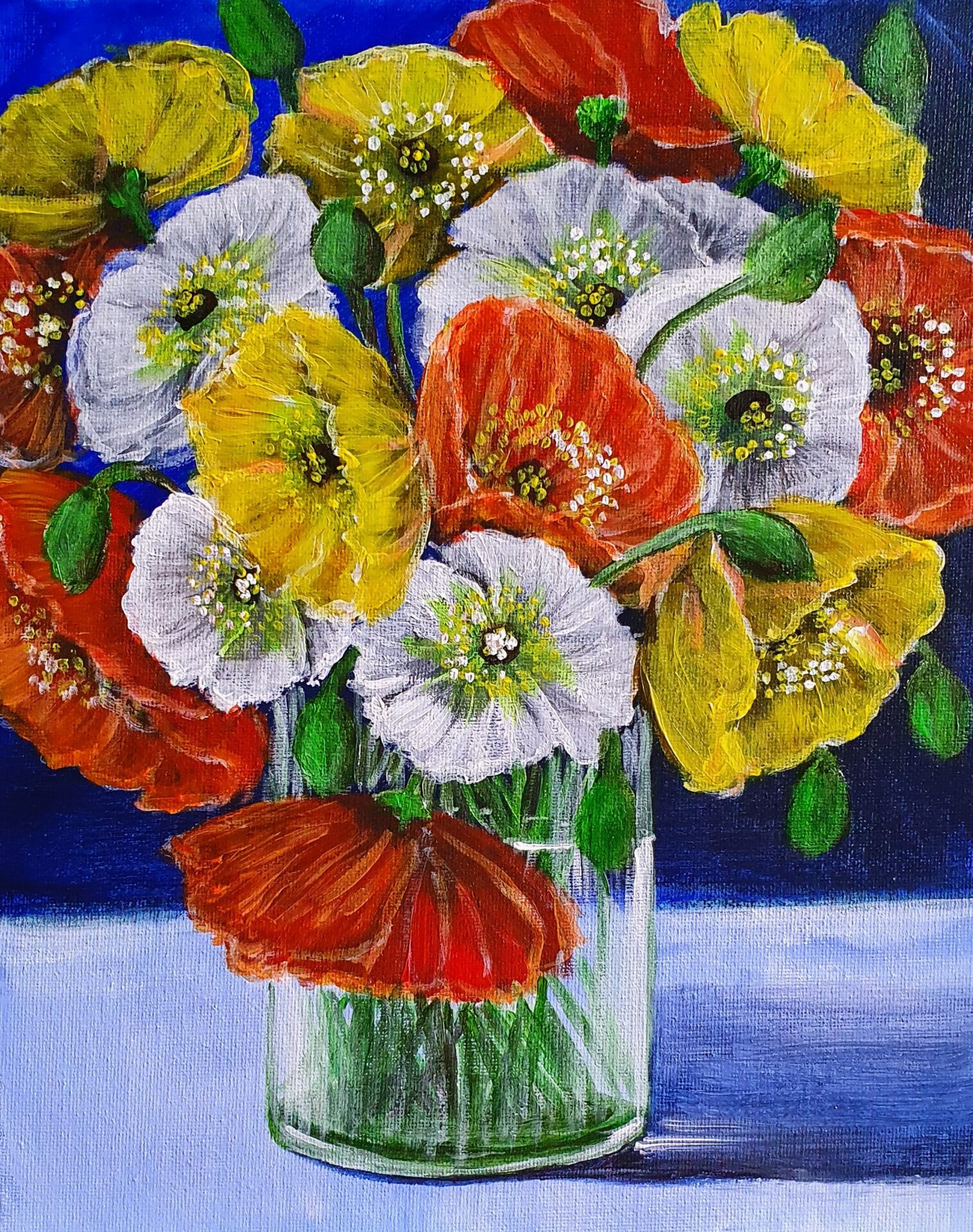
In Bouquet of Poppies, the flowers feel bright and animated. Yellow, orange and white blooms stand against a deep blue background, creating a lively contrast. The vase holds them, but the petals still seem to move.
This is where the line between still and wild becomes interesting.
A flower can be in a vase and still feel untamed. A bouquet can be arranged and still carry looseness. Poppies have that quality. Their petals feel light, almost like they could flutter if the air shifted.
I like this because it reminds me that order and freedom are not opposites in a simple way. We can have structure without losing life. We can be held without becoming rigid. We can be arranged by circumstance and still keep some movement inside us.
The poppies seem to say: even here, I am alive.
Pansies and Individuality Within Harmony
Pansies have personality.
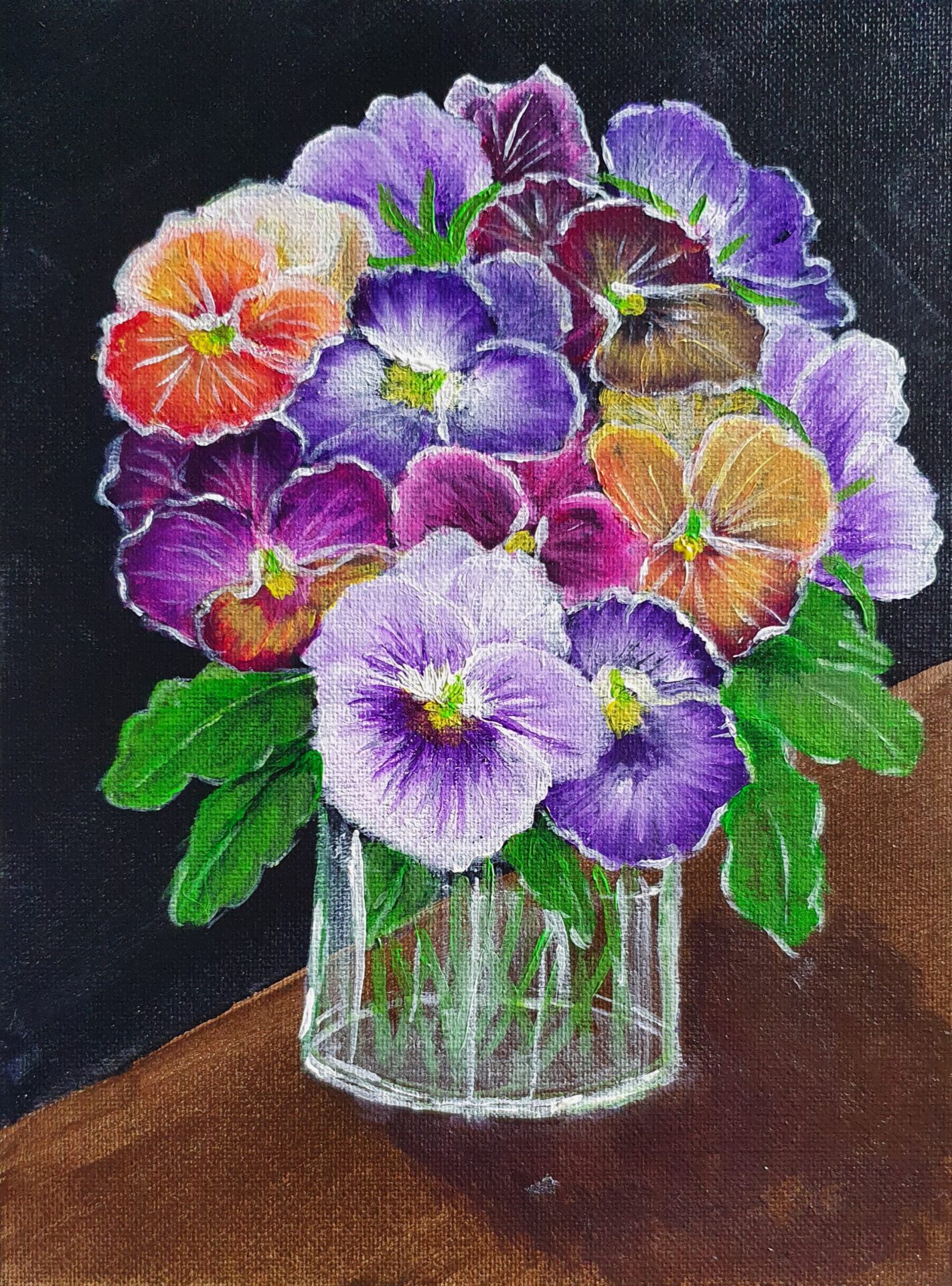
Bouquet of Pansies feels expressive because each flower has a slightly different face. Pansies often look as though they are looking back. Their colours and markings give them character, and together they create a bouquet full of variation.
This painting makes me think about individuality within harmony.
A bouquet is not a crowd where each flower disappears. If painted with care, it becomes a gathering. Each bloom contributes something distinct. One may be brighter. One may be turned away. One may sit quietly at the edge. Together, they create the fullness of the arrangement.
That is also true of wildflower fields.
Beauty often comes from many differences living together.
Oreo Among Flowers and the Invitation to Pause
There are also pieces in this collection that bring a personal, playful tenderness into the floral world.

Oreo Smelling Flowers 1 holds a different kind of meaning for me. It is an imagined scene of Oreo among flower pastures, taking in the sight and smell of the blooms. There is humour in it, but also sweetness.
This painting says something very simple that I still need to remember:
Take time to smell the flowers.
That phrase can sound like a cliche until life becomes too busy and we realise how rarely we actually do it. Flowers ask us to pause. Animals know how to pause. A cat lying among flowers seems to understand something we often forget: beauty is not only for achievement, collection or display. It is for being with.
In this way, Oreo becomes part of the message of the collection.
The wild is not only a place outside us. It is also the part of us that still knows how to rest in the middle of beauty without needing to own it.
Joy, Hope and Peace
Flowers can also carry symbolic meaning beyond the garden.
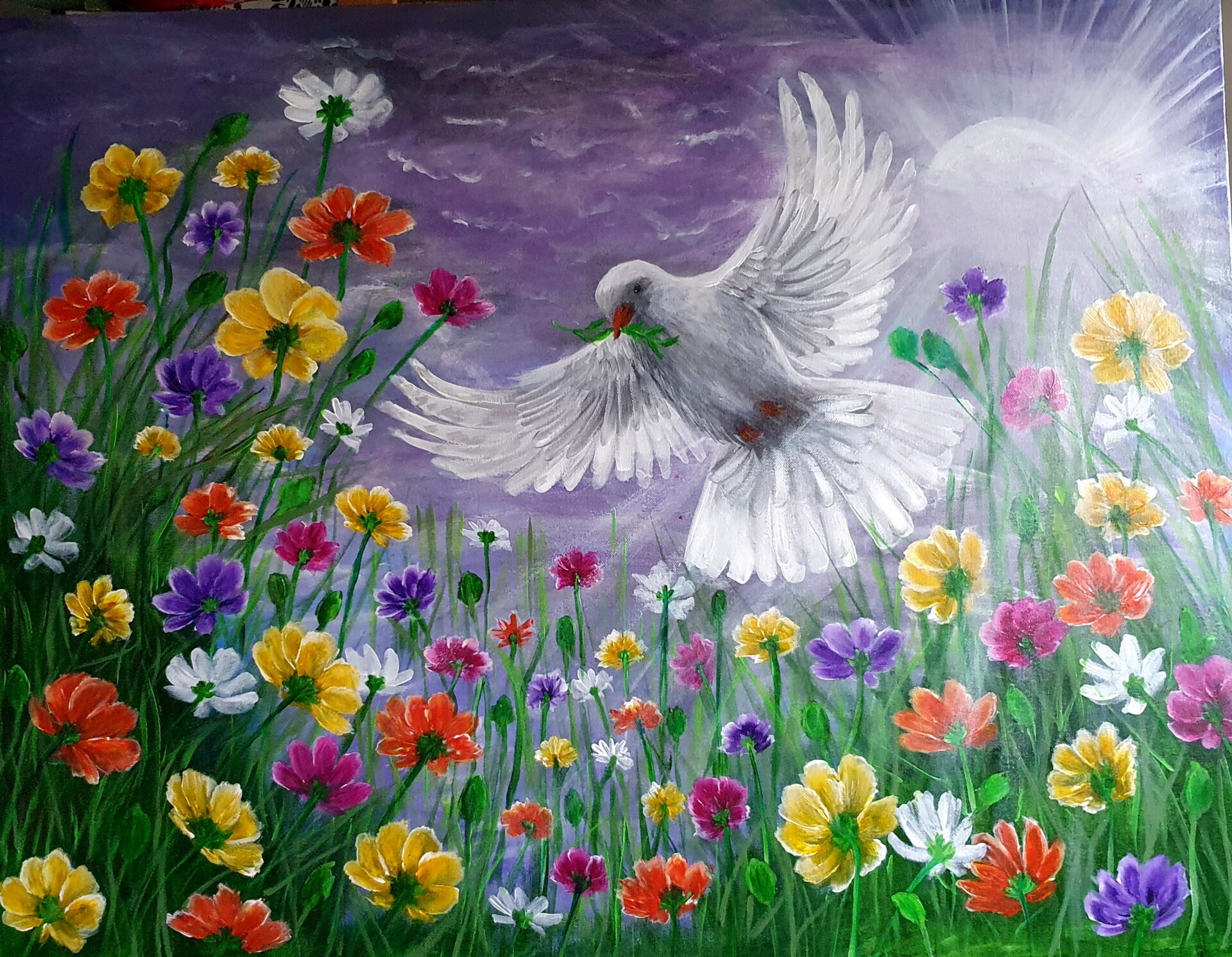
Joy, Hope and Peace has a clearer symbolic language: light, flowers and a descending dove. The flowers become part of a larger emotional landscape. They are not only botanical forms. They are signs of renewal, warmth and life returning.
This painting reminds me that flowers are often present at turning points.
We bring them to celebrations. We bring them to hospitals. We bring them to memorials. We place them in homes when we want a room to feel cared for. Flowers hold joy and grief, beginnings and endings, tenderness and hope.
That is why they remain powerful subjects.
They are beautiful, but they are also witnesses.
What This Series Signifies
If Tutti Fruitti was about abundance and everyday joy, Petals, Still and Wild feels to me like a series about becoming.
Not becoming only one thing, but learning to honour more than one nature inside us.
There is the part of us that needs stillness, care, ritual, structure and a safe vase to hold what is tender. There is also the part of us that needs open air, unpredictability, movement, freedom and room to grow beyond the shape others expect.
Both are real.
Both are beautiful.
A flower in a vase is not lesser because it is arranged. A wildflower is not lesser because it is unplanned. Each tells a different truth.
The vase says: beauty can be tended.
The meadow says: beauty can emerge without permission.
The bouquet says: gather what is precious and give it water.
The wild field says: trust the wind and bloom anyway.
This is why the collection feels emotionally rich to me. It does not choose only order or only freedom. It lets them speak to each other.
Cultivated and Wild
I think many of us live between these two states.
We build routines, homes, practices, responsibilities and relationships. We try to arrange life so that it can hold us. We need structure. We need care. We need some kind of vase.
But we also need wildness.
We need spontaneity, imagination, risk, growth, surprise, open space, and the courage to bloom in ways that cannot always be planned. Too much control can make life beautiful but airless. Too much wildness can make life vivid but ungrounded. The art is in learning how both can belong.
That is what flowers teach me here.
A bouquet and a meadow are not enemies.
They are two expressions of life.
The Quiet Lesson of Petals
Petals are fragile, but they keep opening.
This is a small miracle.
A petal can bruise. It can fall. It can be torn by wind or softened by rain. Yet flowers still open themselves to the world. Their beauty is vulnerable by nature. They do not become less beautiful because they are temporary.
Maybe that is one of the deepest meanings of floral paintings.
They remind us that tenderness is not something to hide. It can be part of how we meet the world. A flower does not apologise for being delicate. It simply grows, opens, responds to light, and offers what it can while it can.
That feels brave to me.
Whether in a vase or a wild meadow, flowers carry a kind of quiet courage.
A Garden of Perspectives
When I imagine these paintings in a home, I imagine them creating a garden of perspectives.
A bouquet can bring calm into a room. A wildflower field can bring air and movement. A mountain meadow can offer spaciousness. Daisies can bring sincerity. Poppies can bring brightness. Pansies can bring individuality. Oreo among flowers can bring humour and the reminder to pause. A dove above flowers can bring hope.
Together, they invite us to live with more than one kind of beauty.
Not everything needs to be controlled.
Not everything needs to be wild.
Some things need tending.
Some things need freedom.
Some parts of us need the vase.
Some parts of us need the meadow.
And perhaps a full life learns to make room for both.
Leave a Reply