

The Sketchbook Is Where the Painting Learns to Think
There is a difference between a sketchbook made for performance and a sketchbook made for work.
The first is tidy, photogenic and easy to admire. The pages look finished. The colours sit obediently. Every line seems to know where it is going.
The second kind is more interesting to me.
It may contain half-formed ideas, awkward thumbnails, colour notes, quick diagrams, scribbled words, abandoned compositions and small experiments that never become anything directly. It is not always beautiful. It can be repetitive, messy and full of questions. Yet this is exactly why it matters.
A sketchbook is not only a place to draw. It is a laboratory for visual thinking.
In a studio practice, finished paintings often appear more confident than the process that produced them. Viewers see the resolved surface: the final colour relationships, the chosen composition, the subject that survived all earlier possibilities. What they do not see are the private trials that helped the painting arrive there.
This Insider Peek is about that hidden stage. Not the glamorous sketchbook, but the useful one. The sketchbook that lets an artist test an idea before committing it to canvas. The sketchbook that holds uncertainty long enough for something clearer to emerge.
Why a Sketchbook Does Not Need to Be Pretty
Many artists feel pressure to make every creative object shareable. Even the sketchbook can become a stage. Social media has made it easy to admire beautifully arranged pages, but it has also made some people afraid to use their sketchbooks honestly.
If every page must be presentable, the sketchbook loses its most valuable function.
A working sketchbook needs permission to be ordinary. It should be allowed to contain bad drawings, clumsy colour notes, repeated shapes, sudden thoughts, taped scraps, written reminders and experiments that lead nowhere. These are not failures. They are evidence that the artist is thinking on the page.
The page is allowed to ask:
- What if this object is cropped more tightly?
- What happens if the blue becomes colder?
- Where should the focal point sit?
- Is this subject really about detail, memory, humour or mood?
- What does the painting need less of?
These questions do not always require polished answers. Sometimes a small scribble is enough to prevent a larger mistake later.
Object Memory: Shelf of Stories
Some paintings begin with the emotional charge of objects. A sketchbook can help uncover why a thing matters before the finished work decides how to present it.
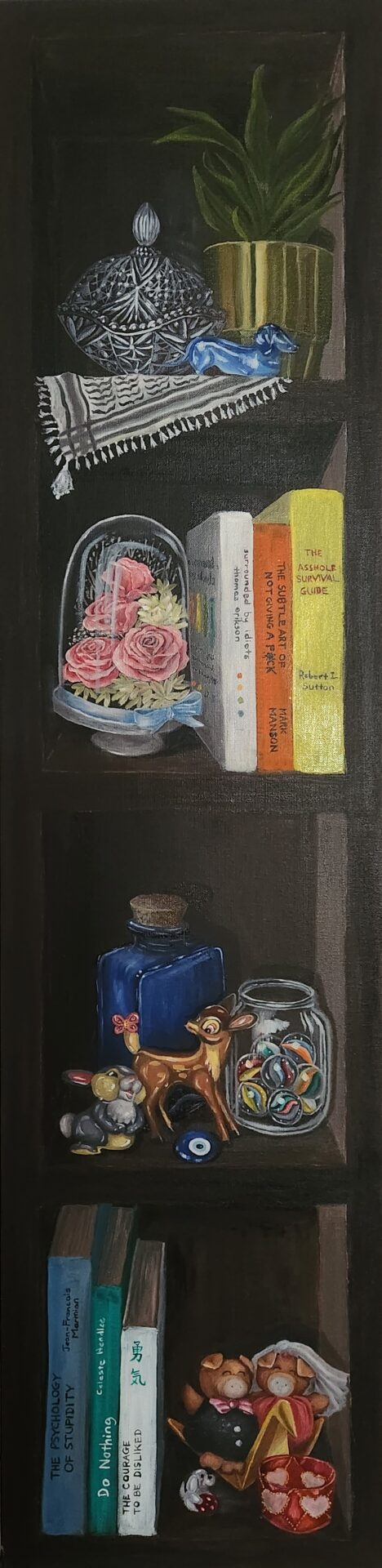
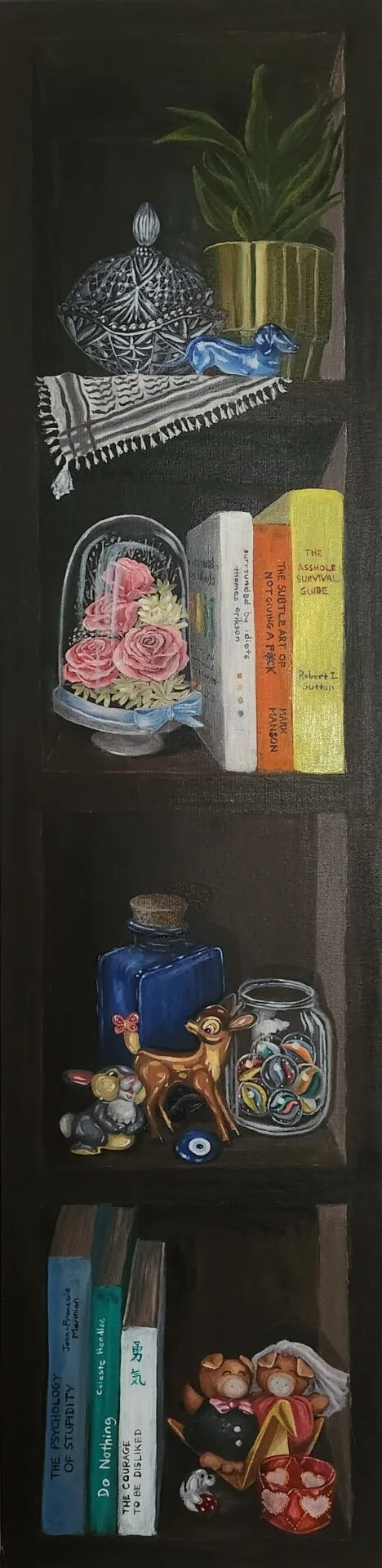
Shelf of Stories is a still-life painting of books, trinkets and plants. The work reflects the healing power of cherished objects and the way ordinary things can hold memory, resilience and growth.
A painting like this is not only about arranging items on a shelf. It is about deciding which objects carry emotional weight and how they speak to one another.
In a sketchbook, this might begin with lists rather than drawings. Which objects belong together? Which title should face outward? Should the plant soften the structure? Is the shelf a place of comfort, protection, recovery or identity? The page can hold these questions without needing to solve them immediately.
The sketchbook also allows an artist to test hierarchy. In a still life filled with meaningful items, every object may feel important. But a painting cannot give equal emphasis to everything. The eye needs pathways. The viewer needs a way to enter the image.
Small sketches help decide which shapes should anchor the composition, which details should remain quieter and where visual pauses are needed. In this way, the sketchbook becomes a place where private meaning is translated into visual order.
Play as Research: Gummy Chaos
Not every subject begins with seriousness. Some begin with play.
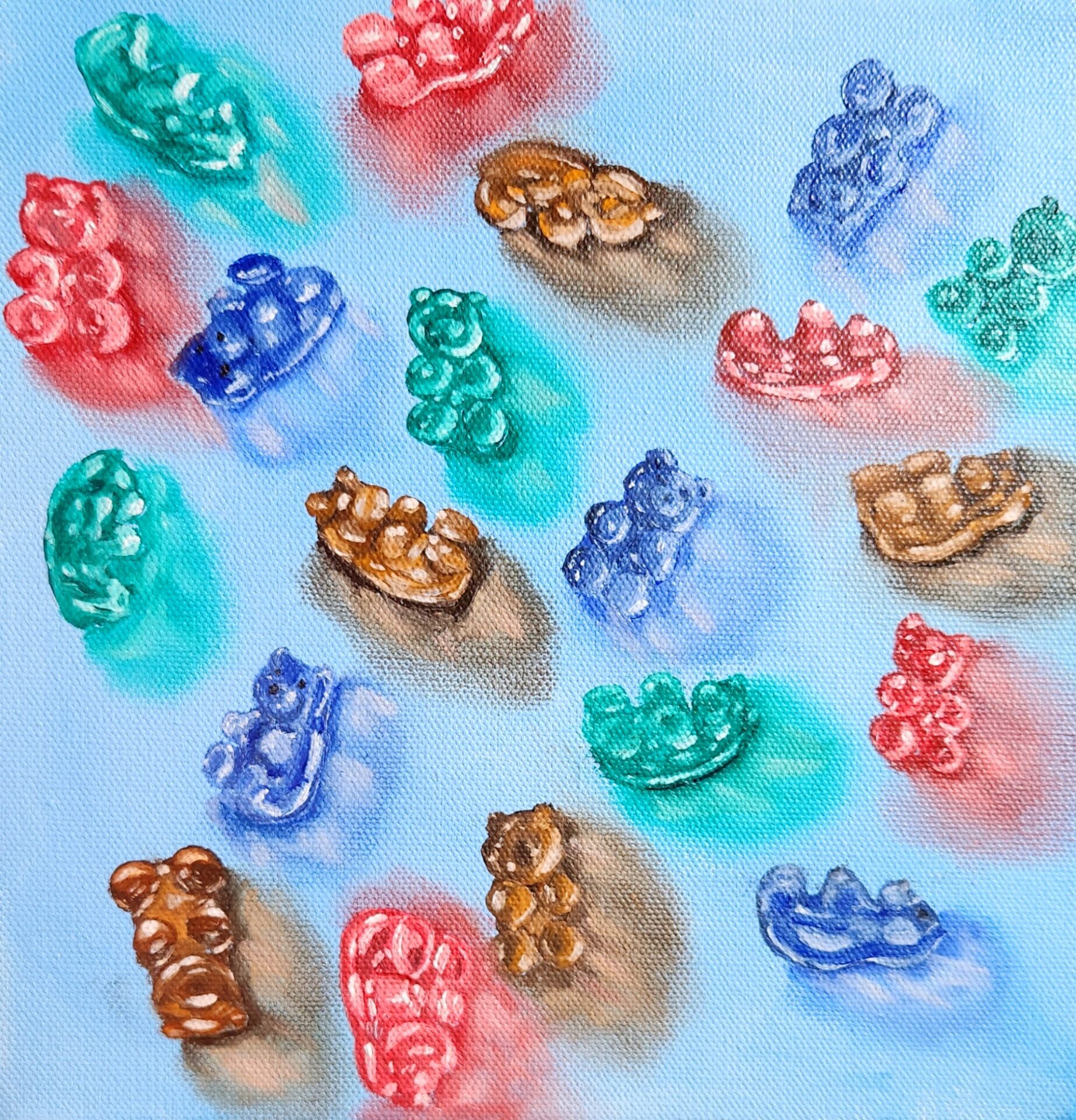
Gummy Chaos is bright, joyful and deliberately playful. Colourful gummy bears float across a dreamy blue background, creating a sense of nostalgia, spontaneity and sweet disorder.
A subject like this may look effortless, but playful paintings often need careful testing. If the candies are spaced too evenly, the image can become static. If they are too chaotic, the eye may lose its way. If the colours are all equally loud, the painting can feel flat rather than lively.
This is where the sketchbook becomes a laboratory for rhythm.
Quick thumbnails can explore whether the objects should cluster, scatter or drift diagonally. Small colour notes can compare the effect of warm bears against a cool background. A few written words might help clarify the emotional tone: childhood, mischief, abundance, nostalgia, chaos, delight.
The purpose of sketchbook play is not to make childish work. It is to keep the artist responsive. Play gives permission to move things around, exaggerate, simplify and ask what would make the painting more alive.
For artists, this matters because play can be fragile. Once a playful idea is transferred too quickly to a final surface, fear can enter. The canvas feels serious. Materials feel expensive. The idea may tighten. A sketchbook protects the looseness long enough for the painting to find its energy.
Detail Studies: A Tray of Fancy Chocolates
Some subjects require a different kind of laboratory: one that studies detail, texture and repetition.
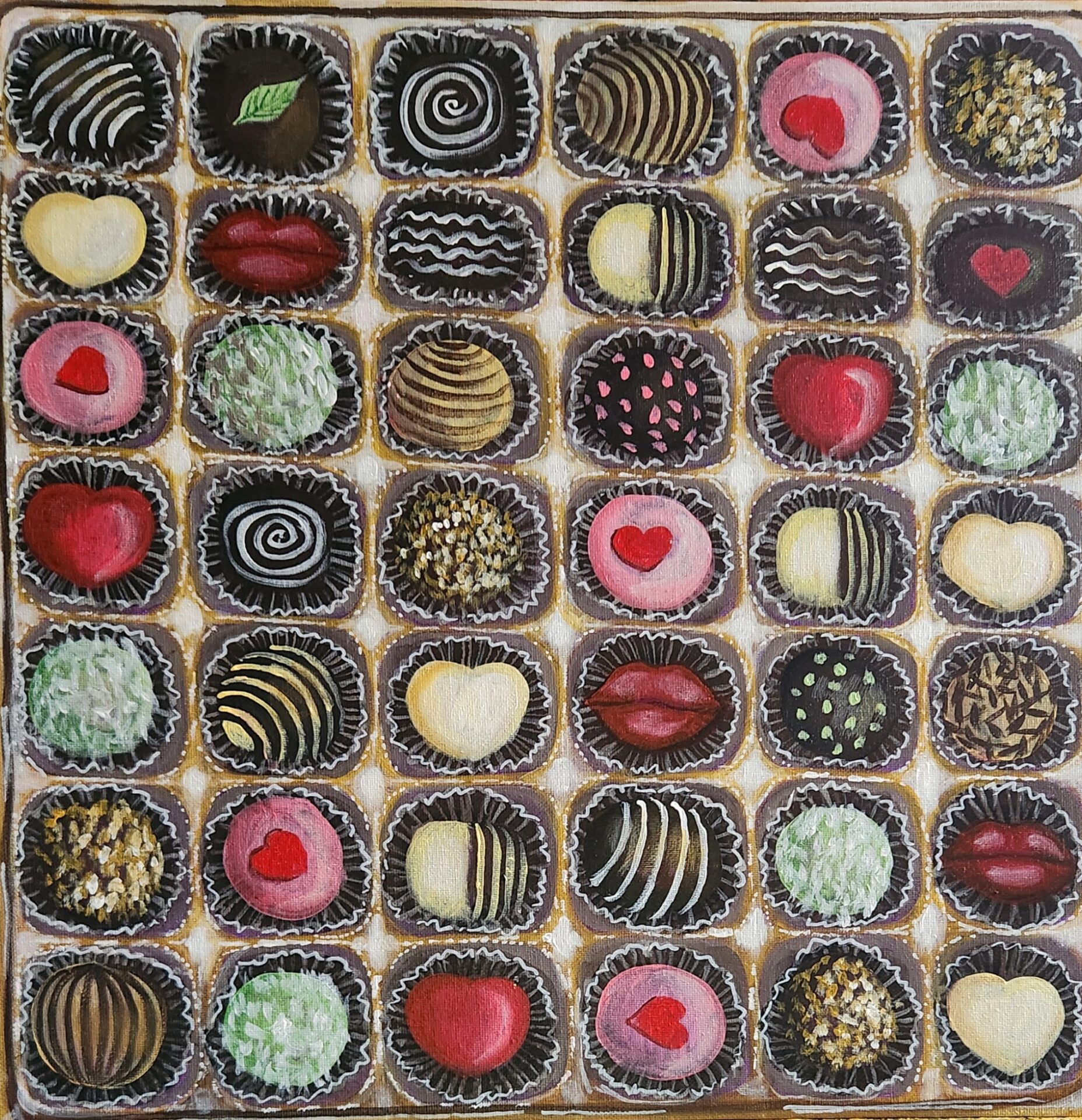
A Tray of Fancy Chocolates celebrates assorted chocolates with varied shapes, toppings, textures and colours. Each piece has its own small personality, yet the painting must still feel like one complete image.
Before a detailed painting, a sketchbook can help separate attention from anxiety. The artist does not need to solve the whole tray at once. One page might study circular shapes. Another might compare dark chocolate against pale paper cups. Another might record tiny highlights, decorative lines or the way shadows collect between objects.
These studies are not necessarily meant to be beautiful. They are practical questions:
- How much detail is enough?
- Which textures are essential?
- Where should the eye rest?
- How can repeated objects avoid becoming monotonous?
- Which small highlights will make the surface feel alive?
Detail-heavy subjects can tempt the artist into copying everything. The sketchbook helps decide what not to paint.
This may be one of the most underrated uses of preliminary work. A sketchbook is not only where ideas are added. It is where unnecessary information can be removed before the final painting becomes crowded.
Place Observation: Reflections of Boat Quay
When painting a place, especially a lively urban place, the sketchbook can become a field notebook.

Reflections of Boat Quay captures the charm of Singapore’s riverside, with historic shophouses, colourful awnings, outdoor dining, shimmering water and modern buildings in the distance.
Scenes like this contain many competing elements. Architecture, reflections, people, light, perspective and atmosphere all ask for attention. A sketchbook can help decide what the painting is really about.
Is the focus the rhythm of the shophouses? The contrast between heritage and modernity? The water reflections? The warmth of a familiar Singapore place? The answer affects every compositional decision.
A field sketch does not need to be accurate in every detail. Sometimes it records direction: the slope of a roofline, the vertical pull of a tower, the flicker of reflection under the buildings. Sometimes it records colour notes that a photograph may flatten. Sometimes it simply captures the feeling of being there.
This kind of sketchbook work teaches the artist to look actively. Instead of collecting information passively, the artist begins choosing. That choice is the beginning of interpretation.
From Notes to Synthesis: Melting Pot
Some sketchbook ideas do not remain observational. They become abstract.
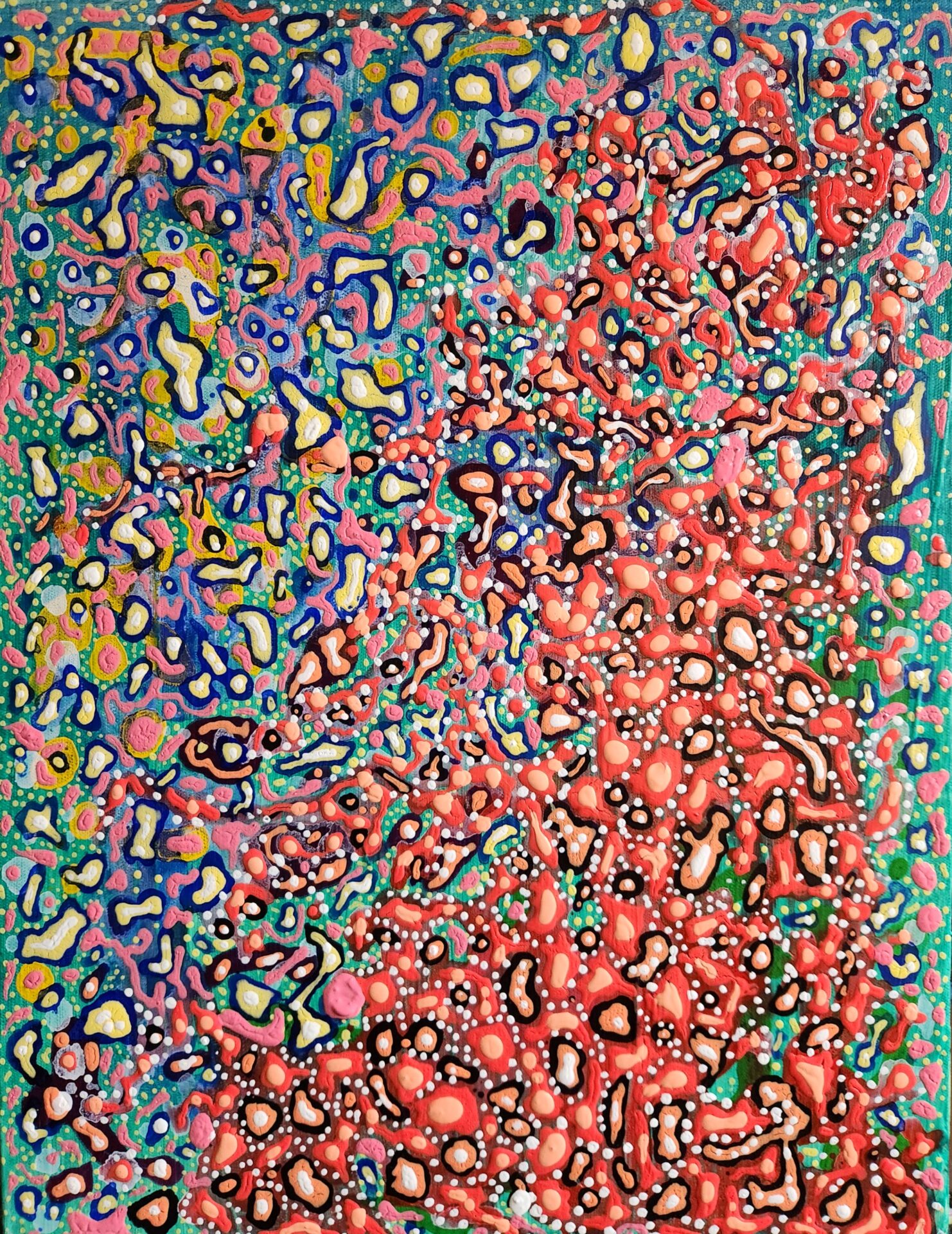
Melting Pot is an abstract tribute to Singapore, reflecting cultural diversity, layered identity and shared rhythm through vibrant shapes and colours.
For a painting like this, the sketchbook may hold fragments rather than direct studies. A shape noticed in architecture. A colour combination from food packaging. A line from a map. A memory of crowd movement. A written phrase about layered identity.
Abstract painting does not mean the absence of observation. Often, it means observation has been transformed.
The sketchbook allows unrelated impressions to sit near one another until a pattern begins to form. One page may not make sense alone. Ten pages may reveal a recurring rhythm. The final painting may not show any literal source, but the sources have helped shape its internal logic.
This is why I think of the sketchbook as a laboratory rather than a storage room. It does not merely collect ingredients. It lets them react.
The Private Page Makes the Public Painting Possible
A finished painting asks to be seen. A sketchbook does not always need that.
There is freedom in having a place that is not constantly evaluated. The private page allows doubt, revision and awkwardness. It lets the artist draw the same object repeatedly without needing every attempt to justify itself. It permits notes like “too heavy,” “try warmer background,” “less detail here” or “this is not the real subject.”
These remarks may look insignificant, but they are part of the thinking process.
In many ways, the sketchbook protects the painting from premature certainty. It gives the idea a chance to change shape before it becomes fixed. It helps the artist notice what keeps returning and what loses energy quickly.
This is especially useful when an artwork carries personal meaning. A painting like Shelf of Stories may need time to separate sentiment from structure. A playful work like Gummy Chaos may need time to remain lively without becoming visually noisy. A city scene like Reflections of Boat Quay may need time to decide which details serve the feeling of place and which details only add clutter.
The sketchbook gives each problem somewhere to unfold.
What Makes a Sketchbook Practice Useful?
A useful sketchbook practice does not need to be daily, disciplined in a rigid way or visually impressive. It needs to be honest enough to support the work.
For painters, that might mean keeping several kinds of pages:
- quick thumbnails for composition;
- colour tests with short notes;
- lists of possible subjects;
- studies of small textures;
- written memories connected to objects;
- experiments with cropping;
- observations from walks, travel or daily life;
- and pages where nothing quite works.
The last category is important. Pages where nothing works often teach more than pages where everything looks charming.
If a composition fails three times, the sketchbook may be showing that the subject needs a different format. If a colour combination keeps becoming muddy, the artist may need more contrast or fewer pigments. If a subject looks technically correct but emotionally flat, the real idea may be somewhere else.
The sketchbook is a place to notice these things while the stakes are still low.
Sketchbooks and the Finished Body of Work
Viewers do not need to see every sketchbook page to feel its influence. The work done privately often appears as confidence in the finished painting.
Composition feels more resolved because awkward arrangements were tested elsewhere. Colour feels more intentional because earlier combinations were tried and rejected. Details feel clearer because the artist has already decided what matters.
This does not mean the final painting becomes predictable. On the contrary, a working sketchbook can make the final surface more alive because the artist has already explored enough to respond freely.
The laboratory does not remove spontaneity. It supports it.
When I look across works such as A Tray of Fancy Chocolates, Melting Pot, Gummy Chaos, Shelf of Stories and Reflections of Boat Quay, I see different kinds of visual thinking. Some are about detail. Some are about play. Some are about place. Some are about memory or abstraction. Yet all of them benefit from the same principle: the finished work is stronger when the idea has had room to be tested.
Let the Sketchbook Be Unfinished
Perhaps the most useful thing a sketchbook can do is remain unfinished.
Not every page needs a conclusion. Not every study needs to become a painting. Not every note needs to be understood immediately. Sometimes a page only becomes useful months later, when a shape, colour or phrase suddenly connects to a new idea.
This slower usefulness is easy to miss if we judge the sketchbook only by how attractive it looks.
A showpiece sketchbook may impress quickly. A working sketchbook may serve quietly for years.
For artists, the invitation is simple: let the sketchbook become a place where thinking is allowed to be visible. Let it be practical, repetitive, clumsy, observant, playful and unresolved. Let it hold the questions before the painting has answers.
The finished artwork may be what eventually meets the viewer, but the sketchbook is often where the first real conversation begins.
Leave a Reply