

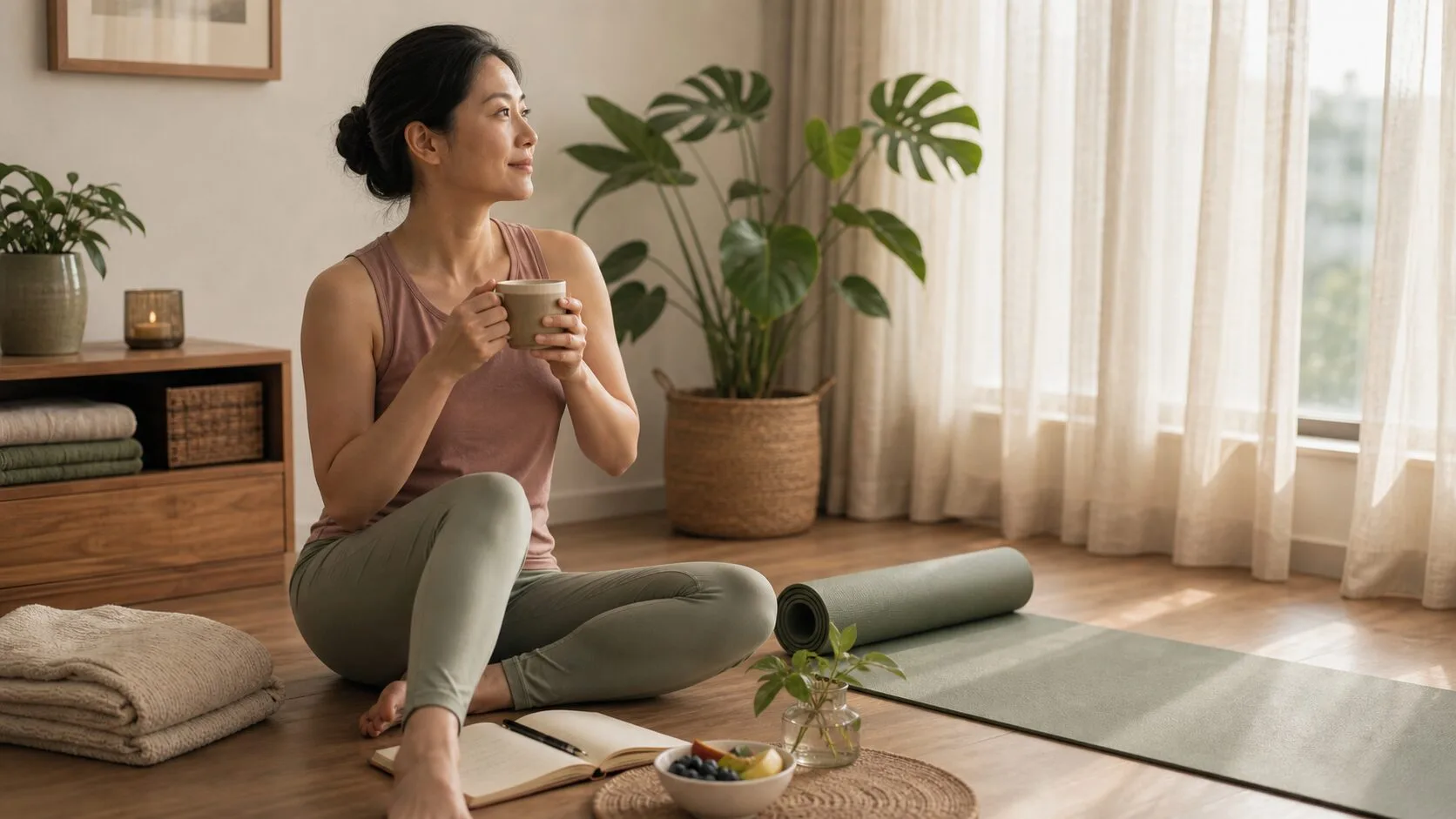
A Routine Is Not the Same as a Rhythm
Some routines look beautiful on paper but collapse the moment real life arrives.
Wake up early. Drink warm water. Practise yoga. Meditate. Journal. Eat at the right time. Walk. Work without distraction. Sleep early. Repeat.
There is nothing wrong with any of these habits. Many of them can be genuinely supportive. The problem begins when a daily routine becomes another standard we use to judge ourselves. If we miss one step, the whole day can feel like it has gone wrong.
Dinacharya, a Sanskrit word often translated as daily routine or daily conduct, offers a different way to think about the day. In Ayurveda, it points to the value of repeated daily rhythms that support balance. For modern life, I find it helpful to approach dinacharya less as a rigid checklist and more as a set of anchors.
An anchor is something you can return to. It does not need to be elaborate. It simply helps the body and mind recognise where they are in the day.
This is the fourth article in the Finding Calm series. We have already explored why rest is a practice and how gentle breath awareness can be approached without force. Dinacharya belongs naturally beside those themes because it asks a very practical question: what if calm is supported not by one perfect practice, but by a few repeatable rhythms?
What Is Dinacharya?
Dinacharya comes from the Ayurvedic tradition. It generally refers to daily habits that align the body with the rhythm of the day: waking, cleansing, eating, moving, working, resting and sleeping.
Traditional descriptions can be detailed. Depending on the source, they may include waking before sunrise, tongue scraping, oil massage, elimination, bathing, movement, meditation, meals and evening wind-down practices.
That level of detail can be inspiring, but it can also feel intimidating.
For a contemporary yoga therapy context, I prefer to ask: what is the intention behind these practices?
At its heart, dinacharya points to regularity. The body often responds well to signals it can recognise. Morning light, simple movement, meals at reasonably consistent times, pauses during the day and a gentler evening rhythm can all help create a sense of steadiness.
This does not mean every person needs the same routine. It also does not mean Ayurveda should be used as a substitute for medical care. The National Center for Complementary and Integrative Health notes that Ayurvedic products and practices can raise safety considerations, including concerns around some products containing metals or interacting with medications. In this article, I am not recommending herbs, supplements or medical treatment. I am speaking about gentle lifestyle rhythm: sleep, meals, movement, rest and attention.
Why Rhythm Helps When Life Feels Scattered
When life is busy, the nervous system receives many signals at once. Messages, errands, screens, meals eaten at odd times, late nights and constant transitions can make the day feel fragmented.
A daily rhythm reduces the number of decisions we need to make from scratch.
If the morning has a familiar beginning, we do not need to negotiate with ourselves immediately. If there is a small pause between work and dinner, the body learns that the day is shifting. If bedtime has a regular sequence, sleep does not have to arrive from nowhere.
This is not about controlling life. It is about creating enough shape that the body can orient itself.
The NHS includes regular eating, movement, relaxation and sleep habits among practical lifestyle measures that can support energy and reduce tiredness. These are ordinary foundations, but ordinary foundations are often where wellbeing begins.
In yoga therapy, this matters because a person does not only practise on the mat. A yoga practice lives inside the rest of the day. If someone is exhausted, overstimulated or constantly rushing, an intense routine may not help. A smaller daily rhythm may be more realistic and more kind.
The Problem With Ideal Morning Routines
Morning routines are often presented as the secret to a better life. They can be lovely, but they can also become strangely punishing.
If an ideal morning requires ninety uninterrupted minutes, silence, a perfect room and a perfectly cooperative mind, many people will feel they have failed before breakfast.
A sustainable morning rhythm should survive ordinary conditions.
It should still be possible when you sleep later than planned, when the weather is heavy, when the house is not quiet or when you have only ten minutes. The routine may become shorter, but it should not disappear completely.
Instead of asking, “What is the perfect morning?” ask:
- What helps me arrive in the day?
- What is realistic on most days?
- What is the smallest version I can still do?
- Which practice leaves me feeling more present rather than more pressured?
These questions are much more useful than copying someone else’s schedule.
A Three-Anchor Dinacharya
For many modern lives, a simple three-anchor rhythm is more sustainable than a long list of tasks.
Think of the day as having three gentle doorways: morning, transition and evening.
1. Morning: Arrive Before You Rush
The morning anchor does not need to be elaborate. It might include:
- drinking water;
- opening the curtains for natural light;
- washing the face slowly;
- noticing the breath for one minute;
- doing three gentle movements;
- writing one sentence in a journal;
- or sitting quietly before looking at the phone.
The point is not to complete a wellness performance. The point is to let the body know the day has begun.
A short yoga practice can fit here, but it should match the day. Some mornings may invite stretching and standing movement. Others may need a supported seated posture, a few shoulder circles or simply placing the feet on the floor and breathing naturally.

2. Transition: Mark the Middle of the Day
Many people move from one task to another without a clear pause. The body stays in doing mode.
A transition anchor helps create a small boundary.
This could be a five-minute walk, a cup of tea away from the computer, a few slow breaths before lunch or a short reset before returning home. If you work from home, it might mean deliberately changing location, folding a blanket or stepping outside for light.
The transition anchor is especially useful because it prevents the whole day from becoming one long blur.
In yoga therapy, this might be where a very brief practice belongs: one restorative shape, one breathing observation, one mindful movement or one moment of grounding through the feet.
3. Evening: Let the Day Finish
The evening anchor is less about productivity and more about closure.
You might dim lights, reduce scrolling, prepare clothes for the next day, write down unfinished tasks so they do not circle in the mind, stretch lightly or sit quietly for a few minutes.
The body cannot always switch from stimulation to sleep instantly. A repeated evening rhythm gives it a path.
Again, the practice can be small. It may be one forward fold with support, legs resting on a chair, a warm shower, gentle self-massage with no strong claims attached, or simply choosing a consistent time to begin winding down.
The Smallest Version Still Counts
A realistic dinacharya needs a smallest version.
On a full day, your morning rhythm may include water, movement, journaling and a short seated practice. On a difficult day, it may be one hand on the heart and one natural breath before standing up.
Both count.
This is important because consistency is not the same as sameness. The nervous system may benefit from familiar cues, but the exact shape of the practice can change. A rhythm is alive. It adapts.
If we insist on the full version every day, the routine becomes brittle. If we allow a smaller version, the rhythm can continue through illness, travel, low mood or busy seasons.
The smallest version is not a failure. It is the thread that keeps the practice connected to real life.
What to Include and What to Leave Out
Ayurvedic daily routines can include many traditional practices. Some may feel supportive. Others may not be appropriate, accessible or appealing.
You do not need to adopt everything.
Begin with the foundations that are generally sensible for most people:
- regular sleep and waking times where possible;
- meals that are not constantly rushed;
- appropriate movement;
- moments of rest;
- time away from screens before bed;
- and practices that help you notice your current state.
Be more cautious with anything that enters the body, such as herbs, supplements or strong cleansing practices. These can interact with health conditions, medications or individual needs. If you are considering Ayurvedic products or therapeutic interventions, discuss them with a qualified healthcare professional.
For the purposes of a gentle daily rhythm, simple is often enough.
A Gentle Dinacharya Template
Here is a realistic template that can be adjusted.
Morning Anchor, 5 to 20 Minutes
Open the curtains or step toward natural light.
Drink water.
Move slowly through the neck, shoulders, spine and hips.
Notice three natural breaths without trying to improve them.
Choose one word for the day, such as steady, kind, patient or clear.
Daytime Anchor, 3 to 10 Minutes
Pause before or after lunch.
Notice whether the body feels rushed, heavy, scattered or steady.
Take a brief walk, stretch the hands and shoulders, or sit quietly.
Let one task end before beginning the next.
Evening Anchor, 10 to 30 Minutes
Reduce bright screens if possible.
Write down tomorrow’s reminders.
Practise one supported posture or gentle stretch.
Allow the breath to be natural.
Do one simple closing action: washing the cup, folding the blanket, turning down the light.
This is not a prescription. It is a starting point.
How Yoga Therapy Can Personalise Daily Rhythm
One person’s supportive routine may be another person’s burden.
This is why personalised yoga therapy can be helpful. Instead of asking someone to follow a fixed template, we can look at their actual day, energy, responsibilities, sleep patterns, stress levels and preferences.
For one person, the first step may be a morning practice. For another, it may be protecting bedtime. Someone else may need a transition ritual after caregiving, work or commuting. Another may need permission to make the routine much smaller.
Yoga therapy also considers the body. A person with fatigue, pain, anxiety, injury or illness may need practices that are shorter, more supported or less stimulating. The aim is not to perform an ideal routine. It is to create something appropriate.
You can learn more about my approach on the Yoga and Wellness page. If you would like support designing a rhythm that fits your actual life, you can book a private yoga session.
Signs Your Routine Is Too Rigid
A routine should support you. It should not quietly become another source of pressure.
Signs that it may be too rigid include:
- feeling anxious if you miss one step;
- forcing practices when you are unwell or exhausted;
- ignoring what your body is telling you;
- comparing your routine with someone else’s;
- adding more habits even though the day already feels full;
- or believing the day is ruined because the morning did not go as planned.
If this happens, simplify.
Choose one anchor. Make it smaller. Let the routine breathe.
The purpose of dinacharya is not to create a perfect person. It is to offer steadiness.
Let Rhythm Be a Form of Care
A daily rhythm can be humble.
It may look like tea, light, a few movements and a notebook. It may look like closing the laptop and taking three breaths. It may look like going to bed slightly earlier, not because you are trying to be virtuous, but because the body is asking for care.
The calm we seek is not always dramatic. Sometimes it is the quiet relief of knowing what comes next. Sometimes it is a morning that begins with less rushing, a meal eaten with more attention or an evening that actually ends.
Dinacharya, approached gently, reminds us that wellbeing is not only found in special practices. It is also shaped by repeated, ordinary moments.
We do not need a perfect routine. We need a rhythm we can return to.
And if that rhythm is kind enough to keep, it may slowly become part of how calm finds us.
Leave a Reply