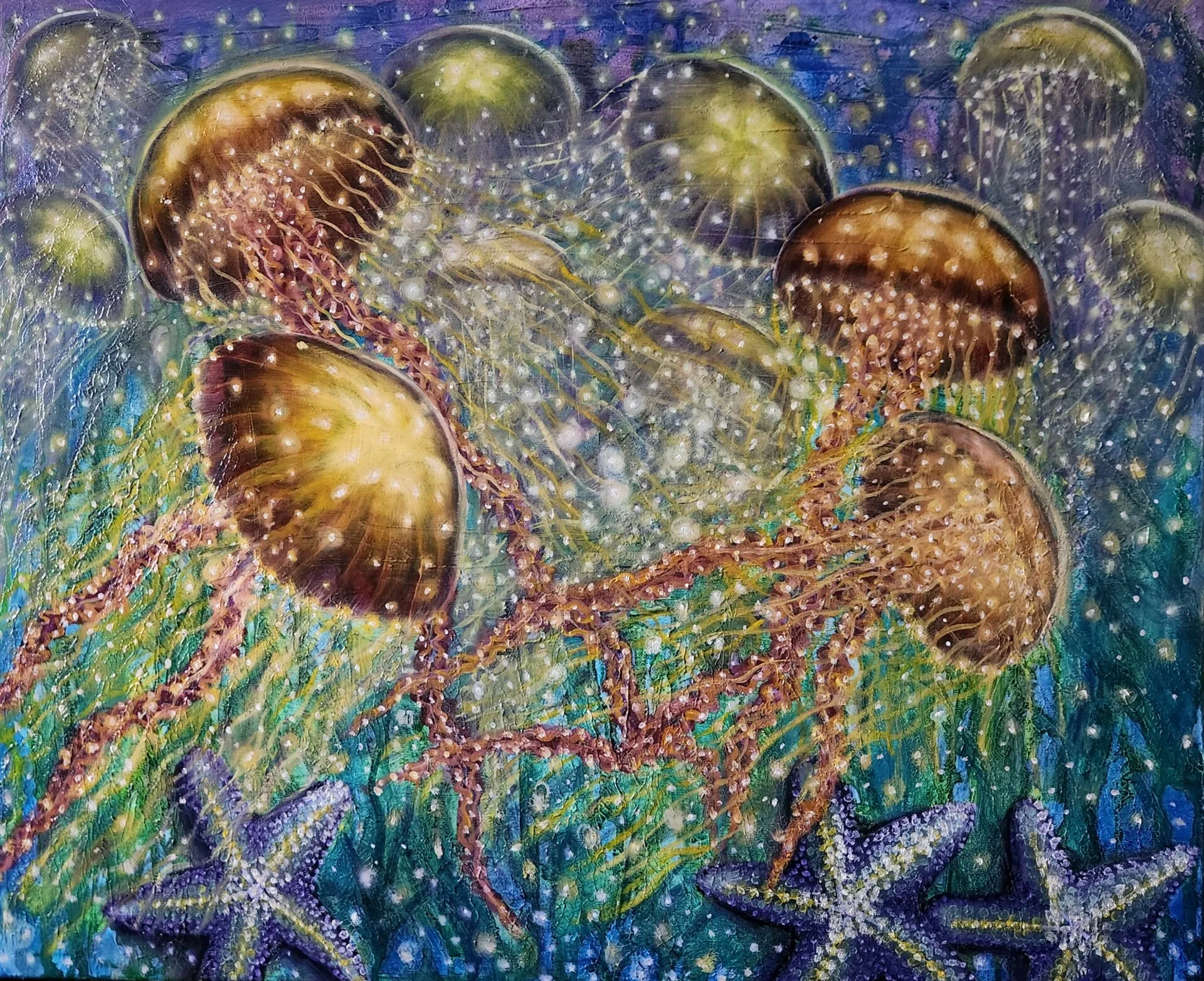
Lately, I’ve been sitting with a question that feels uncomfortable but real. What is the purpose of art, and what is the purpose of being an artist in today’s world?
When Art Feels Small Beside the World
It is not a romantic question. It comes from looking at reality. The world feels heavy. There are real problems everywhere, uncertainty, conflict, instability. And when I place my work against that backdrop, I can’t help but ask, what can a painting actually do? It does not feed people. It does not fix systems. It does not solve anything tangible.
And now, with AI able to generate paintings, music, and visuals faster and often better than humans, the question feels even sharper, especially in a culture already wrestling with what beauty still means in the age of AI. If machines can create endlessly, where does that leave us?
If I measure art based on output, efficiency, or scale, then it loses immediately. AI will always be faster. The world will always prioritise what is practical and useful. By that definition, art does seem useless. And perhaps that is why I started to feel lost.
What Creating Still Changes
But there was something I could not ignore. Even while questioning its value, I kept returning to it. I crocheted for hours and forgot about everything else. I completed a bag and felt a quiet sense of pride. I finished a painting after a long pause and felt like I had reconnected with a part of myself.
Those moments were not imagined. They were real shifts in how I felt.
So the question began to change. If art is useless, why does it change my state so much?
I began to see that art does not solve the world, but it stabilises the person living in it. When I create, my mind quiets. My focus sharpens. I move from something scattered to something grounded. That is not trivial. That is a way of staying steady in an unsteady world.
Part of my struggle came from expecting art to justify itself in big ways. I wanted it to impact society, to be widely appreciated, to make a difference I could clearly see. But maybe that expectation was misplaced. Most impact is not visible, and it does not happen on demand. Even Vincent van Gogh did not see the value of his work in his lifetime. That does not mean it had no value. It simply means impact does not always follow our timeline.
Then there is AI. AI can generate images, styles, and compositions at a speed no human can match. But it does not experience uncertainty. It does not question its existence. It does not feel lost and search for meaning. It produces, but it does not process.
And that made me realise something important. For a human, art is not just about output. It is a way of working through life. It is a way of making sense of what we feel, even when we cannot fully explain it.
Art as a Way to Stay Human
So what is the purpose of art?
Maybe it is not something grand. Maybe it is not meant to compete with industries that solve real world problems. Maybe it is simpler and more personal. To help me stay grounded. To give form to what I cannot easily express. To build something real, one piece at a time. To remain connected to being human in a world that is becoming increasingly automated.
It may not be impressive. It may not be widely recognised. But it is not nothing.
I may not change the world with my art. I may not reach many people. I may not always feel appreciated. But when I create, I am present. I am focused. I am building something instead of just consuming what already exists.
And that already changes something, even if it is only within me.
Maybe the purpose of art is not to prove its usefulness to the world. Maybe it is to hold something human in a world that no longer requires it. And maybe being an artist is not about being needed, but about choosing to create anyway.
This reflection is part of my Insider Peek series, where I write about art, meaning, and what human creativity still protects in a changing world.
Leave a Reply