
Fresh Eyes Are Part of the Studio Practice
There is a particular kind of looking that only becomes possible after time away.
When I am too close to a painting, I can sometimes see the effort more clearly than the work itself. I remember why a certain colour was chosen. I know how long a difficult section took. I can still feel the problem I was trying to solve three layers ago, even if that problem no longer exists on the surface.
The painting in front of me is not only an image. It is also a record of decisions, attempts, corrections, hopes and small negotiations.
That closeness is useful while making the work, but it can also become noisy.
This is why stepping away matters. A pause gives the painting a chance to separate from the story of how it was made. When I return, I am no longer inside every brushstroke. I can meet the work more like a viewer would: quickly, honestly and without remembering all the reasons I tried to make it behave.
That first return is often revealing.
Something that felt unresolved may suddenly seem quiet and complete. A detail I was proud of may now look distracting. A colour that bothered me may have settled into the larger composition. A passage I kept trying to improve may reveal that it only needed to be left alone.
In the studio, time away is not laziness. It is one of the ways a painting teaches me how to see it again.
Why Distance Changes What We Notice
When I work on a painting for many hours, my attention narrows. This is not a flaw. It is part of the labour. A single edge, shadow, pattern or colour relationship may require deep focus. The hand becomes absorbed in one local problem.
But a painting is not experienced one square inch at a time.
The viewer receives the whole image first. They feel the movement, balance, mood, colour temperature and focal point before they begin studying details. If I only stay close, I may solve small areas while weakening the larger feeling.
Distance restores the whole.
Sometimes this means literally standing across the room. Sometimes it means photographing the painting and looking at it smaller on a screen. Sometimes it means turning the canvas to the wall for a day or two. And sometimes it means leaving it alone long enough that my eye stops defending yesterday’s choices.
The return asks a different question:
What does the painting say before I explain it to myself?
That question can be uncomfortable. It removes some of my excuses. If the focal point is unclear, I can see it. If the colour relationship feels too heavy, I can feel it. If the composition is trying to do too many things at once, the whole painting begins to show me.
The pause does not make decisions for me, but it makes certain decisions harder to avoid.
Meeting the Painting Without the Original Plan
Every painting begins with some kind of intention, even if the intention is loose. I may want a work to feel calm, abundant, playful, mysterious, protective, joyful or spacious. I may begin with a memory, a subject, a colour relationship or a sense of movement.
The original plan matters because it gives the painting direction.
But the plan is not the painting.
As the work develops, the image begins to have its own logic. A colour may become more important than expected. A quiet area may start carrying the emotional weight. A subject that seemed central may need less emphasis. The painting may begin in one mood and slowly reveal a more interesting one underneath.
When I return after time away, I try to notice whether I am still serving the work in front of me or only protecting the first idea.
This is one of the delicate parts of studio practice. Abandoning an intention too quickly can make a painting scattered. Holding the intention too tightly can prevent the painting from becoming more alive.
The return helps me ask:
- What still feels true from the beginning?
- What has changed?
- Which part of the painting now has the strongest life?
- Am I trying to force the work back into an earlier version of itself?
The most useful answers are not always dramatic. Sometimes the painting still wants the same direction, only with less noise. Sometimes the main idea remains, but the colour needs a different temperature. Sometimes the subject is right, but the space around it needs more air.
Returning is not starting over. It is listening again.
When a Painting Feels Almost Finished
The most dangerous stage can be the almost-finished stage.
At the beginning, everything is open. In the middle, problems are expected. But near the end, every change carries more weight. One overworked passage can disturb the freshness of the whole. One unnecessary detail can make the painting feel less confident. One extra correction can remove a quality that was difficult to create in the first place.
This is why I often pause before finishing.
An almost-finished painting can produce a strange restlessness. Because it is close, I feel tempted to keep doing something. I may look for small areas to refine simply because the studio energy has not yet caught up with the painting’s readiness.
But finishing is not the same as continuing.
Sometimes the final stage requires restraint rather than effort. The painting may need one softened edge, one adjusted value, one quieter corner or one small connection between colours. It may also need nothing more than my willingness to stop.
Time away helps me tell the difference between incompleteness and unfamiliar quiet.
There are paintings that feel unfinished because they truly need more work. There are also paintings that feel unfinished because I am not yet used to their simplicity.
Those are very different situations.
The Courage to Leave Space Alone
One thing I often notice after a pause is whether an empty or quiet space is doing its job.
While painting, quiet areas can feel suspicious. The hand wants to add interest. The mind says a corner looks too plain. A blanker passage may appear less impressive than a detailed one. Yet a painting needs places where the eye can rest.
Space is not automatically absence.
In a calm seascape, open space may be the subject’s emotional centre. In a still life, the area around an object may help the object breathe. In an animal painting, a quieter background may allow expression, gesture or colour to come forward. In an abstract work, open passages can make active marks feel more intentional.
Returning after time away helps me notice whether the quiet is empty or alive.
If it is empty, it may need a subtle shift in value, texture or colour temperature. If it is alive, it should be protected.
This is one of the hardest things to trust because quiet support rarely announces itself. Viewers may not consciously say, “That untouched area is working beautifully.” They simply feel that the painting has balance.
The studio decision is private: do I add more because the painting needs it, or because I am uncomfortable with enough?
Seeing Stillness: Serene
Some paintings depend on the confidence to leave space open.
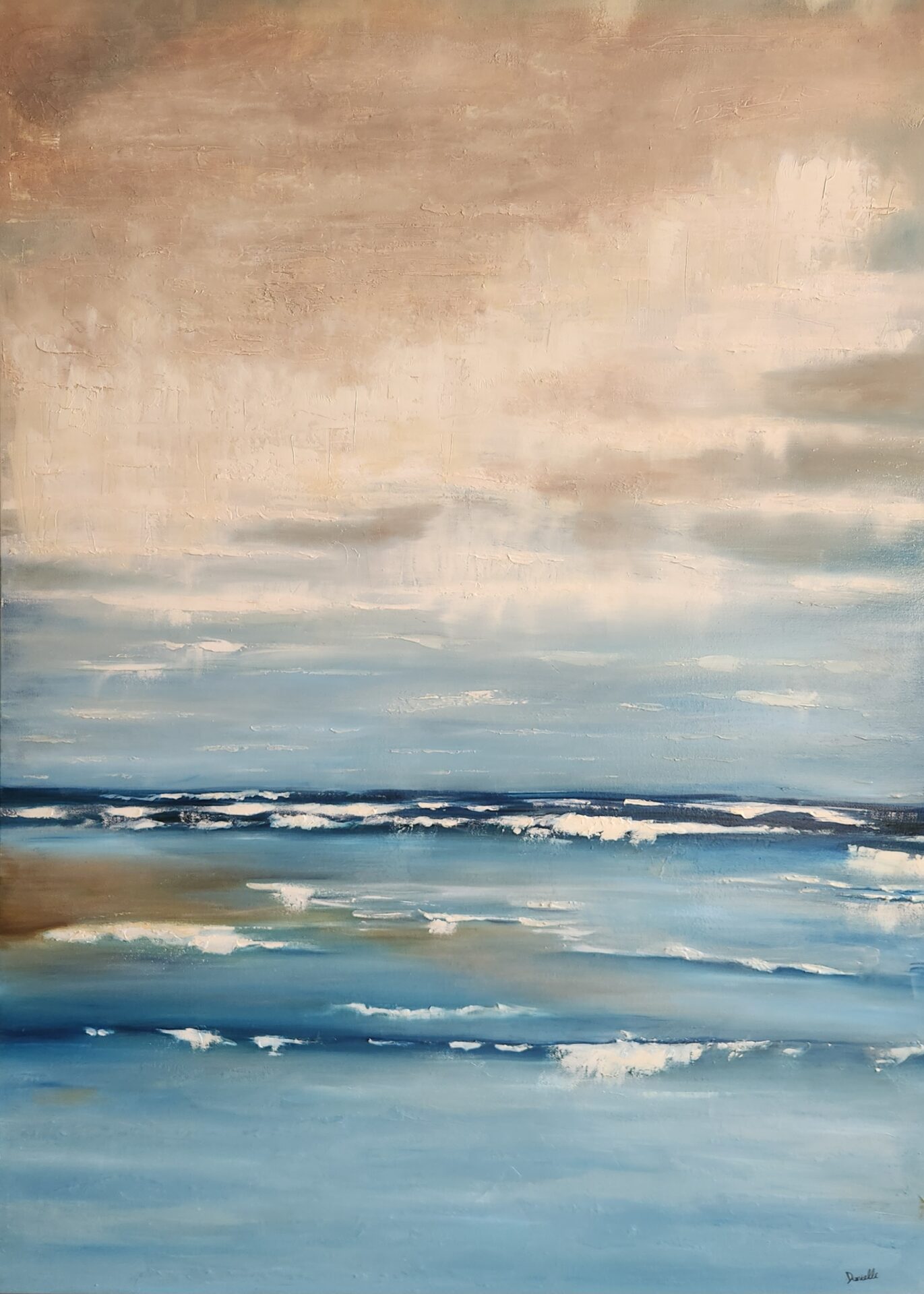
Serene is an abstract seascape built around calm ocean movement and a softened horizon. A painting like this cannot rely on dramatic detail everywhere. Its strength comes from atmosphere, spaciousness and restraint.
If I approached every quiet area as a problem, the painting would lose the very quality it needs. The eye needs to move slowly. The water needs to breathe. The sky cannot compete with the sea in a loud way if the whole work is meant to offer calm.
Returning to a painting like this after time away is especially useful because stillness can be difficult to judge while actively making. In the middle of the process, open areas may feel unfinished. Later, with more distance, they may reveal themselves as necessary.
This is one reason I think of rest as part of painting. The work may need rest from me so I can stop asking it to prove itself through more marks.
Discovering What Is Too Loud
A pause can also reveal what has become too loud.
This loudness may not be literal. It can be a colour that draws attention for the wrong reason, an edge that is too sharp, a pattern that competes with the subject, or a detail that refuses to stay in its supporting role.
Sometimes the problem area is technically well painted. That makes the decision harder.
I may enjoy a particular passage on its own, but the painting is not a collection of favourite passages. It is a whole relationship. If one area constantly pulls the eye away from the centre, it may need to be simplified, softened or partly covered.
Time away helps because pride fades a little. I become less attached to the hours spent and more willing to ask whether the passage belongs.
This does not mean every strong element should be reduced. A painting needs energy. It needs contrast, surprise and moments of emphasis. The question is whether the strength supports the work’s central feeling or interrupts it.
When I return to the studio and one area shouts before the painting speaks, I pay attention.
Letting Movement Settle: Dance of the Goldfish
Movement can be one of the qualities that changes most after a pause.
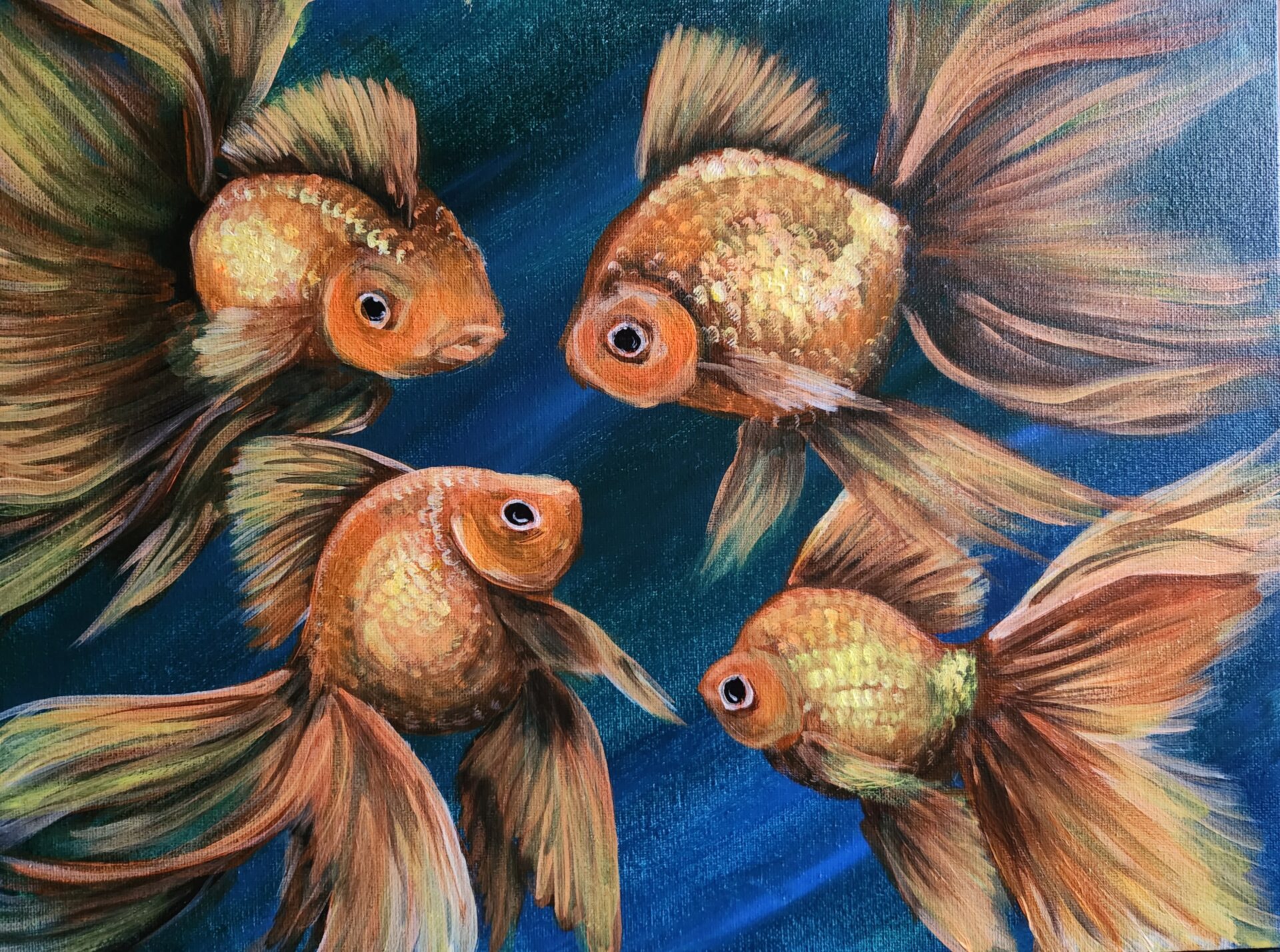
Dance of the Goldfish has a different kind of energy from a quiet seascape. The fish need to feel alive in relation to one another. Their spacing, direction and colour create a visual rhythm across the blue water.
In a painting with movement, too much local adjustment can make the image stiff. A curve may become over-defined. A transition may become too neat. A background may start competing with the swimming forms. The movement that felt natural at first can become locked in place by too much correction.
Stepping away helps me see whether the eye still travels.
Does the composition carry the viewer from one fish to another? Do the bodies feel connected by the surrounding water? Is there enough variation between activity and rest? Does the blue support the gold, or has it become too busy?
These questions are easier to answer when I return with distance. The painting’s rhythm becomes visible again.
The Difference Between Freshness and Neglect
One difficulty in painting is knowing when a rough passage has life and when it is simply unresolved.
Freshness can look unfinished if judged too quickly. A brushstroke may carry energy because it has not been over-explained. A broken edge may suggest movement more convincingly than a fully described contour. A thin layer may let earlier colour glow through in a way that a heavier layer would destroy.
But not every incomplete area is magically expressive.
Some passages really do need more attention. They may confuse the structure, weaken the focal point or distract from the whole. The challenge is to distinguish living freshness from accidental neglect.
Time away helps here too.
When I return, I ask whether the passage contributes to the painting’s feeling. Does it invite the eye, or does it cause uncertainty? Does it look intentional in relation to the rest of the surface? Does it hold enough information for the viewer to understand its role?
If the answer is yes, I try not to overwork it.
If the answer is no, I can return with a clearer purpose rather than nervous fussing.
Memory, Objects and a Slower Return: Shelf of Stories
Some paintings carry personal or emotional associations that need a slower kind of looking.
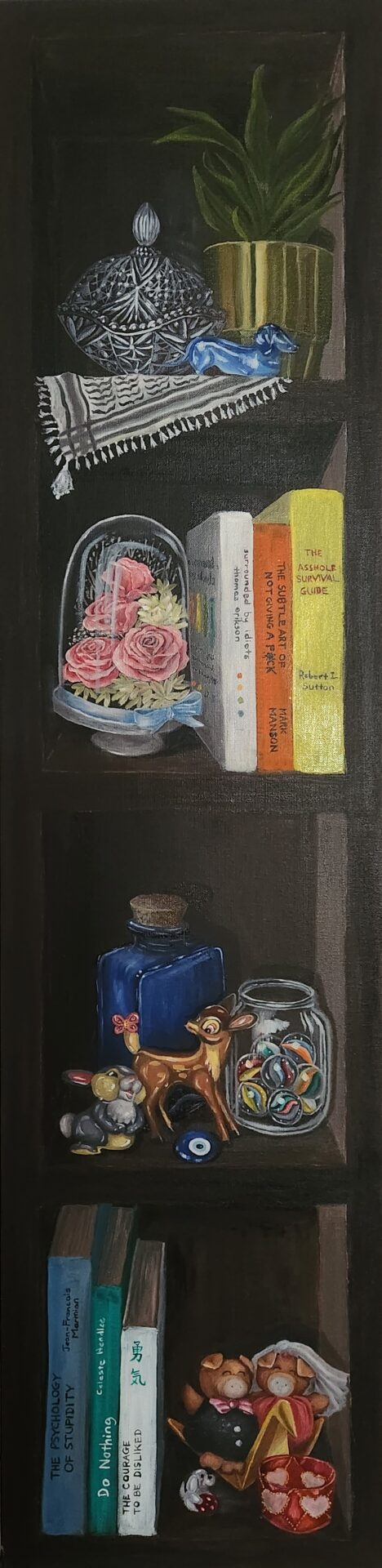
Shelf of Stories is a still-life painting of books, keepsakes and plants. Works like this are not only about arranging objects. They are about deciding how memory, comfort and meaning can sit together visually.
With object-based paintings, I may become attached to individual details because each object feels meaningful. But a painting still needs hierarchy. If every object receives equal emphasis, the image can become crowded even when each part is carefully painted.
Time away helps me see the arrangement less sentimentally.
Which objects hold the structure? Which details should invite close looking? Which areas need to stay softer so the painting can breathe? Does the shelf feel like a living arrangement or a display of separate items?
The pause does not remove the emotional connection. It gives that connection a clearer visual form.
Returning With Practical Questions
When I come back to a painting after time away, I try not to begin by fixing immediately.
First, I look.
Sometimes I write down what I notice before touching anything. The notes can be simple:
- focal point still unclear;
- background too warm;
- lower left corner too active;
- soften edge near main subject;
- leave right side alone;
- colour relationship works better than expected;
- stop after one adjustment.
The last note is important.
Without a limit, a small return can become another full round of overworking. A painting that needed one thoughtful change may receive ten anxious ones. Written notes help me separate observation from impulse.
I also try to begin with the largest issue, not the easiest one. It is tempting to improve a small detail because that feels manageable, but if the real problem is value structure, focal point or composition, the small detail will not solve it.
The useful return asks:
- What do I see first?
- Is that what I want the viewer to see first?
- Does the colour world feel connected?
- Is there enough rest?
- Is anything distracting from the central feeling?
- What is the smallest change that would help?
That final question protects the work. Not every problem needs a dramatic solution.
When the Pause Reveals That a Painting Is Finished
One of the sweetest returns is discovering that the painting is already finished.
This can feel surprising because the urge to continue is strong. The studio is a place of making, so stopping can feel like not doing enough. But sometimes the most respectful decision is to let the painting stand.
When I return and the work holds together without asking for correction, I try to trust that.
The focal point is clear enough. The quiet areas support the active ones. The colour relationships belong to the same world. The surface has variation without confusion. The original feeling is still present, perhaps changed but not lost.
At that point, more work may only make the painting different, not better.
This is not always easy to accept. A finished painting may still contain imperfect areas. But perfection is not the goal. Wholeness is different from flawlessness. A living surface may need a little irregularity, a trace of search, a brushstroke that carries the moment of its making.
The pause helps me recognise when the work has enough life to leave the studio and meet someone else’s eyes.
When the Pause Reveals That a Painting Needs More Time
Of course, the opposite can happen.
I may return and see that a painting is not finished at all. The composition may lack focus. The subject may feel disconnected from the background. The palette may be almost right but not yet alive. The work may contain several good sections that have not yet become one image.
This can be disappointing, but it is also helpful.
Before the pause, I might have felt vague frustration. After the pause, the problem may become more specific. Instead of thinking, “Something is wrong,” I may see, “The background value is too close to the subject,” or “The lower edge is pulling attention away from the face,” or “The warm accents need to repeat once more.”
Specific problems are kinder than vague ones.
They give the hand a task.
If a painting needs more time, the return can restore direction. I no longer have to push blindly. I can re-enter with a clearer sense of what the work is asking.
The Studio Rhythm of Leaving and Returning
Over time, I have come to see leaving and returning as part of the rhythm of painting.
There is immersion, when I need to be close and responsive. There is distance, when I need to step back and see the whole. There is action, when the next mark is clear. There is waiting, when the painting needs time to become visible again.
This rhythm is not always convenient. It does not obey a neat schedule. A painting may need to pause when I want to finish it quickly. Another may suddenly become clear when I thought it would take much longer.
But this unpredictability is part of working with a material, visual and intuitive process. Paintings are made through decisions, but not all decisions arrive at the same speed.
Some decisions need the hand.
Some need the eye.
Some need time.
What Time Away Teaches Me
Returning to a painting after time away teaches me humility.
It reminds me that I do not always know what the work needs while I am inside the effort of making it. It reminds me that attachment and care are not the same thing. It reminds me that not every strong passage belongs, not every quiet passage is empty, and not every unresolved feeling means the painting is unfinished.
It also teaches trust.
Trust that a pause can clarify rather than interrupt. Trust that the painting may become more itself when I stop pressing it. Trust that the first glance after time away carries information worth respecting.
This is part of the quiet work behind finished art.
Viewers may never know which areas were changed after a pause, which passages were saved by restraint, or which decisions only became clear because the painting was left alone for a while. But those pauses remain inside the final image. They shape its balance, its confidence and its ability to breathe.
In the end, returning to a painting is not only about seeing what still needs to be done.
It is about seeing what is already there.
Leave a Reply