

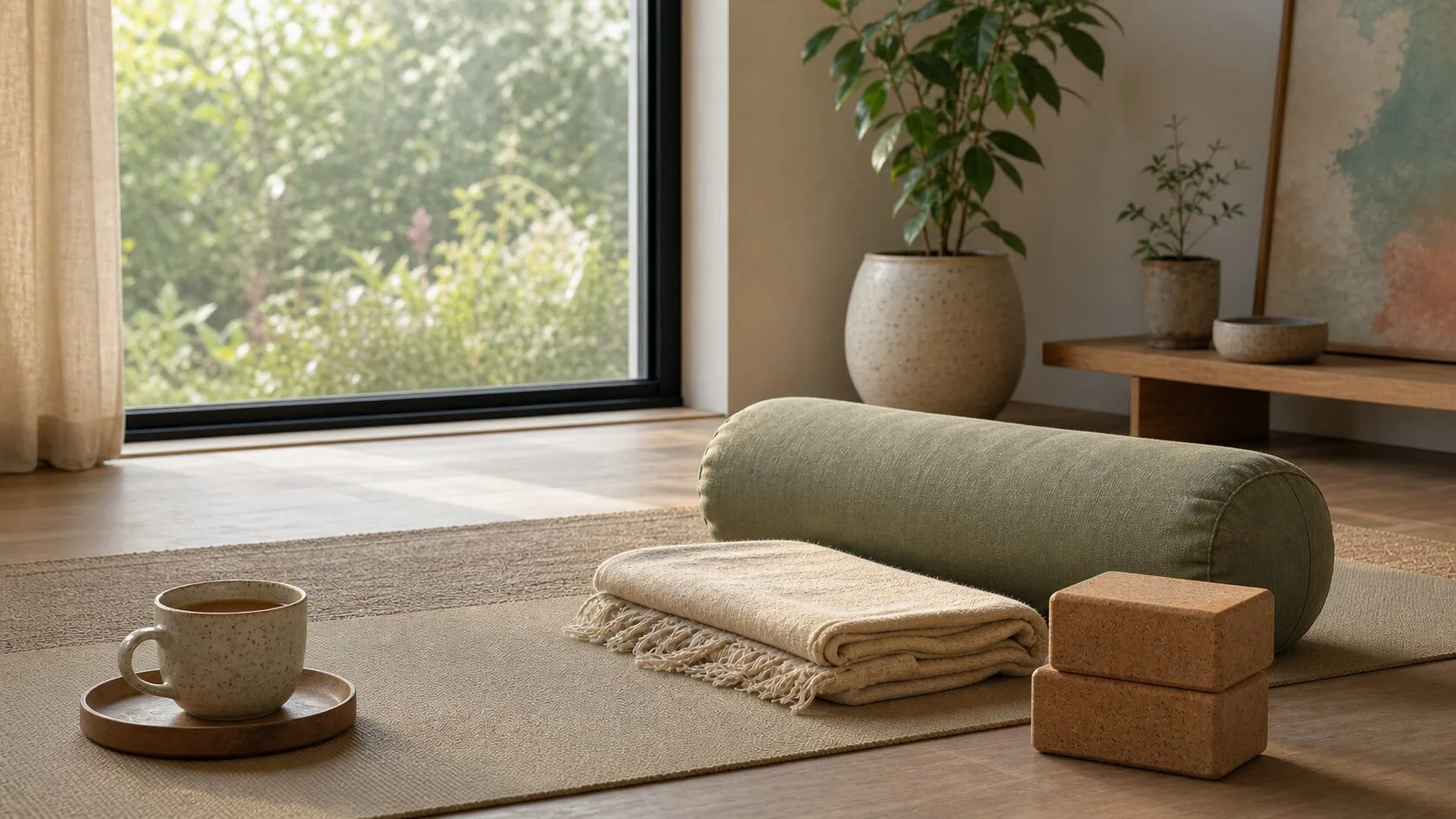
The Quest to Stay Calm in a Chaotic World
Many of us arrive at rest carrying an invisible task list. We lie down, but the mind continues to organise, anticipate, replay, and solve. The body is still while the inner pace remains fast.
This can lead to a painful conclusion: “I am bad at resting.”
From a yoga therapy perspective, rest is not a performance and it is not a state we can command on demand. It is a capacity that may be supported through conditions of safety, choice, rhythm, and time. Some days the nervous system settles easily. Other days stillness makes thoughts louder or sensations more noticeable. Both experiences are human.
A therapeutic practice begins with what is true today, not with an ideal image of perfect calm.
What does it mean to find calm through yoga?
Finding calm through yoga does not mean forcing the mind to become blank or the body to remain perfectly still. A yoga therapy approach uses choice, comfortable support, gentle movement, natural breathing, and manageable periods of rest to help a person notice what feels steadying today. Calm may appear gradually and in small moments rather than as one perfect state.
This is the first article in Finding Calm, a yoga series about developing a more compassionate relationship with rest, breath, movement, attention, and the nervous system. Each practice will be offered as an invitation that can be adapted rather than a standard that must be achieved.
Important note: This article is general education, not medical advice or a substitute for individual care. Persistent anxiety, trauma symptoms, breathing difficulty, pain, severe insomnia, or other health concerns deserve support from an appropriately qualified healthcare professional. In yoga therapy, practices should be adapted to the individual.
Rest is not collapse
Exhaustion can make us stop, but stopping and restoring are not always the same. We may scroll late into the night, fall asleep in front of a screen, or spend a free afternoon worrying about what is unfinished. The activity has paused, yet the system has not necessarily received a clear message that it can soften.
Restorative experiences vary. For one person, lying quietly under a blanket feels nourishing. For another, gentle walking is more settling than stillness. Someone living with pain may need a supported chair rather than the floor. A person who feels vulnerable with closed eyes may prefer a soft gaze and a view of the room.
Yoga therapy treats these differences as meaningful information. The goal is not to fit everyone into the same pose. It is to explore what helps this person feel adequately supported, present, and able to choose.
Rest therefore includes agency. You can move, open your eyes, change position, skip a breathing instruction, or stop. Knowing that you are not trapped in a practice can itself make settling more possible.
A simple view of the nervous system
The nervous system continually gathers information from inside and outside the body. It responds to obvious events, but also to tone of voice, uncertainty, fatigue, hunger, pain, memory, environment, and expectations.
Popular wellness language sometimes divides experience too neatly into “regulated” and “dysregulated,” as if calm is good and activation is failure. Activation is essential. It helps us wake, focus, move, protect ourselves, and meet challenges. The concern is not that activation exists; it is whether we can respond flexibly and recover when the demand has passed.
A useful rest practice does not force the body into a particular nervous-system state. It offers steady, tolerable cues: contact with the ground, predictable movement, a comfortable exhale, warmth, orientation to the room, and freedom to adjust.
Small doses matter. Five minutes of genuine support may be more helpful than a long practice endured with clenched teeth.
Begin by orienting
Before turning inward, it can be helpful to notice the environment.
Sit or stand in a position that does not require effort to maintain. Let your eyes move naturally around the space. Notice colours, shapes, areas of light, and the location of doors or windows. You do not need to search for danger or convince yourself that everything is safe. Simply allow the present room to become more available to your senses.
Notice one neutral or pleasant detail: the texture of fabric, a patch of daylight, the green of a plant, or the sound of a fan. If nothing feels pleasant, neutral is enough.
Then notice where your body receives support. Perhaps the feet meet the floor, the sitting bones meet a chair, or the back meets a wall. You may gently press into that support and release. The pressure provides clear sensory information: I am here; there is something beneath me.
Orientation is especially useful when closing the eyes or immediately focusing on internal sensation feels too intense. Yoga does not require us to withdraw from the world before we have arrived in it.
Movement before stillness
For a busy or anxious system, moving directly into a long resting pose may create more agitation. Gentle, repetitive movement can provide a bridge.
Try sitting toward the front of a stable chair with both feet supported. As you inhale naturally, allow the chest to broaden and the spine to lengthen slightly. As you exhale, let the spine round only as far as comfortable. Move slowly for six to ten cycles, without trying to maximise the range.
Next, keep the torso quiet and alternately press one foot and then the other into the floor. Feel the change of pressure travel through the legs. Or lift and lower the heels together in an easy rhythm.
You might then roll the shoulders a few times or slide the hands forward and back along the thighs. Repetition reduces decision-making and can make the practice feel predictable.
The movement should not be used to exhaust yourself into stillness. Its purpose is to offer enough activity for attention to have a clear, manageable place to rest.
Pause afterward and notice whether stillness now feels different. There is no required answer.
Let the breath remain a companion
Breath practices are often presented as fast routes to calm. They can be helpful, but breath is also intimate. Deliberately changing it may feel uncomfortable for people with respiratory conditions, panic, trauma histories, pregnancy, cardiovascular concerns, or other health circumstances.
Begin with observation rather than control. Where is breathing easiest to notice today: nostrils, chest, ribs, back, or abdomen? If internal attention is uncomfortable, feel the movement of clothing or listen to the quiet sound of breath instead.
You do not need to take a deep breath. “Deep” can become another demand. Allow the inhale to arrive in its ordinary size. See whether the exhale can finish without being pushed.
If that feels comfortable, try a very mild lengthening of the exhale. An inhale of three and exhale of four may be enough. Keep the breath smooth and return to normal breathing at the first sign of strain, air hunger, dizziness, or unease. Breath retention is unnecessary for this practice.
Another option is a soft hum on the exhale. The vibration gives attention a sensory anchor and naturally extends the outgoing breath. Keep the sound easy, not loud or prolonged.
The purpose is not to manufacture a perfect breathing pattern. It is to build a kinder relationship with the breath you have.
Support changes the pose
In restorative yoga, props are not signs that we are doing less. They change the physical demand of a position so effort can reduce. Pillows, folded blankets, towels, a stable chair, and a wall can all be useful.
Consider a supported rest on the back. Place a pillow or folded blanket under the head so the throat feels easy. Support the knees with a bolster, several pillows, or the seat of a chair. Let the arms rest wherever the shoulders are comfortable. If lying flat causes pain, reflux, breathlessness, dizziness, or distress, choose a reclined or seated position instead.
Notice practical details. Are you warm enough? Is the light too bright? Does the lower back need a change? Would a heavier blanket feel comforting or restrictive? Can the jaw be at ease?
There is no universally correct arrangement. Make one adjustment at a time, then wait long enough to feel its effect.
Side-lying is another valuable option. Place support under the head, bend the knees comfortably, and put a pillow between them if helpful. Hold a pillow in front of the chest or rest the top arm on it. Side-lying can feel contained and may be easier than facing upward.
Seated rest is fully valid. Sit back in a supportive chair, place both feet on the floor or a footrest, and support the forearms. You can remain upright or recline slightly if the chair is designed for it.
The best resting pose is the one you do not have to endure.
A ten-minute practice
The following sequence is an invitation, not a prescription. Adjust or omit anything that does not suit you.
Minutes 1-2: Arrive. Look around the room. Notice three colours and two sounds. Feel your points of contact with the chair, floor, or mat. Remind yourself that movement is available.
Minutes 3-4: Move. Choose one small repetitive movement: seated spinal rounding and lengthening, heel lifts, slow shoulder circles, or sliding the hands along the thighs. Keep the rhythm comfortable.
Minutes 5-6: Notice breath. Let breathing be natural. Feel one location where it is easy to sense. If welcome, allow the exhale to be slightly longer or add a soft hum.
Minutes 7-9: Receive support. Settle into a supported seated, side-lying, or reclined position. Feel the weight of one body area at a time being held. There is nothing to release on command.
Minute 10: Reorient. Open the eyes if they were closed. Notice the room, move fingers and toes, and transition slowly. Ask, “What do I need next?”
That final question matters. A practice does not end when a timer sounds. You may need water, food, quiet, conversation, fresh air, or a return to your day.
When rest brings discomfort
Stillness can reveal what activity has kept in the background. Thoughts may speed up. Pain may become more noticeable. Sadness, irritation, or numbness may emerge. This does not mean you have failed, and it does not mean you must stay in the position.
Try opening the eyes and orienting to the room. Increase movement by pressing the feet, rubbing the hands, or walking slowly. Choose a more upright posture. Name ordinary objects around you. If the experience remains overwhelming, stop the practice and seek appropriate support.
It is also reasonable to choose active forms of restoration. Gardening, painting, preparing food, walking in a familiar place, or listening to music may provide steadiness through gentle engagement. Rest is broader than lying down.
For people living with trauma or significant mental-health symptoms, trauma-informed professional support can make practices safer and more individualised. No online sequence can assess your history, current state, or medical needs.
Rest within real life
A beautiful hour-long practice is not useful if it can only happen in an imaginary schedule. Yoga therapy looks for forms that can live inside actual days.
You might create a transition ritual after work: wash your hands, change clothes, sit for three minutes, and feel both feet on the floor. Before bed, you might lower the light and take six unforced breaths with a longer exhale. Between tasks, you might look out a window and let your eyes focus at a distance.
These moments are small, but repetition builds familiarity. The body learns the sequence. A particular blanket, chair, piece of music, or cup of warm tea can become part of a dependable rhythm.
Rest also has social and structural dimensions. No breathing practice can solve an impossible workload, unsafe environment, lack of healthcare, or ongoing discrimination. Personal practice may support us within difficult conditions, but it should not be used to make those conditions invisible.
Sometimes nervous-system care means setting a boundary, asking for help, changing an expectation, or addressing a practical problem.
From achievement to relationship
Modern wellness culture easily turns rest into another achievement. We track sleep, optimise recovery, and judge whether a practice was productive. The language changes, but the pressure remains.
Yoga offers another possibility: relationship. We learn how this body signals fatigue, how this mind responds to silence, and what kinds of support make presence more available. We become curious about change rather than demanding consistency.
Some practices will feel deeply settling. Others will feel ordinary. A few may show us that what worked last month is not right today. This variability is not evidence that the practice has failed. Responsiveness is the practice.
Rest need not be earned by reaching the end of the list. It is one of the conditions that allows us to meet life with greater clarity, creativity, and care.
Begin smaller than you think you should. Choose support. Keep your options open. Let the breath remain natural. Notice one moment when effort decreases, even slightly.
Rest is not something you must become good at. It is a conversation you can return to.
Frequently asked questions
Can yoga help me feel calmer?
Gentle yoga may support calm by giving attention a steady focus and reducing unnecessary physical effort. Its effects vary between people and from day to day. Yoga should complement, not replace, appropriate healthcare for ongoing anxiety, trauma symptoms, pain, insomnia, or other health concerns.
What kind of yoga is best for relaxation?
Restorative yoga, gentle chair yoga, slow mindful movement, and individually adapted yoga therapy may all support relaxation. The best option is one that feels accessible, allows choice, and does not require you to tolerate pain, strain, breathlessness, or distress.
Do I need to control my breathing to calm down?
No. Begin by observing the breath without changing it. If it feels comfortable, a slightly longer exhale or a soft hum may be useful, but there is no need to take very deep breaths or hold the breath. Return to normal breathing whenever you feel strain or unease.
What if lying still makes me more anxious?
Open your eyes, sit upright, look around the room, or choose gentle repetitive movement instead. Walking, pressing the feet into the floor, or moving the hands can provide a clearer sense of orientation. Stillness is not required for a practice to be restorative.

Leave a Reply