

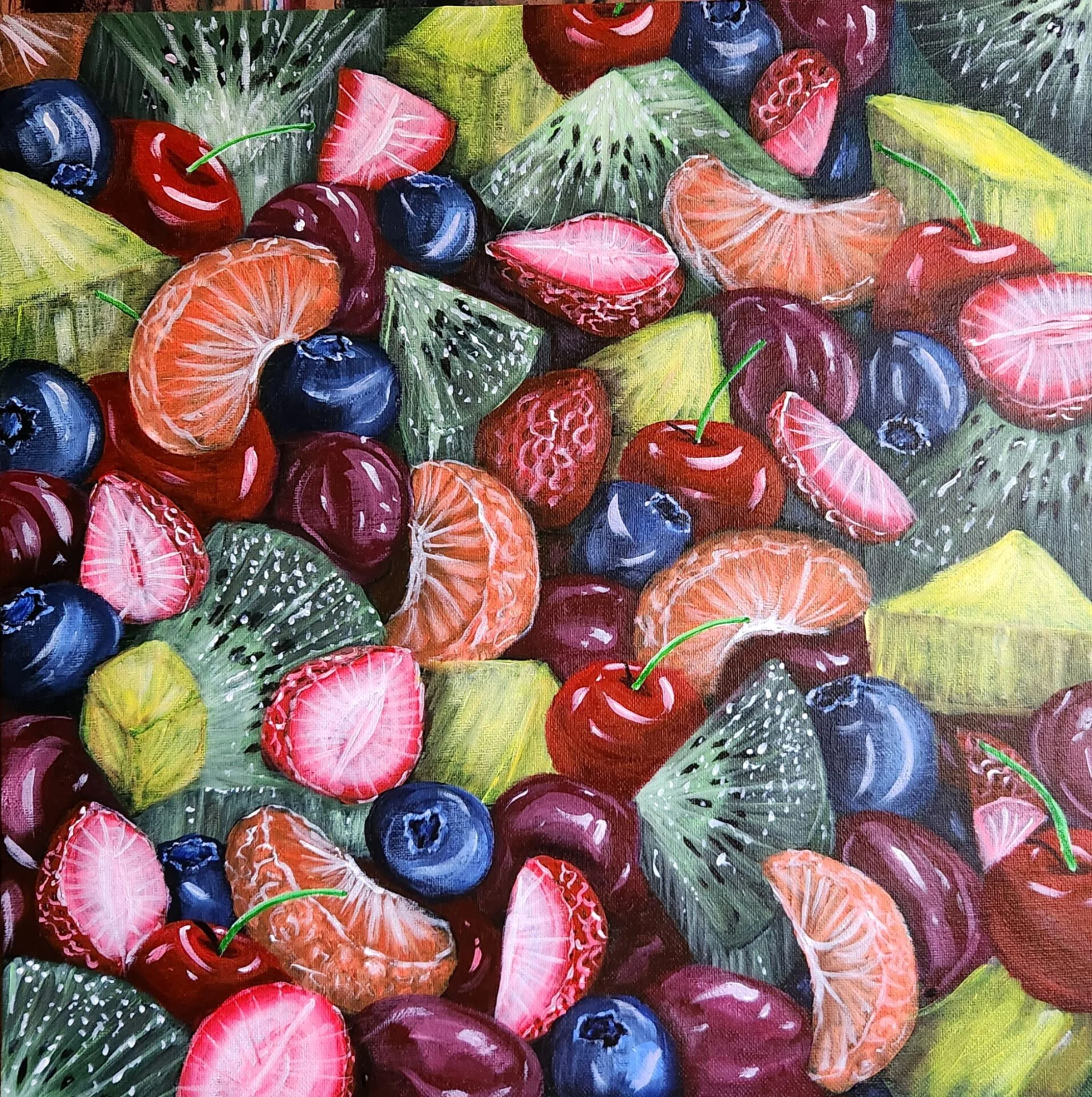
Insider Peek 25: Tutti Fruitti and the Abundance of Ordinary Joy
The Tutti Fruitti collection feels like a celebration of nature at its most generous.
When I look at these fruit paintings together, I see abundance, yes. But not abundance in a loud or excessive way. I see the kind of abundance that sits quietly on a kitchen table. A pear ripening slowly. A mandarin orange peeled open. Grapes gathered in clusters. Strawberries cut in half, revealing their hidden heart. A kiwi slice glowing with tiny seeds. A papaya opened to show its warm orange flesh and dark beads inside.
The Tutti Fruitti collection is about fruit, but it is also about attention.
Fruit can seem ordinary because it belongs to daily life. We buy it, wash it, slice it, offer it, eat it, place it in bowls, pack it in lunch boxes, serve it after meals, bring it to gatherings, exchange it during festive seasons, or leave it on the counter until it becomes fragrant. It is so close to us that we can forget to really look.
But when I paint fruit, I am reminded that nature has already done something astonishing.
A lemon is not only yellow. It is sunlight made edible. A strawberry is not only red. It is sweetness, seed, memory and softness. A grape is not only round. It is a small globe of ripeness holding light. An avocado is not only food. It is texture, nourishment, contrast and quiet fullness.
That is what this series signifies to me: abundance, nature, nourishment, and the joy of noticing what is already here.
Why Fruit Feels So Alive to Paint
Fruit is still life, but it never feels lifeless to me.
Even after it has been picked, fruit carries the memory of growth. It holds the story of sun, rain, soil, patience, season and harvest. It carries the marks of nature’s process: speckles, bruises, shine, rough skin, smooth flesh, seeds, stems, leaves, curves, softness and weight.
This is why fruit is such a beautiful subject for painting. It allows me to study form, colour and texture, but it also carries emotional meaning. Fruit is sensual without needing drama. It is generous without needing explanation. It offers itself to the senses: sight, smell, taste, touch, even memory.
Some subjects ask the artist to invent meaning. Fruit arrives already full of it.
There is cultural meaning too. Mandarin oranges bring ideas of good luck, prosperity and celebration. Grapes suggest harvest and plenty. Lemons suggest brightness, renewal and resilience. Strawberries suggest sweetness and summer. Apples suggest freshness and simple clarity. Pears suggest softness and ripeness. Papaya and kiwi bring tropical warmth, colour and inner surprise.
Together, these paintings become more than a group of fruit studies.
They become a language of nature’s generosity.
A Symphony of Fruits
Some paintings gather many kinds of fruit into one lively conversation.
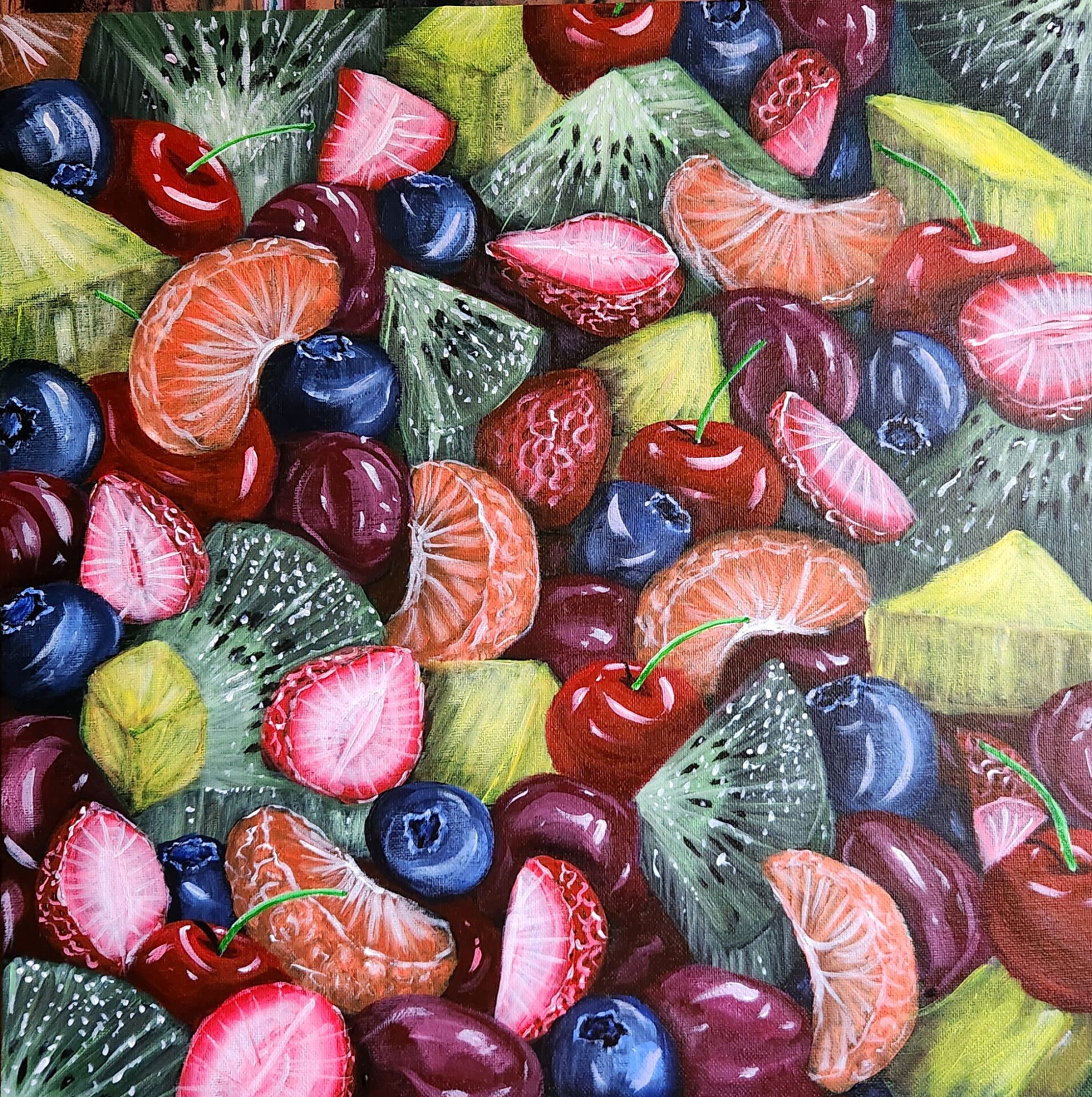
A Symphony of Fruits feels like the heart of the collection because it brings together variety. Each fruit contributes its own colour, shape, texture and personality. The reds, oranges, greens and yellows create a surface that feels lively without becoming chaotic.
This painting makes me think about abundance as harmony.
Abundance is not only having more. It is having many different things coexisting beautifully. Sour and sweet. Soft and crisp. Round and sliced. Bright and dark. Familiar and surprising. A good fruit bowl has this kind of balance. So does a good life.
I like the title A Symphony of Fruits because a symphony is not one note played loudly. It is many notes arranged so that each one has a place. That is what nature does so effortlessly. It gives variety, but it also gives rhythm.
When I painted this kind of subject, I wanted the viewer to feel the pleasure of looking before eating. The pause before the bite. The moment when fruit is still whole enough to admire, but close enough to be enjoyed.
There is generosity in that moment.
Blush Pear and the Beauty of Ripeness
Pears have a quieter presence.
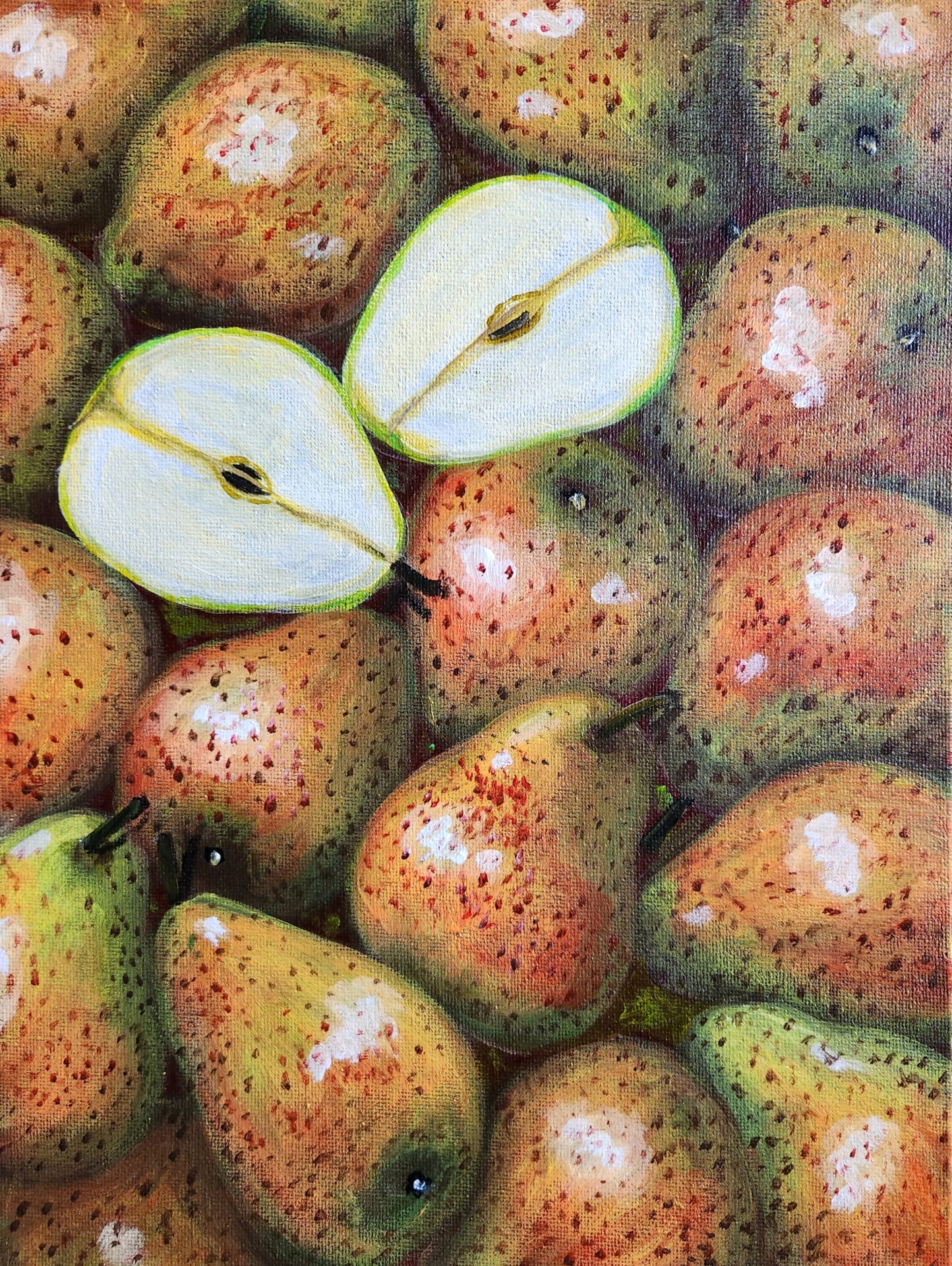
Blush Pear is about softness and patience. Pears do not shout for attention the way citrus or strawberries can. Their beauty is gentler. A pear’s colour shifts quietly from green to yellow to blush. Its skin may carry speckles and uneven marks. Its form is familiar, but never perfectly symmetrical.
I love that.
To paint pears is to honour imperfection. Nature rarely makes things that are mathematically flawless, and yet the result is more beautiful because of the irregularities. The little marks on the skin, the curve that leans slightly, the variation between one pear and another: these details make the subject feel alive.
The sliced pear in the painting also matters. It lets us look inside. It turns the still life into something more intimate. We see the pale flesh, the structure, the quiet promise of sweetness. It reminds me that abundance is not always dramatic. Sometimes abundance is simply ripening in its own time.
That feels like a tender lesson.
We do not always have to bloom loudly.
Sometimes we become ready quietly.
Strawberries and the Sweetness Beneath the Surface
Strawberries are joyful little things.
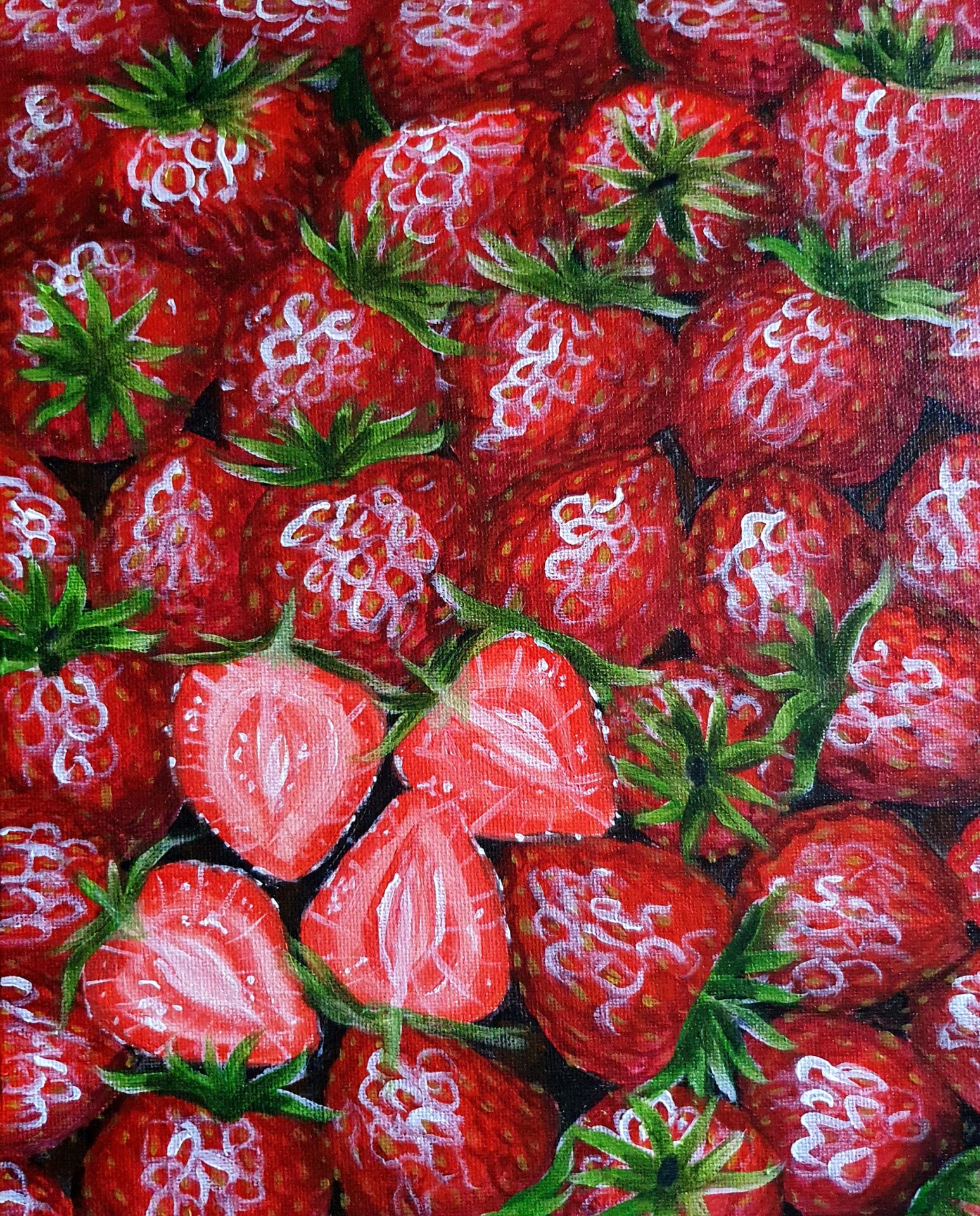
In New Acrylic Painting – Strawberries, the halved strawberries are important to me because they reveal what is usually hidden. From the outside, a strawberry is already beautiful: red, seeded, bright, almost heart-shaped. But when it is cut open, another beauty appears. The inside glows differently. The structure becomes visible. The softness feels more immediate.
That is one of the recurring ideas in Tutti Fruitti: looking beyond the surface.
Fruit is familiar, but familiarity can make us careless. We think we know what we are seeing. Then a cut strawberry, a sliced apple, a halved lemon or an opened avocado reminds us that ordinary things have interiors. They have design. They have layers.
For me, strawberries carry a feeling of summer and small pleasure. They remind me of sweetness that does not need to be complicated. A strawberry can be simple and still feel luxurious. It can be tiny and still hold a whole world of colour.
Painting strawberries is a way of saying: look, this small thing is enough to celebrate.
Lemons and the Brightness of Resilience
Lemons bring a different energy.
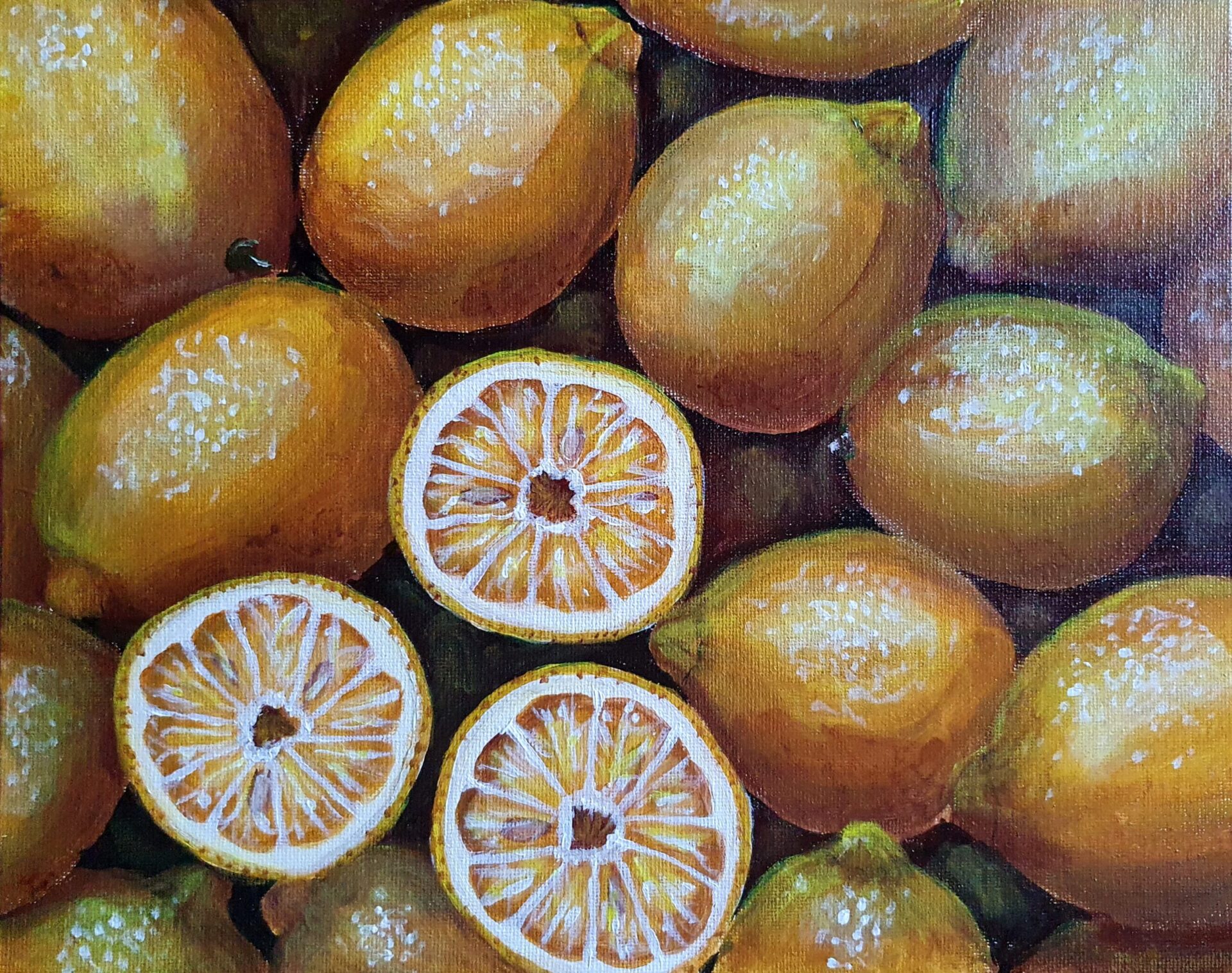
When Life Gives You Lemons naturally carries the familiar saying in its title, but the painting is not only about making the best of difficulty. It is also about the directness of lemons themselves.
Lemons are bright. Sharp. Useful. Fragrant. Their colour feels like sunlight, but their taste has bite. I like this combination because it feels honest. Not all brightness is soft. Some brightness wakes us up.
In painting lemons, I am drawn to the way nature combines beauty and function. The skin has texture. The sliced fruit has radial patterns. The yellow is cheerful, but not superficial. Lemons bring freshness to food, scent to a room, and energy to the senses.
They remind me that positivity is not always gentle sweetness.
Sometimes it is zest.
Sometimes it is the crisp feeling of beginning again.
Mandarin Oranges and Festive Abundance
Mandarin oranges carry cultural warmth for me.
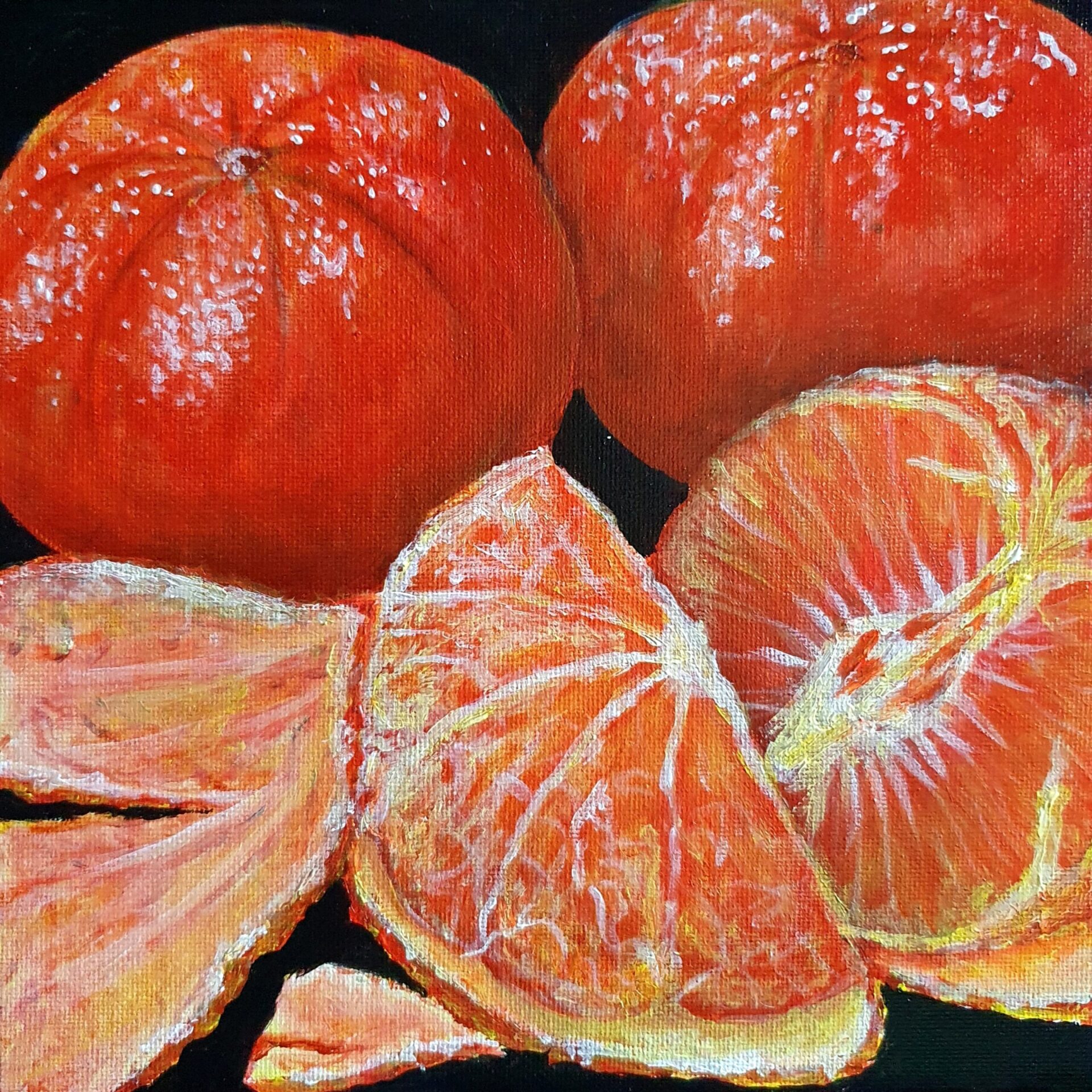
During Lunar New Year, mandarin oranges are exchanged among friends and relatives as symbols of good luck and prosperity. That tradition gives the fruit a meaning beyond taste. A mandarin orange becomes a gesture. A wish. A small round offering of abundance.
In Mandarin Oranges 1, the peeled and whole fruits create a sense of openness. Some are still enclosed in their skins. Others reveal their segments. The orange glow feels warm against the darker ground, and the composition carries both richness and simplicity.
I enjoy painting fruits that have ritual meaning because they connect personal memory with a larger cultural rhythm. Fruit is not only something we consume. It is something we give. Something we place on tables. Something we associate with seasons, blessings, family and celebration.
That is abundance too.
Not only fullness in the bowl, but fullness in the gesture.
Avocado and the Abundance Within
Avocados feel rich in a quieter, earthier way.
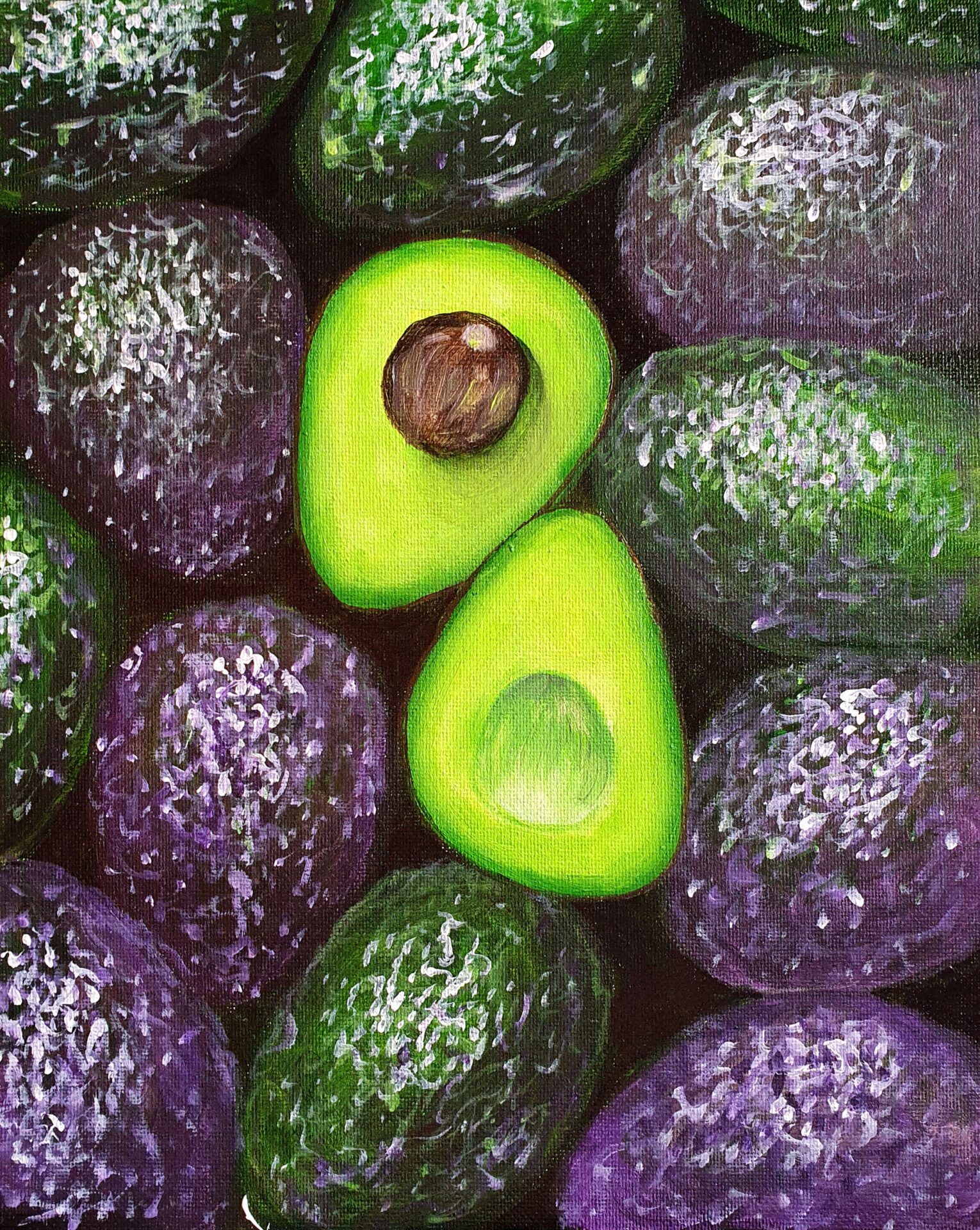
Live Happily Avo After has a playful title, but the painting itself speaks about inner richness. The outer skin is dark and textured. The inside is creamy, green and luminous. The seed sits like a quiet centre.
This contrast fascinates me.
An avocado is not showy in the same way a strawberry or orange can be. It does not rely on sparkle. Its beauty is substantial. It suggests nourishment, wellness and fullness. It also reminds me that nature often hides abundance inside modest forms.
That is one reason I think this series is connected to nature in a deep way. It is not only about pretty colours. It is about the intelligence of natural design. A fruit has protection, flesh, seed, pattern, purpose. It is both beautiful and functional.
When I paint fruit, I am often amazed by how much is contained in something we casually slice open.
Grapes and the Rhythm of Plenty
Grapes are naturally abundant.
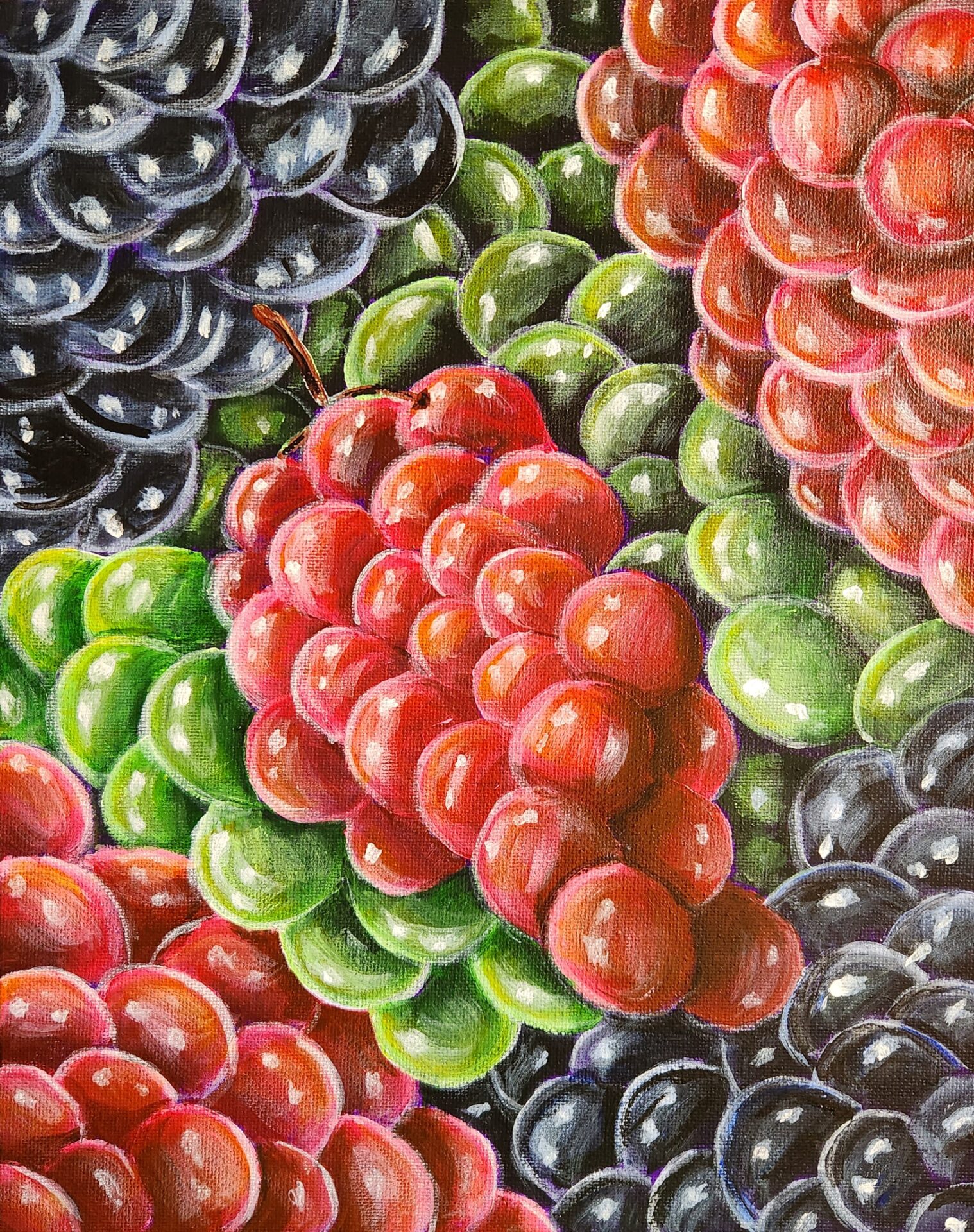
In Bunches of Grapes, the repeated round forms create rhythm. Grapes are small individually, but together they become plentiful. That makes them a beautiful subject for thinking about abundance.
Not every form of plenty comes as one grand object.
Sometimes abundance is repetition. Cluster. Gathering. Many small things held together.
I like painting grapes because the light behaves differently on each one. One grape may catch a highlight. Another may disappear slightly into shadow. A cluster becomes a study in variation, even though the basic form repeats again and again.
That feels true to life too.
The things that sustain us are often small and repeated: meals, conversations, cups of tea, fruit shared after dinner, a bowl placed on the table, the daily return to ordinary nourishment.
Grapes remind me that abundance can be built from many small round moments.
Green Apples and Fresh Clarity
Green apples bring crispness to the collection.
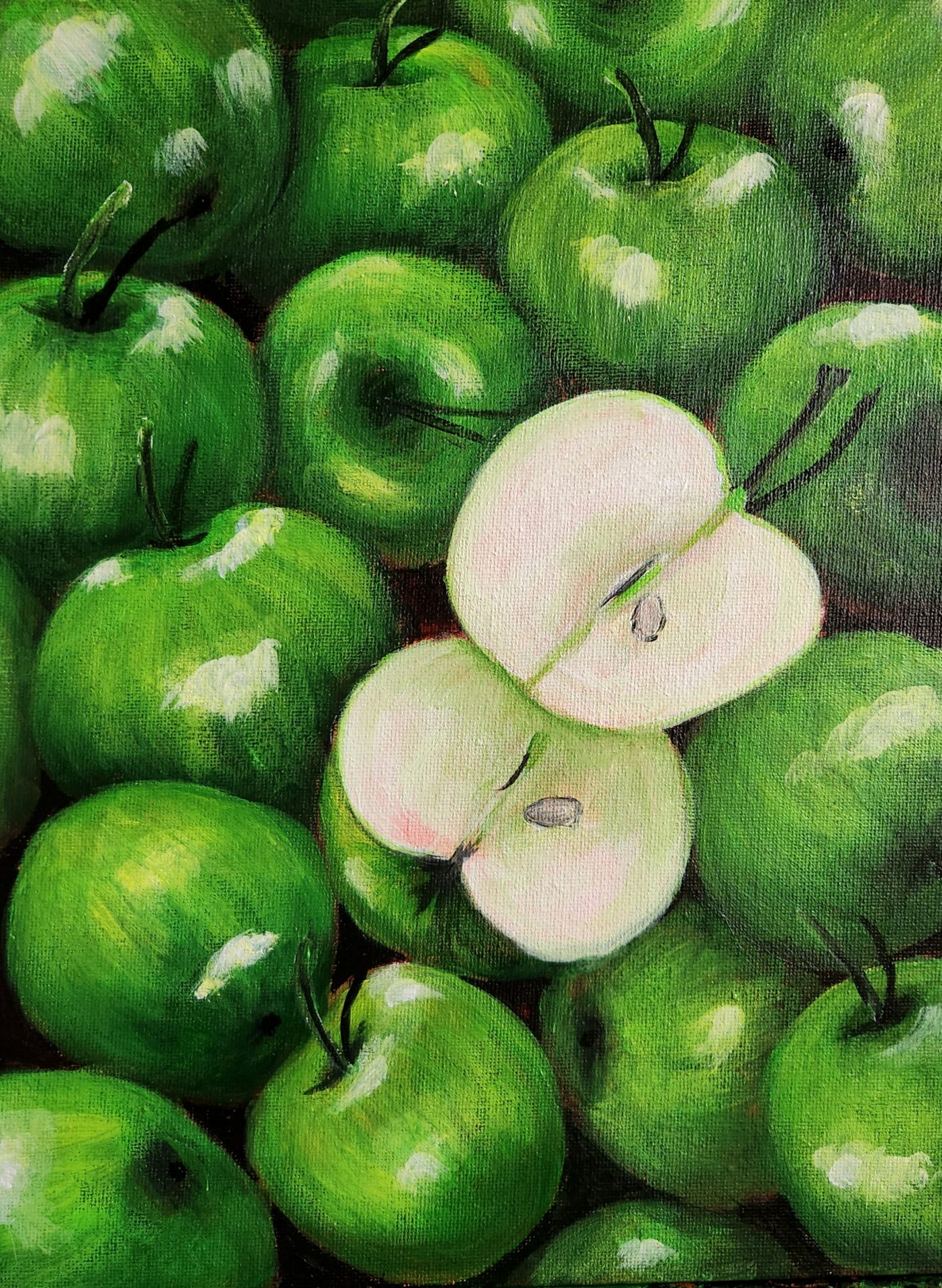
Green Apples feels clean and refreshing. The palette is cooler than the mandarins, lemons or strawberries, and that gives the painting a different emotional temperature. It is still about abundance, but in a more restrained way.
I am drawn to the sliced apple because it reveals structure. The pale interior, the seeds, the crisp edge between skin and flesh: these details make the familiar feel newly interesting.
Sometimes painting fruit is an exercise in respect.
Respect for the things we think we already know. Respect for daily nourishment. Respect for nature’s quiet engineering. Respect for forms that have been painted for centuries and still have something to say.
A green apple can feel simple.
But simplicity is not emptiness.
It can be clarity.
What Tutti Fruitti Signifies to Me
So yes, I do think Tutti Fruitti signifies abundance.
But it is also nature, nourishment, freshness, joy, memory and gratitude. It is a reminder that abundance does not always look extravagant. Sometimes it looks like a bowl of fruit waiting on the table. Sometimes it looks like a shared mandarin orange. Sometimes it looks like a strawberry cut open, a lemon catching light, an avocado revealing its soft green centre.
The collection celebrates the beauty of ordinary things before they disappear into use.
That is the tenderness of still life.
A still life pauses what is usually temporary. Fruit ripens, softens, sweetens, bruises, dries, changes and eventually disappears. To paint it is to hold a moment before it passes. It is to say: this was here, and it was beautiful.
There is something deeply human in that.
We live among temporary things. Meals, seasons, flowers, fruit, gatherings, conversations, moods, light. Art allows us to honour them without pretending they can last forever.
In Tutti Fruitti, I see the abundance of the present moment.
The fullness of colour.
The generosity of nature.
The pleasure of nourishment.
The small joy of looking closely.
Nature on the Table
Fruit reminds me that nature is not somewhere far away.
It is not only in forests, oceans, mountains or gardens. Nature enters our homes quietly. It sits in bowls. It fills kitchens with scent. It stains fingers. It becomes breakfast, dessert, offering, refreshment, decoration, memory.
Painting fruit lets me bring that closeness into focus.
A fruit still life is a small meeting between the natural world and domestic life. It belongs to the table, but it also belongs to the tree, the vine, the field, the rain, the soil. That double belonging gives the subject depth.
When we bring fruit into a room, we bring a little piece of season with us.
That is why these paintings can feel warm in a home. They are not only decorative. They carry associations of care, food, hospitality, family, celebration and sensory pleasure. They remind us that life is not only what we achieve, but also what we taste, share and notice.
The Joy of Everyday Plenty
If Tutti Fruitti has a message, I think it is this:
Do not overlook the everyday plenty.
The world can make us feel that abundance must be rare, expensive, dramatic or difficult to reach. But nature keeps offering smaller forms of abundance all the time. Colour in a strawberry. Pattern in a kiwi. Brightness in a lemon. Warmth in a mandarin. Softness in a pear. Fullness in an avocado. Rhythm in grapes. Crispness in an apple.
These are not small because they are ordinary.
They are ordinary because they are woven into life.
That is what makes them precious.
As an artist, I love returning to subjects like fruit because they remind me to pay attention. They teach me that joy does not always arrive as a grand event. Sometimes joy is a colour relationship. A curved stem. A slice of citrus. A shadow under a pear. A cluster of grapes catching light.
Sometimes joy is simply nature saying, here, look what I made.
And painting becomes my way of answering:
I see it.
I am grateful.
I want to remember.
Leave a Reply