

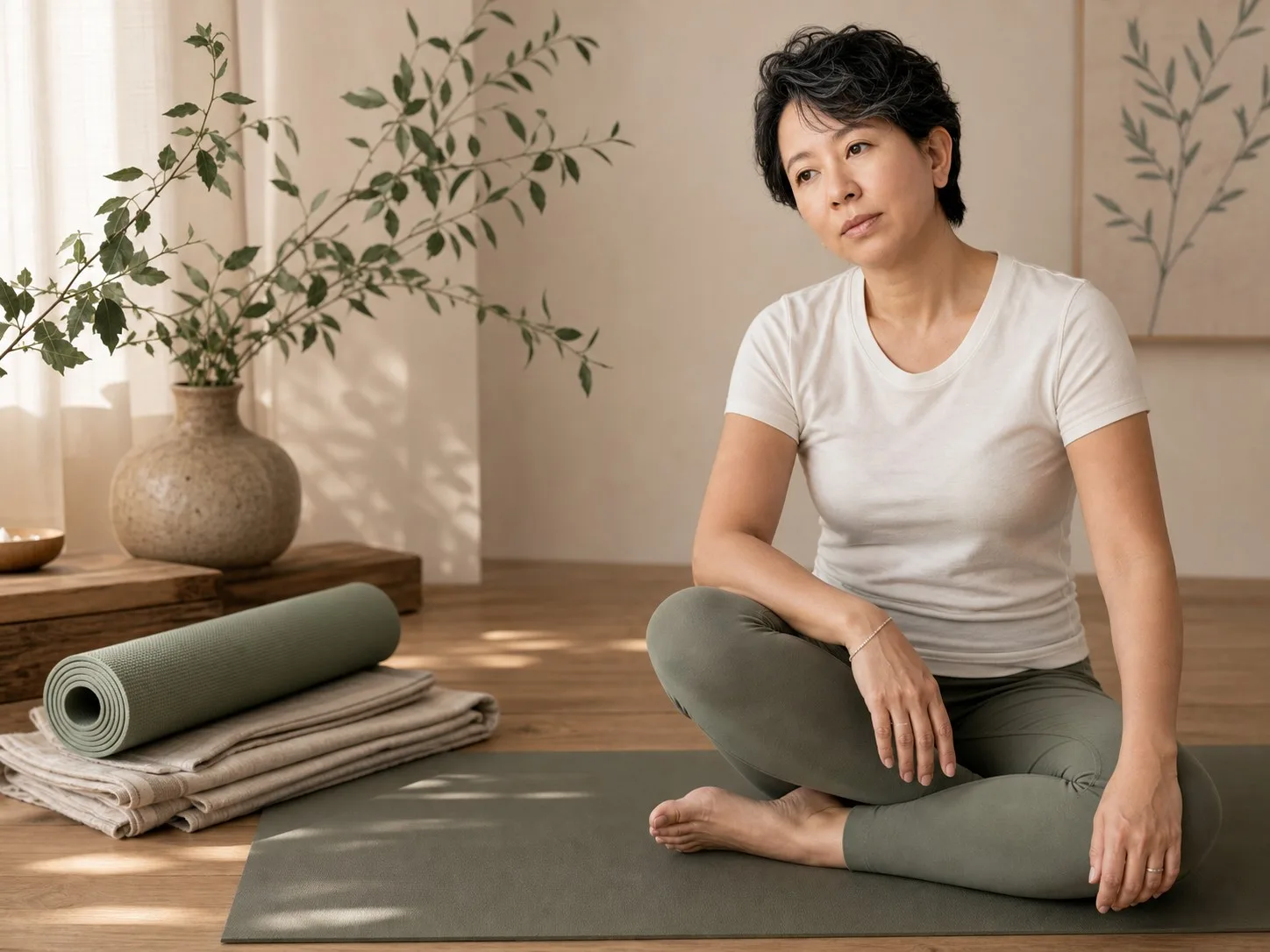
Finding Calm 12: Yoga for the Stressed Mind
A Gentle Practice for When Your Thoughts Will Not Sit Still
A stressed mind can feel very noisy.
Sometimes it is not one clear worry, but many thoughts moving at once. A conversation replays. A task list grows. The body feels tired, but the mind keeps running. Even rest can feel difficult because the moment things become quiet, the thoughts become louder.
This is one of the tender places where yoga can help.
Not because yoga magically removes stress. Not because one breathing technique can fix everything happening in a life. Stress can come from real responsibilities, grief, conflict, financial pressure, caregiving, health concerns, work demands, hormones, trauma, uncertainty or simply too much being carried for too long.
Yoga should never be used to dismiss those realities.
But a gentle yoga practice can give the mind something kinder to return to: the feeling of feet on the floor, the movement of breath, the support of the ground, the rhythm of simple movement, the permission to pause without needing to solve everything immediately.
When the mind is stressed, I do not think the first aim is to become perfectly calm.
The first aim is to become a little less alone inside the experience.
A Safety Note Before Practice
This article is educational and not medical advice. Yoga can support stress care, but it does not replace professional help, therapy, medical care, medication or crisis support when these are needed.
Please seek qualified support if stress is affecting sleep, appetite, work, relationships, mood, safety, concentration or daily functioning. If you feel at risk of harming yourself or someone else, contact emergency services or a local crisis line immediately. If panic, trauma responses, depression or anxiety feel intense or persistent, a mental health professional can offer care that yoga alone cannot provide.
In practice, choose movements and breathing that leave you steadier afterward. If closing the eyes, lying still, focusing on the breath or holding a posture makes you feel more anxious, keep the eyes open, move gently, shorten the practice or stop.
Yoga for a stressed mind should feel supportive, not like another demand.
Why Stress Lives in the Body Too
Stress often feels mental because thoughts become so loud, but the body is usually involved.
The jaw tightens. The shoulders lift. The chest may feel narrow. The belly may grip. The breath may become shallow. The hands may clench. The eyes may work hard. The spine may collapse from tiredness or brace from alertness.
This is why trying to think our way out of stress does not always work.
The mind may understand that worrying is not useful, but the body may still be in a state of readiness. It may still feel as if something needs to be fixed, answered, protected, avoided or controlled. Yoga can help because it speaks through the body. It gives the nervous system repeated signals of steadiness: slow movement, contact with the floor, easy rhythm, softening where possible, and breath that is observed rather than forced.
The point is not to command the mind to calm down.
The point is to create conditions where calm has a place to return.
The Practice Attitude: Less Control, More Contact
When the mind is stressed, it is tempting to turn yoga into another project.
We may think: I must breathe correctly. I must relax. I must stop thinking. I must do enough poses to feel better. I must become calm quickly because I do not have time for this.
That attitude often adds more pressure.
For a stressed mind, I prefer a practice built around contact rather than control. Contact with the ground. Contact with the breath as it is. Contact with the present moment through the senses. Contact with the body without judging what we find.
This changes the question.
Instead of asking, “How do I make my mind quiet?” we might ask, “What can I feel right now that is steady enough to notice?”
The mat beneath the feet.
The support under the sitting bones.
The movement of the ribs.
The warmth of the hands.
The weight of the body being held by the floor.
These are small anchors, but small anchors matter when the mind is crowded.
A Quick Practice Map
| If stress feels like… | Try this | Practise this way |
|---|---|---|
| Racing thoughts | Grounding through feet and slow movement | Keep the eyes open and name physical sensations. |
| Tight chest or shallow breathing | Gentle side bends, supported rest, natural breath awareness | Do not force deep breathing. Let space return gradually. |
| Irritability | Strong but simple standing shapes, then rest | Use steady effort without turning practice into a workout. |
| Overwhelm | Child’s Pose with support or Legs on a Chair | Choose fewer instructions and more support. |
| Exhaustion | Constructive Rest or a short restorative practice | Let the practice be brief and complete. |
| Anxiety in stillness | Seated Cat-Cow, shoulder rolls, walking meditation | Move gently before attempting quiet rest. |
| Mental fog | Mountain Pose, simple balance near a wall, slow flow | Use structure without complexity. |
This map is not a prescription. It is a set of possibilities.
The right practice is the one your body can receive today.
Practice 1: Arriving Through the Feet
When the mind is busy, the feet can become a surprisingly helpful doorway back to the present.
Stand in Mountain Pose with the feet hip-width apart. If balance feels uncertain, stand near a wall or place one hand lightly on a chair. Let the knees be soft. Notice the weight under the heels, the balls of the feet and the outer edges. Feel the toes spread without gripping.
Take three to five natural breaths.
Then gently shift the weight forward and back. Not enough to lose balance, only enough to feel the body responding. Shift side to side. Return to centre.
This is simple, but it can be powerful because stress often pulls awareness upward into the head. Feeling the feet reminds the body that there is ground here. The mind may still be thinking, but now there is also contact.
You do not have to empty the mind.
You only have to include the body.
Practice 2: Shoulder Rolls and Jaw Softening
Stress often gathers around the shoulders, neck and jaw.
Sit or stand comfortably. Inhale naturally as the shoulders move slightly forward and up. Exhale as they roll back and down. Repeat six slow rounds. Then reverse the direction for six rounds.
After that, bring attention to the jaw. Let the teeth separate. Let the tongue soften. Move the jaw gently from side to side if that feels good. Blink the eyes a few times. Let the forehead release.
This tiny sequence can be useful during the day because it does not require a mat, special clothing or much time. It is yoga as interruption: a way of interrupting the stress pattern before it becomes the whole atmosphere of the body.
A stressed mind may not relax immediately, but the body receives the message that it does not have to keep bracing everywhere at once.
Practice 3: Seated Cat-Cow
Seated Cat-Cow is helpful when lying down feels too vulnerable or when the mind needs movement before stillness.
Sit on a chair with the feet on the floor. Place the hands on the thighs. As you inhale, gently lengthen the spine and let the chest open a little. As you exhale, round the back slightly and allow the chin to soften toward the chest.
Move slowly for eight to ten rounds.
The movement does not need to be large. In fact, smaller may be better when the nervous system is already overstimulated. Let the spine move like a quiet wave. Let the breath accompany the movement without forcing it.
This practice gives the mind a simple rhythm to follow.
Inhale, open.
Exhale, soften.
Again and again, not to escape life, but to return to the body that is living it.
Practice 4: Side Bends for More Space
Stress can make the body feel compressed.
A gentle side bend can create a sense of room around the ribs, breath and waist. Sit or stand comfortably. Inhale and reach one arm up if that feels comfortable. Exhale and lean gently to the opposite side. Keep both sides of the neck soft. Stay for two or three breaths, then return to centre and repeat on the other side.
If raising the arm creates shoulder tension, keep the hand on the hip or slide the hand along the side of the chair instead.
The purpose is not to stretch as far as possible. The purpose is to remind the body that space still exists.
Sometimes the stressed mind narrows everything. It makes the future feel tight, the body feel tight, the choices feel tight. A side bend cannot solve the situation, but it can offer a physical experience of widening.
That experience can matter.
Practice 5: Supported Forward Fold
Forward folding can be quieting when it is supported well.
Sit on a chair and place another chair, table or stack of cushions in front of you. Fold forward just enough to rest the arms or forehead on the support. Keep the belly soft. Let the back round naturally without forcing the spine. Stay for one to three minutes.
If folding forward makes the breath feel restricted, come higher. If it feels emotionally uncomfortable, keep the eyes open or choose a seated upright practice instead.
A supported forward fold can give the mind a break from looking outward. The support matters because the body does not have to hold the shape through effort. The head has somewhere to land. The eyes have less to manage. The back can widen.
For some people, this feels like a small cave of quiet.
For others, it may feel too inward. Both responses are valid. Yoga therapy asks us to adapt, not endure.
Practice 6: Legs on a Chair
Legs on a Chair is one of the most useful poses for a stressed and tired mind.
Lie on your back with the calves resting on a chair, sofa or bed. Let the knees bend comfortably. Place a folded towel under the head if needed. Rest the arms where they feel easy: beside the body, on the belly, or one hand on the chest and one hand on the abdomen.
Stay for three to ten minutes.
This posture gives the body a clear message of support. The legs are held. The back is held. The floor is steady. There is nothing to balance, prove or organise.
If lying flat is uncomfortable, raise the upper body with pillows. If stillness increases anxiety, shorten the time or add a small movement such as gently turning the head from side to side.
The mind may continue thinking in this pose. That is not failure.
Each time you notice the mind racing, return to one physical detail: the calves on the chair, the back on the floor, the movement of the breath, the weight of the hands.
The return is the practice.
Practice 7: Constructive Rest
Constructive Rest is a good choice when stress has become exhaustion.
Lie on the back with the knees bent and feet on the floor. Let the feet be wider than the hips and allow the knees to rest toward each other, or place a pillow under the knees. Keep the arms easy. Let the face soften.
Stay for five minutes, or for one minute if that is all you have.
This pose is not dramatic. It does not look impressive. That is part of its medicine.
When the mind is stressed, we may unconsciously believe that everything needs a complicated solution. Constructive Rest offers something quieter: support, breath, gravity, time.
Sometimes the body needs to feel held before the mind can stop scanning for danger.
Breath Awareness Without Forcing
Breathing practices can be helpful for stress, but only when they are kind.
A stressed person does not need to be told to breathe perfectly. In fact, trying to control the breath too much can make some people more anxious, especially if there is panic, trauma history or a feeling of air hunger.
Start with noticing.
Where do you feel the breath most easily? At the nostrils? The chest? The ribs? The belly? The back? The hands resting on the body?
Stay there for a few breaths.
If it feels comfortable, allow the exhale to become slightly longer than the inhale. Not by force. Not by strict counting. Just a small softening. You might imagine the exhale as a sigh that does not need to be loud.
If counting helps, try inhaling for three and exhaling for four. If counting becomes another task, let it go.
The breath should feel like company, not homework.
A Five-Minute Practice for a Busy Day
This short practice can be done between tasks, before a meeting, after difficult news, or anytime the mind feels crowded.
- Stand or sit and feel the feet, thirty seconds.
- Roll the shoulders slowly, six rounds each direction.
- Practise Seated Cat-Cow, eight rounds.
- Take a gentle side bend, two breaths each side.
- Sit still with one hand on the chest and one hand on the belly, one minute.
- Name one thing you can feel, one thing you can hear, and one thing you can see.
That is enough.
A short practice done with attention is not inferior to a long practice done with pressure.
For stress, small pauses can become powerful because they change the pattern of the day. They create spaces where the nervous system is not being pushed from one demand into the next.
A Fifteen-Minute Practice for Evening
Evening stress often carries the residue of the whole day.
Try this if the body is tired but the mind is still busy:
- Seated Cat-Cow, two minutes.
- Shoulder rolls and jaw softening, two minutes.
- Supported Forward Fold, three minutes.
- Legs on a Chair, five minutes.
- Constructive Rest, three minutes.
Keep the lights low. Avoid making the sequence complicated. Let the practice become a bridge between the demands of the day and the possibility of rest.
If sleep is difficult, do not turn the practice into a test of whether you can fall asleep. Let it be enough that the body has been given a quieter place to land.
Sleep may come.
It may not.
But care has still happened.
When the Mind Will Not Stop Thinking
One of the most common frustrations in yoga is the belief that a good practice means having no thoughts.
But minds think. That is what they do.
A stressed mind may think even more because it is trying to protect, solve, prepare, review or prevent. The aim of yoga is not to punish the mind for doing this. The aim is to notice the thinking and gently widen the field of attention.
There are thoughts.
And there is also the breath.
There are worries.
And there is also the floor.
There is planning.
And there is also the feeling of the hands.
This is important because stress narrows attention. It makes the problem feel like the only reality. Yoga can remind us that the problem may be real, but it is not the only thing present.
The body is present too.
Support is present.
This breath is present.
This moment, even if imperfect, is present.
What to Avoid When the Mind Is Overloaded
When stress is high, more intensity is not always better.
You may want to reduce or avoid:
- Hot yoga if heat makes the body feel more agitated.
- Fast flows when the mind already feels rushed.
- Strong breath retention or forceful breathwork.
- Long silent holds if stillness increases anxiety.
- Complicated sequences that create frustration.
- Comparing your practice to what you used to do.
- Using yoga as a way to ignore problems that need action or support.
This does not mean challenging practice is always wrong. Some people find steady strength work helpful when stress feels like restlessness or irritability. But the practice should be chosen carefully. It should help the body process energy without leaving it more wired.
A useful question is: after this practice, do I feel clearer, kinder and more steady, or more strained?
Let the answer guide you.
Making Yoga Part of Stress Care
Yoga works best for stress when it becomes ordinary.
Not another impossible routine, but a set of small practices you can actually use. Three breaths before replying to a message. Feet on the floor before a difficult conversation. Shoulder rolls while waiting for the kettle. Legs on a Chair after work. A short restorative practice before bed.
These moments may seem too small to matter, but stress often builds through repetition. So calm can also be rebuilt through repetition.
A little steadiness, repeated often, becomes a different kind of inner climate.
You might create your own stress care menu:
- One practice for the morning.
- One practice for work breaks.
- One practice for evening.
- One practice for days when you are too tired to do much.
Keep it simple enough that you will actually return to it.
The Kindness of a Smaller Practice
There is something humbling about practising yoga when the mind is stressed.
We may arrive wanting transformation. What we may actually need is a smaller beginning: unclenching the jaw, feeling the feet, taking one supported rest, letting the exhale soften slightly.
But these small beginnings are not small in their effect.
They teach the nervous system that we can pause. They teach the mind that it does not have to carry every thought at once. They teach the body that it is allowed to receive support before collapse.
Sometimes calm returns as a dramatic shift.
More often, it returns quietly.
A little more space in the chest.
A little less grip in the hands.
A little more breath.
A little more patience.
That is enough to begin.
Returning to Yourself
Yoga for the stressed mind is not about becoming a perfectly peaceful person.
It is about returning to yourself in the middle of life as it is.
There may still be emails, responsibilities, uncertainty, noise and emotion. There may still be situations that need action. Yoga does not erase the world outside the mat. But it can change how we inhabit the body that has to meet that world.
It can remind us that we are allowed to pause.
Allowed to breathe without performing calm.
Allowed to rest before everything is finished.
Allowed to ask for help.
Allowed to be human.
For a stressed mind, this is already a meaningful practice.
Not escape.
Return.
Again and again, through the feet, the breath, the ground, the body, the present moment.
A quieter place may not be far away.
It may begin with one small act of contact.
Leave a Reply