

Finding Calm 11: Yoga for Hot Flushes in Perimenopause
Cooling the Body Without Fighting the Season You Are In
Hot flushes can feel as if the body has suddenly changed the weather from the inside.
One moment you may feel ordinary. The next, heat rises through the chest, neck, face or scalp. The skin may redden. Sweat may appear quickly. The heart may feel faster. There may be a wave of irritation, embarrassment, anxiety or exhaustion. At night, the same heat may arrive as night sweats, interrupting sleep and leaving the body tired before the day even begins.
Perimenopause can make these heat surges feel unpredictable. They may come during work, rest, conversation, exercise, sleep, or a quiet moment when nothing obvious seems to have caused them. That unpredictability can be one of the hardest parts. It is not only the heat. It is the sense of not knowing when the body will suddenly ask for attention.
Yoga cannot promise to stop hot flushes. It should not replace medical care, especially if symptoms are severe, new, disruptive or worrying. But yoga can offer a gentler way to meet the body when heat is part of the season. A cooling practice can reduce extra strain, support steadier breathing, calm the nervous system and help us make wise choices about movement, rest and recovery.
The aim is not to defeat the flush.
The aim is to stop adding fuel to it.
A Safety Note Before Practice
Hot flushes and night sweats are common during perimenopause and menopause, but common does not mean they must be ignored. Speak with a qualified healthcare professional if symptoms disturb sleep often, affect daily life, come with chest pain, fainting, unexplained weight loss, fever, unusual bleeding, severe mood changes, new neurological symptoms, or anything that feels alarming.
This article is educational and not medical advice. Yoga can be a supportive practice alongside appropriate healthcare, but it is not a diagnosis or treatment plan. Medication, hormone therapy, non-hormonal medical options, mental health support, pelvic health care or other approaches may be appropriate for some people.
The most important yoga principle here is simple: choose practices that leave you cooler, steadier and less depleted afterward.
If a practice makes you hotter, breathless, dizzy, agitated or ashamed of your body, it is not the right practice for that moment.
Understanding the Heat Response
A hot flush is not a failure of discipline.
It is not weakness. It is not overreacting. It is not something you should be able to control through willpower.
During perimenopause, hormonal fluctuations can affect the body’s temperature regulation. The internal range in which the body feels comfortable may become narrower, so a small trigger can sometimes create a strong heat response. Stress, alcohol, spicy food, warm rooms, poor sleep, tight clothing, dehydration, caffeine, rushing, emotional pressure and intense exercise may all affect some people, although triggers vary from person to person.
From a yoga therapy perspective, this matters because the practice environment and pacing become part of the practice itself.
A heated room, fast flow, strong breath retention, competitive effort or long holds in powerful poses may be unsuitable when hot flushes are active. That does not mean strength is forbidden forever. It means the body may need a different relationship with intensity.
For hot flushes, yoga becomes less about pushing heat through the body and more about creating conditions for cooling, steadiness and recovery.
What Cooling Yoga Feels Like
A cooling yoga practice is not lazy. It is intelligent.
It may include slower transitions, supported postures, longer exhalations, simple breath awareness, relaxed jaws, soft hands, spacious clothing, a cool room and permission to pause. It may use props generously. It may avoid rushing from pose to pose. It may choose the floor over standing work when the body is tired.
Cooling yoga often has these qualities:
- The breath is natural, not forced.
- The face, throat and belly are not held tightly.
- The room is well ventilated.
- Movements are smooth rather than sharp.
- Rest is included before the body is exhausted.
- Strong heating breathwork is avoided.
- The practice can be shortened without guilt.
This last point matters.
During perimenopause, consistency does not have to mean doing the same long practice every day. Sometimes consistency means returning to a wise practice for five minutes instead of forcing a forty-minute session that leaves the body overheated and resentful.
A Quick Cooling Practice Map
| When hot flushes feel… | Try this kind of practice | Keep in mind |
|---|---|---|
| Sudden and intense | Pause, sit or lie down, soften the breath, cool the face and neck | Do not force deep breathing if it makes you anxious. |
| Linked to stress | Slow exhalation, supported forward rest, legs on a chair | Choose steadiness over perfect technique. |
| Worse at night | Evening restorative practice, low light, cooling room, simple breath awareness | Avoid strong late-night flows. |
| Triggered by exercise | Shorter sessions, slower transitions, more rest between poses | Strength can return gradually when the body feels ready. |
| Paired with fatigue | Constructive rest, supported child’s pose, reclined rest | Stop before depletion. |
| Paired with anxiety | Grounding poses, open eyes, longer exhale, hands on body | Make the practice feel safe, not impressive. |
Before You Begin: Set Up the Room
For hot flushes, the setup can make a real difference.
Before practising, open a window if possible, switch on a fan, loosen tight clothing and keep water nearby. Use a lighter mat cover if the surface feels warm. If you use blankets or bolsters, choose support that feels comfortable without trapping too much heat.
It can help to keep a small towel nearby for the face, neck or chest. Some people enjoy placing a cool cloth near the back of the neck before or after practice. Others prefer simply to reduce layers and keep the practice quiet.
The body may already be working hard to regulate temperature. The room should not become another challenge.
This is part of yoga too.
A practice begins with the conditions we create around the body.
Practice 1: Cooling Pause
When heat rises suddenly, the first practice is not a pose. It is a pause.
Sit down if you are standing. If you are already lying down, roll slightly to one side or come into a supported seated position if that feels better. Let the hands rest somewhere easy: thighs, belly, chest or the floor. Soften the jaw. Let the tongue release from the roof of the mouth. Notice whether the shoulders have lifted toward the ears.
Then breathe normally for a few rounds.
Not perfectly.
Normally.
If it feels supportive, gently lengthen the exhale by a small amount. For example, inhale naturally and exhale a little slower, without counting in a strict way. The breath should feel like a soft settling, not a task.
This cooling pause is useful because hot flushes can sometimes create a secondary wave of panic: Why is this happening now? Will people notice? How long will it last? What if I cannot sleep again tonight?
The pause gives the body fewer demands.
It says: I do not need to fight this moment. I can make space for it to pass.
Practice 2: Supported Child’s Pose
Supported Child’s Pose can be soothing when the body wants quiet and containment.
Place a bolster, firm pillow or folded blankets lengthwise in front of you. Kneel with the knees apart enough to make space for the belly and chest. Fold forward onto the support and turn the head to one side. If kneeling is uncomfortable, skip this pose and choose Legs on a Chair instead.
Stay for one to three minutes, or less if heat builds.
This pose can feel cooling because the body is supported, the back can widen, and the breath can settle without effort. It also gives the eyes a break from stimulation. For some people, however, any enclosed shape can feel too warm or too emotionally intense during a flush. If that happens, lift higher, use fewer blankets, widen the knees, or come out.
The pose should feel like shelter, not pressure.
Practice 3: Legs on a Chair
Legs on a Chair is one of my favourite practical choices for hot flushes, night sweats and tired legs.
Lie on your back with the calves resting on a chair, sofa or bed. Let the knees bend comfortably. Place a folded towel under the head if needed, but avoid raising the head too high. Rest the arms slightly away from the body, palms up or down. Keep the chest open and the belly soft.
Stay for three to eight minutes.
This shape offers rest without the intensity that some people feel in Legs Up the Wall. It can help the body feel grounded, supported and less effortful. Because the legs are supported, there is no need to hold the posture. Because the torso is open, the breath can remain natural.
If lying flat increases reflux, breathlessness or discomfort, raise the upper body with pillows or choose a reclined seat instead.
For night sweats, this pose can be helpful before bed, especially when combined with low light and a cooler room. It is not a guarantee of uninterrupted sleep, but it may help the body shift away from the rush of the day.
Practice 4: Reclined Bound Angle With Plenty of Space
Reclined Bound Angle can be calming, but for hot flushes it needs to be adapted carefully.
Lie back over a low bolster or folded blanket so the chest is gently open, not dramatically arched. Bring the soles of the feet together and let the knees open, supporting each thigh with blocks, cushions or folded blankets. If the groins or lower back feel strained, move the feet farther away or choose Constructive Rest with the knees bent instead.
Stay for two to five minutes.
The key is spaciousness. Nothing should feel stretched to the point of effort. The throat should feel open. The breath should not be controlled. The support should not be so heavy that it traps heat around the body.
This pose may be useful when hot flushes are connected with emotional tension, chest tightness or the feeling of being wound up. It gives the front body a little room, while the props remind the body that it does not have to hold itself together alone.
Practice 5: Supported Forward Fold on a Chair
Forward folding can be calming, but deep forward folds can feel too intense. A chair version is often kinder.
Sit on the floor, on a folded blanket, or on another chair facing a chair in front of you. Place folded blankets or a pillow on the chair seat. Fold forward just enough to rest the forehead or crossed arms on the support. Keep the belly soft and the back broad.
Stay for one to three minutes.
This pose can be especially useful when the mind is busy and the body feels overstimulated. The support under the head may encourage a sense of quiet. The practice becomes less about flexibility and more about giving the nervous system a point of contact.
If the pose makes breathing feel restricted, come higher. If heat rises, come out and sit upright.
A cooling practice should always allow exit.
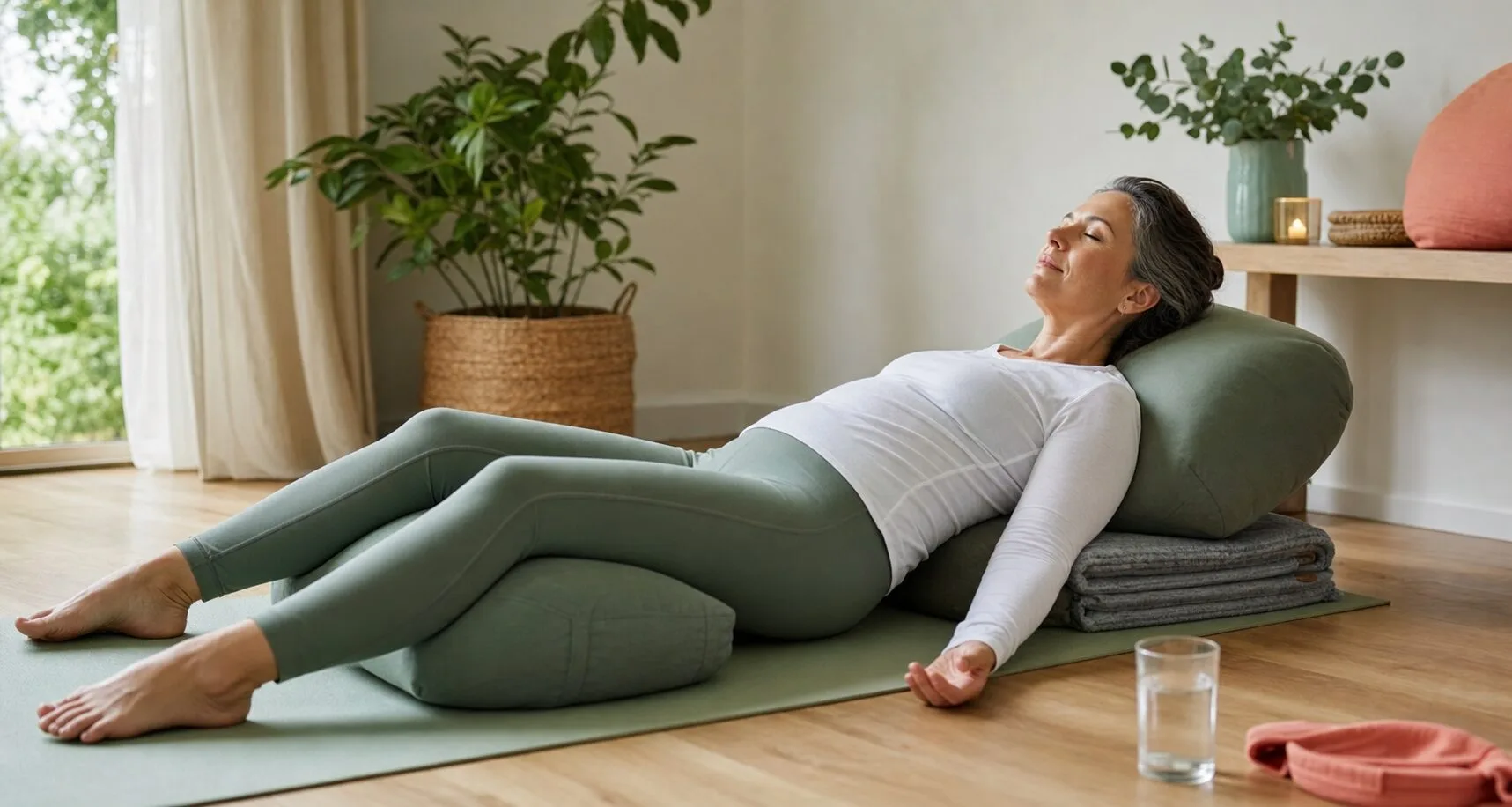
Practice 6: Constructive Rest
Constructive Rest is simple, but it can be powerful because it asks for almost nothing.
Lie on your back with the knees bent and feet on the floor, hip-width apart. Let the knees rest toward each other if that feels comfortable, or place a pillow under them. Allow the arms to rest away from the body. Keep the face soft.
Stay for five minutes, or even one minute on a difficult day.
This is a useful posture when the body is tired from repeated hot flushes or broken sleep. It does not require stretch, strength or balance. It gives the back a neutral place to rest and lets the body feel the support of the ground.
During perimenopause, rest can feel complicated. There may be frustration, impatience or grief about what the body used to tolerate. Constructive Rest can become a small practice of friendliness: I can be with this body as it is today.
That emotional shift matters.
Breath Awareness for Cooling
Breath practices need care during hot flushes.
Strong breathwork can be too stimulating for some people. Breath retention, rapid breathing, forceful pumping techniques and intense heating pranayama may increase agitation or heat. Even slow breathing can feel uncomfortable if it becomes too controlled.
Start with awareness before technique.
Notice the breath at the nostrils, chest, ribs or belly. Let the exhale soften slightly. If counting helps, try inhaling for a comfortable count and exhaling one count longer. If counting creates pressure, drop it.
Some people find gentle humming on the exhale calming. Others prefer silent breathing. Some may enjoy cooling breath techniques such as sitali or sitkari, but these are not suitable for everyone and may irritate sensitive teeth, jaw, throat or breathing patterns. Practise them only if they feel comfortable and you have been shown how to do them safely.
The breath should never become another place where you bully the body.
For hot flushes, the kindest breath is often the one that says: I am here. I am safe enough. This wave can pass.
What to Avoid When Hot Flushes Are Active
A perimenopause yoga practice may need fewer heating elements, at least during phases when hot flushes are frequent.
You may want to reduce or avoid:
- Hot yoga or heated rooms.
- Long, fast vinyasa flows without rest.
- Strong breath retention.
- Forceful kapalabhati or bhastrika-style breathwork.
- Long holds in very demanding standing poses.
- Over-layering with heavy blankets during restorative practice.
- Practising intensely late at night.
- Pushing through dizziness, nausea, chest discomfort or unusual symptoms.
This does not mean the body has become fragile. It means the practice is becoming more responsive.
Strength, mobility and confidence still matter during perimenopause. But strength does not have to be practised in a way that overwhelms temperature regulation. A wiser approach may be to practise strength in shorter sets, rest more often, keep the room cool and notice how the body responds over the next few hours.
Yoga is not only what happens on the mat.
It is also the listening afterward.
A Short Cooling Sequence
Here is a simple practice for days when heat is present or has been disrupting sleep.
Move slowly. Keep the room cool. Stop if symptoms increase.
- Cooling Pause, one minute.
- Seated shoulder rolls, six slow rounds.
- Seated side bend, three breaths each side.
- Supported Child’s Pose or Supported Forward Fold, one to three minutes.
- Legs on a Chair, three to six minutes.
- Constructive Rest, two to five minutes.
- Natural breath awareness, one minute.
This can be a full practice.
It does not need to become more impressive.
If you only do the Cooling Pause and Legs on a Chair, that is still yoga. If you only sit quietly and let the breath return to itself, that is still practice. During hot flushes, the success of yoga is not measured by how much you achieve, but by whether the body feels less alone afterward.
A Night Sweat Version
Night sweats can be particularly tiring because they interrupt the deep rest the body needs.
For evening practice, keep things even simpler:
- Dim the lights.
- Avoid a strong flow close to bedtime.
- Practise Legs on a Chair for five minutes.
- Add Constructive Rest for three minutes.
- Let the exhale soften without forcing.
- Keep water and a light layer nearby.
If you wake hot at night, try not to turn the moment into a battle. Change what needs changing: bedding, clothing, fan, water, towel. Then return to one small anchor such as the feeling of the back body on the bed or the natural movement of the breath.
The body does not need a lecture at 3 a.m.
It needs care.
The Emotional Side of Hot Flushes
Hot flushes can bring emotions that are not always discussed.
There may be embarrassment when heat rises in public. Frustration when sleep is broken again. Sadness when the body feels less predictable. Anger when symptoms are dismissed. Anxiety about ageing, visibility, sexuality, work, family roles or identity.
These feelings deserve compassion.
Yoga is not only a set of postures for managing symptoms. It can also become a place where we stop treating the body as an inconvenience. Instead of asking, “How do I make this stop right now?” we might ask, “What would help me feel supported through this wave?”
That question is softer.
It is also more realistic.
Some waves may still be uncomfortable. Some nights may still be interrupted. Some seasons may need medical help, lifestyle changes or deeper support. But within that, yoga can offer moments of agency. A choice to pause. A choice to cool the room. A choice to rest before exhaustion. A choice to practise without shame.
Perimenopause can make the body feel unfamiliar, but unfamiliar does not mean unworthy.
This body is still yours.
It deserves patience while it changes.
Building Your Own Cooling Menu
Instead of waiting until a hot flush arrives, it can help to create a small personal cooling menu.
Write down three things that usually help. They might include a fan, water, lighter clothing, Legs on a Chair, a cooling cloth, stepping outside for air, lowering the lights, cancelling a heated class, or choosing a shorter practice.
Then write down three things that tend to make heat worse. These might include rushing, strong evening exercise, spicy food, alcohol, stress, warm rooms, tight waistbands, heavy blankets or forcing breathwork.
This is not about becoming rigid. It is about becoming observant.
Patterns are useful when they are held gently.
Over time, you may discover that your body has specific needs. Perhaps morning practice works better than evening. Perhaps restorative yoga helps sleep, but only with fewer blankets. Perhaps standing poses are fine if you rest between them. Perhaps hot flushes are worse after days of poor sleep, and the most helpful practice is not more effort, but earlier rest.
That is the heart of yoga therapy: learning the language of your own body.
A Kinder Relationship With Heat
I think the most important part of yoga for hot flushes is not a single pose.
It is the relationship we build with the body when heat comes.
Can we respond without panic? Can we reduce shame? Can we make room? Can we stop pushing through every signal? Can we choose cooling without making the body wrong for needing it?
Hot flushes can feel disruptive, and sometimes they are. They can interrupt sleep, confidence, work and ordinary comfort. But they can also teach us to become more honest about our limits and needs. They ask us to stop pretending the body is a machine. They ask us to listen sooner.
A cooling yoga practice is one way of answering that request.
Not with control.
With care.
The body may be changing, but it is not betraying you. It is moving through a transition that deserves support, information and tenderness. On the mat, that support may look very simple: a cool room, a softened breath, a supported posture, a pause before the next demand.
Sometimes calm begins there.
Not when the heat disappears completely, but when you no longer have to meet it with fear.
Leave a Reply