

When Breathing Becomes Another Thing to Get Right
The instruction to “take a deep breath” sounds simple. Yet the moment we try to do it, the breath can become surprisingly complicated.
We may pull in too much air, lift the shoulders, tighten the throat or begin measuring every inhale against an idea of what a good breath should feel like. Instead of becoming calmer, we become more aware of effort. The practice quietly turns into another task to perform correctly.
Gentle breath awareness begins somewhere else. It begins by noticing the breath that is already happening.
There is no demand to make it longer, deeper, smoother or more impressive. We simply become curious about where the breath can be felt and how it changes from one moment to another. This creates a softer relationship with breathing: less like controlling a machine and more like listening to a living rhythm.
This is the third reflection in my Finding Calm series. The first explored why rest is a practice, and the next looked at the value of personalised yoga therapy. Here, I want to stay with one of the simplest foundations of yoga: learning to pay attention to the breath without forcing it.
Breath Awareness and Breath Control Are Not the Same
Breath awareness means observing breathing as it is. Breath control means deliberately changing its pace, depth, pathway or rhythm.
Both can have a place in yoga. Traditional pranayama includes many purposeful breathing techniques, and some people find structured breathing supportive. But awareness is an important foundation because it helps us recognise what is happening before we decide whether anything needs to change.
Without that foundation, it is easy to impose a technique on the body.
Someone may try to breathe slowly even though the inhale feels strained. Another person may force the abdomen outward because they have been told this is the correct way to breathe. A rigid count may be comfortable one day and unpleasant the next. Breath holds may feel steady for one practitioner and unsettling for another.
Gentle awareness leaves room for these differences.
The question is not, “Am I breathing properly?” It is, “What can I notice right now?”
That small change in language matters. It replaces judgement with observation. It also allows the breath to remain responsive to posture, emotion, movement, fatigue and the surrounding environment.
Why We Often Try Too Hard
Many of us approach wellbeing practices with the same habits we bring to work and daily responsibilities. We want to improve quickly. We look for the right technique, the ideal duration and a clear sign that the practice is working.
Breathing can become caught inside this achievement mindset.
We may assume that a bigger inhale is always better, that the belly must move in a particular way, or that calm should arrive after a certain number of rounds. When it does not, we may conclude that we are bad at breathing or unable to relax.
But breathing is not a performance. It is an ongoing relationship between the body, the nervous system and the situation we are in.
The natural breath may be light while resting, fuller after movement, uneven during emotion or temporarily shallow when the body feels guarded. Observing these variations does not mean approving of discomfort or ignoring a medical concern. It means gathering information without immediately fighting what we find.
Sometimes the effort to calm down becomes another source of tension. Releasing the demand for a particular outcome can be the first calming step.
What Gentle Breath Awareness Can Offer
Breath awareness gives the mind a present and changing point of attention. Unlike a fixed object, the breath moves. Each inhale appears, develops and ends. Each exhale follows, and no two cycles are exactly alike.
This can help interrupt the habit of living entirely inside thoughts about the past or future. We do not need to stop thinking. We simply include another experience in awareness.
The National Center for Complementary and Integrative Health describes breathing exercises among relaxation techniques that may help bring about the body’s relaxation response. Research into specific benefits varies in quality, so it is better to regard breath practice as supportive rather than as a cure or guaranteed treatment.
The most immediate benefit of simple awareness may be that it helps us notice effort. We may discover that the jaw is clenched, the shoulders are raised or the abdomen is being held. We can then choose whether to soften, change position or pause.
Awareness creates options.
It may also teach us that calm is not always a dramatic feeling. Sometimes calm appears as one less layer of effort. The breath remains ordinary, but we stop interfering with it quite so much.
Where Can You Feel the Breath?
People often assume breath awareness must mean watching the abdomen rise and fall. That is one possibility, but it is not the only one.
You might notice:
- air passing at the nostrils;
- a small movement beneath the collarbones;
- the side ribs widening;
- the back ribs pressing gently into a chair or floor;
- the abdomen changing shape;
- the sound of the exhale;
- or the overall sense of the body breathing.
There is no prize for feeling the breath in a particular place.
Some areas may be easy to sense and others almost absent. The breath may feel different on the right and left sides. It may seem clearer while lying down than while sitting. These are observations, not failures.

Touch can sometimes make subtle movement easier to feel. You might rest one or both hands lightly on the lower ribs or abdomen. The hands are there to listen, not to push. If touch makes you self-conscious or uncomfortable, leave the hands wherever they can rest easily.
A Five-Minute Practice for Natural Breath Awareness
This short practice does not use breath holds, fixed ratios or deep breathing. It can be done seated, reclined or lying on one side.
1. Choose a Position That Requires Less Effort
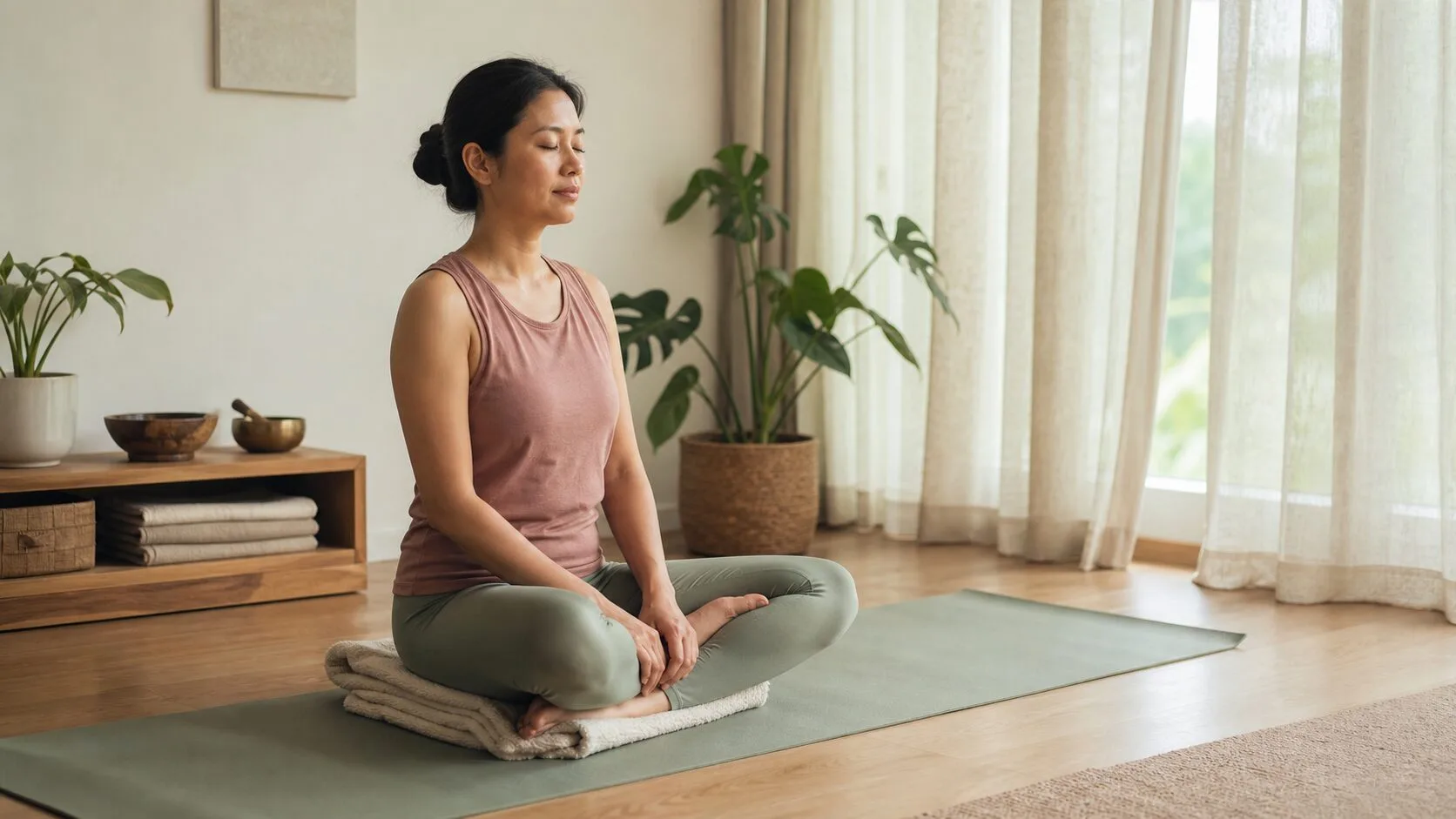
Sit with your back supported, place a folded blanket beneath the hips, or lie down with the knees supported. Comfort does not need to be perfect, but the position should not demand constant muscular work.
Let the hands rest naturally. Keep the eyes open with a soft gaze if closing them feels uncomfortable.
2. Notice Contact Before Breath
Feel the places where the body meets the chair, floor, mat or cushions. Notice temperature and sound. This helps establish a wider field of awareness before focusing on breathing.
3. Find One Clear Sensation of Breathing
Choose the nostrils, ribs, abdomen or another place where movement is reasonably easy to detect.
You do not need to follow the entire breath. Stay with one simple sensation: coolness, warmth, movement, pressure or sound.
4. Allow the Breath to Be Ordinary
If the breath is small, let it be small. If an inhale becomes fuller by itself, notice that. If a sigh appears, allow it to finish.
Try not to pull in extra air to prove that you are paying attention. The practice is awareness, not enlargement.
5. Notice the Difference Between Inhale and Exhale
Without counting, observe whether the two phases feel different. One may be easier to sense. There may be a natural pause, or there may be no noticeable pause at all.
Nothing needs to be added.
6. Widen Attention Again
After a few minutes, include the whole body and the room around you. Notice how you feel without demanding a particular result.
Then continue with your day gently.
Signs That You May Be Forcing the Breath
Effort is not always obvious. It may feel like determination rather than strain.
Possible signs include:
- repeatedly taking large gulps of air;
- lifting or bracing the shoulders;
- tightening the jaw, throat or face;
- becoming preoccupied with completing a count;
- feeling that the lungs must be filled completely;
- pushing the exhale until no air seems to remain;
- feeling dizzy, light-headed, tingling or increasingly agitated;
- or continuing because you think you should, despite discomfort.
If any practice makes you feel unwell, return to normal breathing and stop. Sit or lie somewhere comfortable. Persistent or unexplained breathing difficulty, chest pain, fainting, or other concerning symptoms require appropriate medical attention rather than a yoga exercise.
The NHS guidance on breathing exercises for stress advises allowing the breath to flow as deeply as is comfortable, without forcing it. That phrase is important: as comfortable. A technique should adapt to the person, not the other way around.
When Watching the Breath Does Not Feel Calming
Breath awareness is often presented as universally soothing, but that is not everyone’s experience.
For some people, focusing closely on breathing can increase anxiety or create a feeling of being trapped inside the body. This may happen during stress, panic, respiratory discomfort, trauma-related responses or simply because breath focus is not the right anchor at that moment.
You do not need to persist in order to prove that you can meditate.
Instead, shift attention outward. Feel the feet on the floor. Name colours or shapes in the room. Listen to nearby sounds. Hold a textured object. Practise a small, comfortable movement such as slowly opening and closing the hands.
The breath can remain in the background.
This is not avoiding the practice. It is responding intelligently. Yoga is not only about maintaining focus; it is also about recognising what supports steadiness now.
Over time, breath awareness might become more accessible when combined with movement, sound or a strong sense of physical support. It may also remain unnecessary. There are many valid ways to practise presence.
Pairing Breath Awareness with Gentle Movement
Some people find the breath easier to observe when the body is moving.
Try lifting the arms only as far as comfortable and noticing whether an inhale or exhale naturally accompanies the movement. Slowly rock the pelvis while seated or lying down. Turn the head gently and observe what happens to the breath.
There is no requirement to match movement to a prescribed breathing pattern.
At first, let movement and breath meet naturally. You may discover that inhaling accompanies expansion and exhaling accompanies release. If the opposite occurs, simply notice. The aim is not immediate coordination but increased sensitivity.
This approach can be especially useful for someone who becomes tense while sitting still. Movement gives the mind another point of orientation and prevents breath observation from becoming too narrow.
The Role of the Exhale
Many calming techniques emphasise the exhale, often making it somewhat longer than the inhale. This can be useful for some people, but it should still feel easy.
Before introducing a ratio, notice the natural exhale. Does it leave smoothly or get interrupted? Is there a tendency to hold it back? Can the jaw and lips remain relaxed?
You might experiment with allowing the exhale to finish without pushing. That is different from emptying the lungs forcefully.
A soft sigh can sometimes release unnecessary effort. So can humming quietly, if the sound feels pleasant. But these are invitations, not requirements.
The breath should not become a contest to see how slowly you can breathe.
How Yoga Therapy Personalises Breath Practice
General instructions are written for an imagined average person. Real people arrive with different bodies, histories, health concerns, energy levels and responses to breath attention.
In a personalised yoga therapy session, breath practice can be adapted alongside posture, movement, rest and daily routines. The starting point might be observing the breath for only a few seconds. It might be feeling the back ribs while lying on one side, using a quiet sound on the exhale, or not focusing directly on breathing at all.
The practice can also change over time. What feels supportive during a calm period may not feel suitable during illness, exhaustion or emotional strain.
This individual approach is one reason I value yoga therapy. The question is not which breathing technique is best in general. It is which practice is appropriate, accessible and meaningful for the person in front of us.
You can learn more about my approach on the Yoga and Wellness page. If you would like individual guidance, you can also book a private yoga session.
Yoga therapy can complement appropriate healthcare, but it does not replace diagnosis or treatment from a qualified medical professional.
Bringing Breath Awareness into Daily Life
A formal practice is useful, but gentle awareness can also happen in small moments:
- before opening the laptop;
- while waiting for the kettle;
- after sitting down on a bus or train;
- before replying to a difficult message;
- when moving from work into rest;
- or while settling into bed.
Pause for one natural breath. Notice one sensation. Then continue.
This keeps the practice from becoming another large commitment. It also teaches us that awareness does not require ideal conditions.
You may not feel calmer every time. The purpose is not to manufacture serenity on demand. It is to become more familiar with your present state and perhaps respond with a little less force.
Let the Breath Come to You
The breath has been moving since before we knew how to name it. We do not need to master it before it can become part of a yoga practice.
Sometimes the kindest instruction is simply: let the next breath arrive.
Feel where it touches the body. Notice where there is movement and where there is stillness. Allow the exhale to leave without chasing it. When attention wanders, return without scolding yourself.
Calm may come, or it may not. Either way, the practice can remain honest.
Gentle breath awareness is not about producing the perfect breath. It is about learning to listen without immediately correcting, controlling or demanding.
And sometimes, when the effort softens, the breath finds a little more room on its own.
Leave a Reply