

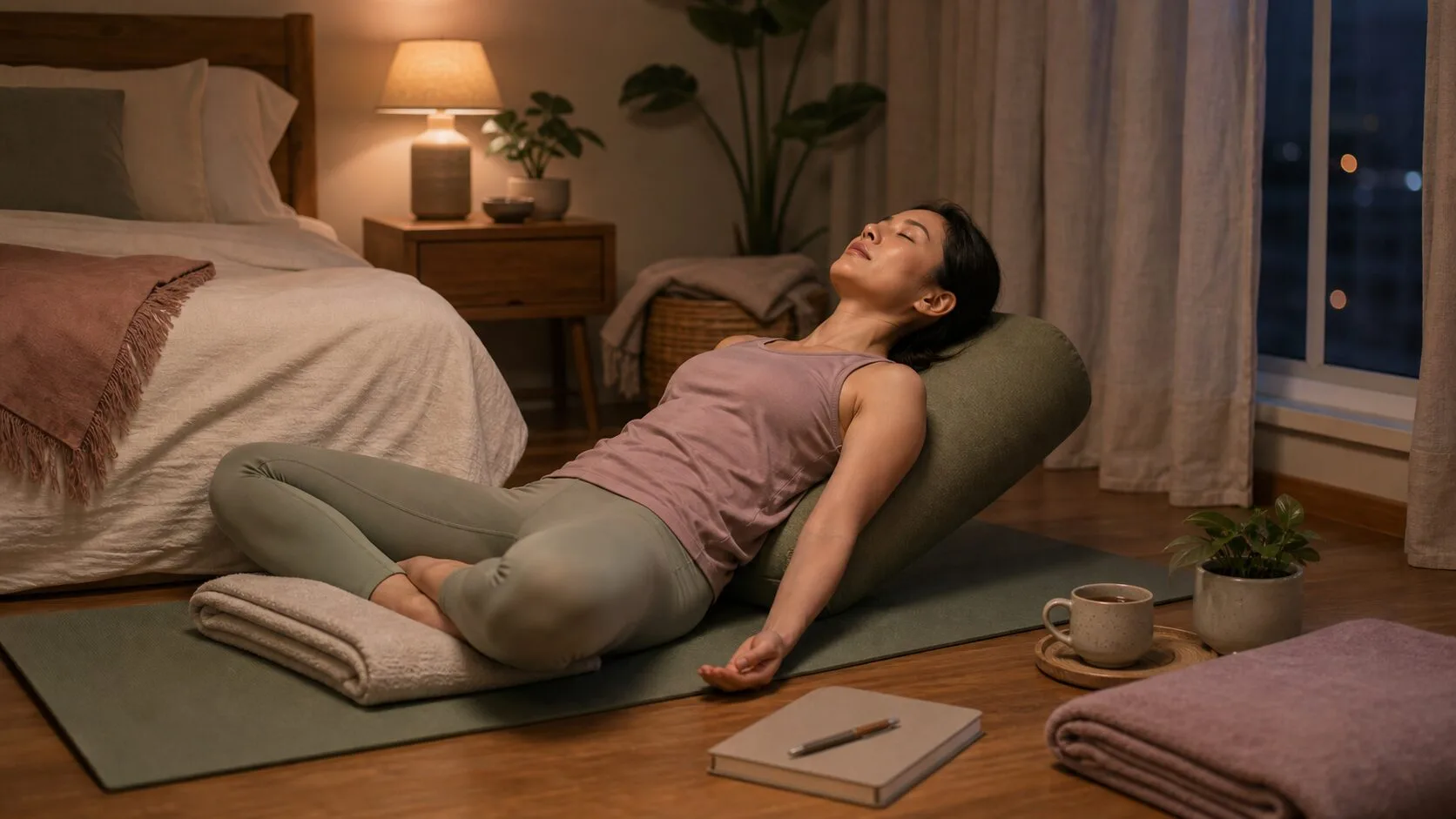
How to Sleep Well
There is a particular kind of tiredness that does not always lead easily into sleep. The body may feel exhausted, but the mind is still sorting the day. One thought opens another. Tomorrow’s list appears too early. Even when the lights are low, something inside remains slightly alert, as though the nervous system has not received the message that the day is allowed to end.
This is where a gentle evening yoga practice can be helpful. Not as a performance. Not as another task to squeeze into an already full life. Not as a promise that every sleep difficulty will disappear. Rather, it can be a simple, kind ritual: a way of changing the pace of the body so the mind has a better chance of following.
In this fifth post in the Finding Calm series, I want to explore a soft evening sequence for better sleep. It is designed for ordinary evenings, especially the ones when the body feels wired, restless, or heavy from too much screen time, work, caregiving, studying, errands, or emotional noise. It does not require advanced flexibility. It does not require long holds or complicated postures. It asks for very little except a quiet corner, a few props, and the willingness to slow down.
If you have been following the earlier posts, this practice builds naturally from the rhythm of Finding Calm 4: A Daily Rhythm You Can Actually Keep and the simplicity of gentle breath awareness. The theme is the same: calm is not something we force. It is something we invite, again and again, through small repeatable choices.
Why Evening Yoga Can Support Sleep
Sleep is not an isolated event. It is connected to the way we move through the hours before bedtime. Many sleep resources, including the NHS guidance on sleep and mental wellbeing, point toward the value of regular routines, winding down, and creating conditions that help the body prepare for rest.
Yoga can be part of that wind-down. The National Center for Complementary and Integrative Health notes that yoga combines physical postures, breathing practices, and meditation or relaxation, and that it is generally considered safe for most people when practiced appropriately with attention to individual conditions and limits. You can read their overview here: Yoga: What You Need To Know.
For evening practice, the key word is gentle. This is not the time for strong heat-building flows, deep backbends, ambitious stretches, or breathwork that leaves you feeling stimulated. A sleep-supporting practice should feel like slowly dimming the lights inside the body.
The aim is to reduce unnecessary effort. We move slowly. We use support. We allow the breath to settle without controlling it too aggressively. We give the mind something quiet to rest on, such as sensation, weight, warmth, or the feeling of the floor underneath us.
Good sleep cannot be commanded. Anyone who has spent a long night trying to force themselves to sleep knows this very well. But the body can be invited toward rest. Yoga gives us a language for that invitation.

Before You Begin: Make the Practice Smaller
One reason evening practices fail is that we make them too grand. We imagine we need a full hour, the perfect mat, and the right mood. Then real life arrives, and the practice disappears.
For better sleep, smaller is often more useful. Ten to twenty minutes can be enough. Even five minutes can be meaningful if it helps you pause before collapsing into bed with a buzzing mind.
Before beginning, lower the lights if possible. Put your phone away or switch it to silent. If you use music, choose something without a strong beat. A warm drink nearby can be comforting, but avoid turning the practice into another multitasking moment. Let it be simple.
Useful props include a folded blanket, cushion, bolster, chair, or eye pillow. If you do not have yoga props, ordinary household items are perfectly fine. A firm pillow can become a bolster. A towel can support the head. A sofa cushion can support the knees.
The purpose of props is not to make the practice look more professional. Their purpose is to reduce effort. In evening yoga, support is not cheating. Support is the whole point.
A Safety Note
This sequence is gentle, but it is still important to listen to your body. Stop if you feel sharp pain, dizziness, breathlessness, numbness that worries you, or emotional distress that feels too intense to sit with alone. If you have a medical condition, injury, pregnancy-related concern, persistent insomnia, anxiety that feels unmanageable, or any condition affecting balance, blood pressure, joints, spine, or breathing, seek guidance from a qualified healthcare professional.
Yoga can support wellbeing, but it is not a substitute for medical care. If sleep problems continue for a long time or affect your daily functioning, it is worth getting proper support.
For a personalised practice, you can explore my Yoga and Wellness offerings or book a session with me.
The Sequence
This sequence is written as a gentle evening arc. You do not have to do every posture. Choose the parts that feel appropriate. Move slowly between them, and let each transition be part of the practice.
The full sequence can take around twenty to thirty minutes. A shorter version can take ten minutes.
1. Arrive in a Seated Position
Sit on a folded blanket, cushion, chair, or the edge of the bed. Let the spine be upright but not stiff. Rest your hands on your thighs or in your lap. Close your eyes if that feels comfortable, or soften your gaze toward the floor.
Begin by noticing the day without judging it. Perhaps it was productive, messy, or ordinary. You do not need to fix the day now. You are simply acknowledging that it happened, and that you are here.
Feel the points of contact underneath you. Notice the weight of the pelvis. Notice the shape of the shoulders. Notice the expression on the face. If the jaw is holding tension, let the tongue soften in the mouth. If the hands are gripping, let the fingers loosen.
Take three natural breaths. Do not make them impressive. Just notice them.
Then quietly say to yourself: I am allowed to slow down. You may not fully believe it at first. That is okay.
Stay here for one to three minutes.
2. Gentle Neck and Shoulder Release
From your seated position, slowly turn your head to one side, then back to centre, then to the other side. Keep the movement small and easy. This is not a stretch competition. It is simply an invitation for the neck to stop guarding.
Next, lift the shoulders gently toward the ears as you inhale, and let them release as you exhale. Repeat this three to five times.
Then circle the shoulders slowly. Forward, up, back, and down. Reverse the direction. If the movement feels crunchy or uneven, do not worry. Bodies are not machines. They carry the shape of our days.
Many of us bring the whole day into the shoulders.
3. Supported Child’s Pose or Supported Forward Fold
If Child’s Pose is comfortable for your knees and hips, come onto the floor and bring a bolster, firm pillow, or stacked cushions lengthwise in front of you. Let your torso rest over the support. Turn your head to one side, or support the forehead so the neck feels easy.
If Child’s Pose does not suit your body, take a seated forward fold instead. Sit on a cushion, place pillows on your lap, and fold forward only as much as feels restful.
The intention is not to stretch the back deeply. The intention is to feel held.
Let the belly soften against the support. Let the breath move into the back ribs. If thoughts arise, you do not need to argue with them. Each time you notice the mind wandering, bring attention back to one simple sensation: the weight of your body on the support.
Stay for two to five minutes.
Halfway through, if your head is turned to one side, turn it gently to the other side.
4. Reclined Twist
Lie on your back and draw the knees toward the chest. Let them fall gently to one side. Support the knees with a pillow or folded blanket if they do not comfortably reach the floor. Keep both shoulders relaxed. The arms can open to the sides, rest on the belly, or stay wherever they feel easy.
Reclined twists can feel lovely in the evening because they allow the spine to unwind without much muscular work. But gentle is the word. If the twist feels strong, reduce it. Bring the knees higher or place more support underneath them.
As you breathe, notice the side ribs, belly, and back body. Let the exhale be a little softer than usual.
Stay for one to three minutes on each side.
When changing sides, move slowly. Pause in the centre before letting the knees fall the other way. There is no rush now.
5. Legs on a Chair
This is one of my favourite evening shapes because it is simple, accessible, and deeply settling for many people. Lie on your back and place your calves on the seat of a chair, sofa, or bed. The knees should be bent comfortably. If the head tips back, place a folded towel under it. If the lower back feels strained, adjust the distance from the chair or place a folded blanket under the pelvis.
Let the arms rest by your sides or on the belly. If you like, place one hand on the lower belly and one hand on the heart. Feel the rise and fall of the breath without forcing it.
This posture can create a sense of being grounded without much effort. It is also a useful alternative to legs up the wall.
Stay here for three to seven minutes.
If the mind is busy, count the exhale softly from one to ten. When you reach ten, begin again. Losing count is not failure. It is simply the mind doing what minds do.
6. Simple Breath Awareness
While still lying down, or seated if you prefer, begin to observe the natural breath. Let the inhale come in by itself. Let the exhale leave by itself.
After a minute or two, you may gently lengthen the exhale, but only if it feels comfortable. Avoid holding the breath. Avoid strain. The breath should feel like a softening, not a command.
If breath awareness makes you anxious, return to body awareness instead. Feel the weight of the heels. Feel the blanket under the back. Feel the hands resting. Breath practices are not one-size-fits-all, and the most important thing is to choose what feels steadying for your nervous system.
You can also use a simple phrase:
Breathing in, I arrive.
Breathing out, I soften.
Repeat for a few minutes.
This is where evening yoga becomes less about postures and more about relationship. You are learning how your body receives quiet.
7. Supported Rest
For the final posture, come into a supported rest shape. Lie on your back with a pillow under the knees, or lie on your side with a pillow between the knees and a cushion under the head. If lying down is uncomfortable, sit in a chair with your back supported and feet resting on the floor.
Cover yourself with a blanket if you feel cool. You may place an eye pillow or folded cloth over the eyes, but keep it light and comfortable.
Let the whole body be held.
You do not need to clear the mind. You do not need to become perfectly calm. You are practising the conditions for rest, not grading yourself on the result.
Bring attention slowly through the body:
Forehead soft.
Jaw soft.
Throat soft.
Shoulders heavy.
Belly loose.
Hands open.
Legs supported.
Feet quiet.
Stay for five to ten minutes, or longer if you wish.
When you are ready to come out, move gently. Bend the knees, roll to one side, and pause before sitting up.
A Short Version for Busy Nights
On some evenings, a full sequence will not happen. That is normal. A practice that only works on perfect days is not a very useful practice.
Here is a shorter version:
Sit and breathe for one minute.
Rest forward over pillows for three minutes.
Lie with legs on a chair for five minutes.
Finish with one hand on the belly and one hand on the heart for one minute.
That is enough.
It may not solve every sleep difficulty, but it can create a different ending to the day.
The Yoga Therapy View: Sleep Begins Before Bed
From a yoga therapy perspective, sleep is not only about what happens at bedtime. It is shaped by the nervous system, daily rhythm, emotional load, breath, sensory input, and the degree of safety the body perceives.
This is why a gentle evening practice does not need to be dramatic. Often, the most therapeutic practices are modest. They create consistency and teach the system that it does not have to stay braced all the time.
Evening yoga offers a respectful way to interrupt the pattern of pushing through. It does not shame the mind for being active. It simply gives the body a quieter task.
Feel the support.
Soften the jaw.
Let the exhale lengthen.
Notice the floor.
Return.
Return again.
That returning is the practice.
When the Mind Refuses to Be Quiet
Many people think they are bad at relaxation because their mind keeps moving. But a moving mind does not mean the practice is failing. It means you are human.
The mind may replay the day because it wants resolution. It may plan tomorrow because it wants safety. Instead of fighting it, try offering it a simple anchor.
For example:
Count ten slow exhales.
Feel the weight of the back body.
Name five places where the body touches support.
Repeat one calming phrase.
Notice sounds without following them.
If a thought becomes sticky, you can say quietly, not now. This does not mean the thought is unimportant. It simply means bedtime is not the moment to solve everything.
Some people also find it helpful to keep a notebook nearby and write down one or two practical reminders before practice. Keep it brief, so the notebook does not become a second work session.
Making the Practice Yours
The best sleep-supporting yoga practice is the one you will actually do. If you dislike a posture, change it. If five minutes is what you have, use five minutes. If lying on the floor feels inconvenient, adapt the practice to the bed.
You might practise after showering, before brushing your teeth, or immediately after closing the laptop. The timing matters less than the repetition.
Over time, the body begins to associate the sequence with slowing down. The folded blanket, the dim light, the same gentle posture, the same phrase: these become signals. They tell the body that it does not need to keep preparing for the next demand.
This is why I love simple rituals. They do not need to be impressive to be powerful. A repeated small act can become a doorway.
If you would like support building a practice that fits your body and your real life, you can visit my Yoga and Wellness page or book a private session.
Closing Reflection
Better sleep is not only about the number of hours we spend in bed. It is also about how we arrive there.
Some nights will still be restless. Some nights the mind will still run. The practice is not to control every outcome. The practice is to create a kinder transition.
An evening yoga sequence can become a way of saying: the day is complete enough. I do not have to carry everything into sleep. I can put some things down for now.
That is a gentle kind of calm. Not dramatic. Not forced. Just a small turning toward rest.
And sometimes, that small turning is exactly where sleep begins.
Leave a Reply